





SOC as a Service vs MSSP: What Your Business Actually Needs

You’ve been told you need a SOC. Also an MSSP. Then someone mentions SOC as a Service. SOC as a Service vs MSSP: are they the same, different, or do you need all three?
Managed security has a terminology problem, and vendors lean on that confusion to sell services buyers don’t always need. SOC as a Service (SOCaaS) and Managed Security Service Providers (MSSPs) both promise to protect your organization. They go about it very differently. Knowing the difference is how you avoid paying for things you won’t use.
- Depth versus breadth. SOCaaS owns detection and response outcomes with MTTD and MTTR SLAs; an MSSP manages your wider security stack across many domains.
- The response gap decides it. A SOCaaS provider contains a confirmed threat at 3 AM under pre-approved playbooks; a traditional MSSP opens a ticket and your team does the rest.
- Price the comparison honestly. SMB SOCaaS runs $3,000 to $15,000 per month, against $500,000 to $800,000 per year in salaries alone for an internal SOC.
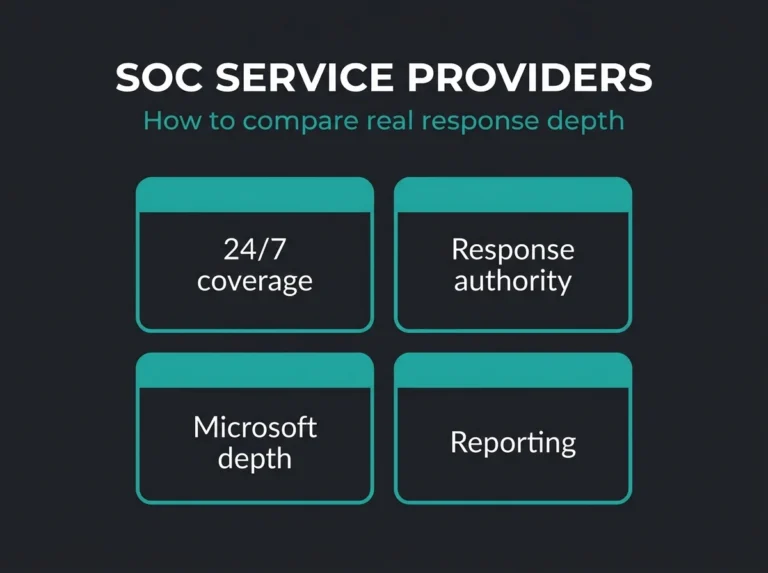
- Labels are blurring. Judge providers on 24/7 human investigation, containment authority, and custom detection rules, not on what the service is called.
- Most SMBs need both. The practical answer is one provider combining MSSP breadth (vulnerability management, compliance) with SOCaaS depth (24/7 detection and active response).
What is SOC as a Service?
SOC as a Service (SOCaaS) is an outsourced Security Operations Center sold as a subscription. The provider runs a dedicated SOC that watches your environment 24/7, detects threats, investigates alerts, and responds to incidents for you. You get the output of a fully staffed SOC without building one internally.
Typical SOCaaS inclusions:
- 24/7 security monitoring across endpoints, network, identity, email, and cloud environments
- Alert triage and investigation by trained SOC analysts who separate real threats from false positives
- Threat hunting to proactively search for hidden compromises that automated detection misses
- Incident response execution including endpoint isolation, account lockdown, and containment actions under pre-approved playbooks
- Detection engineering with custom rules tuned for your environment, continuously refined to reduce noise and improve accuracy
What defines SOCaaS is outcome-driven delivery. The provider is measured on mean time to detect (MTTD), mean time to respond (MTTR), and alert accuracy. They own the detection and response result, not just the tools.
What is an MSSP?
A Managed Security Service Provider (MSSP) delivers a wider set of security services, running and monitoring your security infrastructure across multiple technology domains. SOCaaS is narrow by design. MSSPs cover the full span of security operations. For more detail, see our guide on what MSSPs actually provide.
Typical MSSP services:
- Security device management: Firewall administration, VPN configuration, IDS/IPS management, endpoint protection deployment and maintenance
- Log monitoring and alerting: Collecting and correlating security logs from SIEM platforms like Microsoft Sentinel, generating alerts based on detection rules
- Vulnerability management: Regular vulnerability scanning, patch verification, and risk reporting
- Compliance management: Audit documentation, regulatory reporting (NIS2, GDPR, ISO 27001), and evidence collection
- Email security: Managing and tuning email filtering, anti-phishing, and email threat protection
- Security consulting: Risk assessments, security audits, policy development, and architecture reviews
Breadth is the MSSP’s strength and also its limit. MSSPs run your security stack, but their response to active threats is often limited to alerting and escalation. Hands-on containment is rarely part of the standard contract.
SOC as a Service vs MSSP: key differences
| SOC as a Service | MSSP | |
|---|---|---|
| Primary focus | Threat detection, investigation, and response | Broad security infrastructure management and monitoring |
| Delivery model | Provider-operated SOC, outcome-driven SLAs | Service catalog across multiple security domains |
| Response capability | Active containment and remediation under approved playbooks | Alert forwarding and escalation. Remediation often separate or extra |
| Detection approach | Custom detection rules, continuous tuning, threat hunting | Standard detection rules, broader tool coverage, less detection depth |
| Compliance support | SOC evidence, incident timelines, audit support | Full compliance management: documentation, reporting, policy |
| Tool ownership | Provider’s optimized stack (SIEM, SOAR, EDR) | Manages your existing tools or provides them |
| Pricing model | Data volume (GB/day) and response scope | Per-device, per-user, or per-site fees |
| Best fit | Organizations needing focused detection and response without an internal SOC | Organizations that want one provider handling broad security management |
The response gap
The practical difference shows up the moment a real threat is confirmed. A SOCaaS provider sees lateral movement at 3 AM, works the alert chain, confirms credential compromise, isolates the endpoints, disables the account, blocks the persistence mechanisms, and briefs you in the morning with a full timeline.
A traditional MSSP sees the same activity, generates an alert, and emails you or opens a ticket. Your team handles the rest. That works if your team is awake and watching. Often they aren’t. This is the same gap we describe in our MDR vs MSSP comparison: the difference between notification and protection.
Breadth vs depth
MSSPs run more of your security stack. If you want one provider handling firewalls, email security, vulnerability scanning, and compliance documentation, that’s an MSSP’s natural shape. SOCaaS providers concentrate on the detection and response layer. They usually don’t touch firewall rules or run your scans.
The trade-off is depth. SOCaaS providers invest in detection engineering, writing and tuning custom rules for your specific environment. They maintain playbooks for automated response and keep refining alert accuracy week after week. MSSPs spread their effort across more services. That usually means less specialization per domain.
The convergence reality
The market line between SOCaaS and MSSP is blurring. Plenty of MSSPs now offer a SOC tier. Plenty of SOCaaS providers have bolted on vulnerability management and compliance support. Labels matter less than actual capability.
When you’re evaluating providers, ask:
- Do SOC analysts investigate alerts 24/7, or is it automated alerting?
- When a threat is confirmed, do you contain it, or do you email me?
- What are your MTTD and MTTR numbers?
- Do you write custom detection rules for my environment, or use generic rule sets?
- What compliance reporting and documentation do you actually produce?
If you want more concrete buyer criteria, compare what a managed SOC service should include, where a virtual SOC fits operationally, why SIEM vs SOC is still the question many buyers get wrong at the start, and our MSSP vs SOC comparison for the fuller breakdown of which model fits your business.
Which do you need?
Choose SOC as a Service when:
- You lack internal incident response capability. Your IT team can’t investigate security alerts or contain active threats. You need someone who acts, not just notifies.
- Detection and response is your main gap. Basic security tools are deployed, but nobody is watching them or responding to what they find.
- You need to meet NIS2 incident response requirements. NIS2 mandates incident detection and response with initial notification inside 24 hours. SOCaaS gives you the documented capability to meet that.
- You want faster time to value. SOCaaS typically deploys faster because the provider brings an integrated, pre-tuned stack. You aren’t onboarding their team onto your existing tool sprawl.
Choose an MSSP when:
- You need broad security management. One provider for firewalls, email security, endpoint protection, vulnerability scanning, and compliance reporting.
- Compliance documentation is the main driver. Your industry demands extensive audit trails, regulatory reporting, and policy management beyond SOC operations.
- You already have an internal security team. Your team can investigate and respond, but they need better tooling, monitoring coverage, and operational support.
- Budget requires broad coverage. MSSP pricing covers more services per dollar, which is practical for organizations that need foundational security management across many domains.
The best answer: combined capabilities
For most SMBs, the honest answer is a provider that does both. You need MSSP breadth (vulnerability management, compliance, security hardening) with SOCaaS depth (24/7 detection, investigation, active response). The better providers deliver both without making you pick.
A practical model:
- Your MSP handles IT operations: Microsoft 365 administration, helpdesk, device management, patching
- Your security provider handles both MSSP and SOCaaS functions: security monitoring, threat detection, incident response, vulnerability management, security configuration hardening, and compliance documentation
- Both coordinate through defined processes: the security provider identifies gaps, the MSP implements remediation, escalation paths are documented
How Falconer Security combines both models
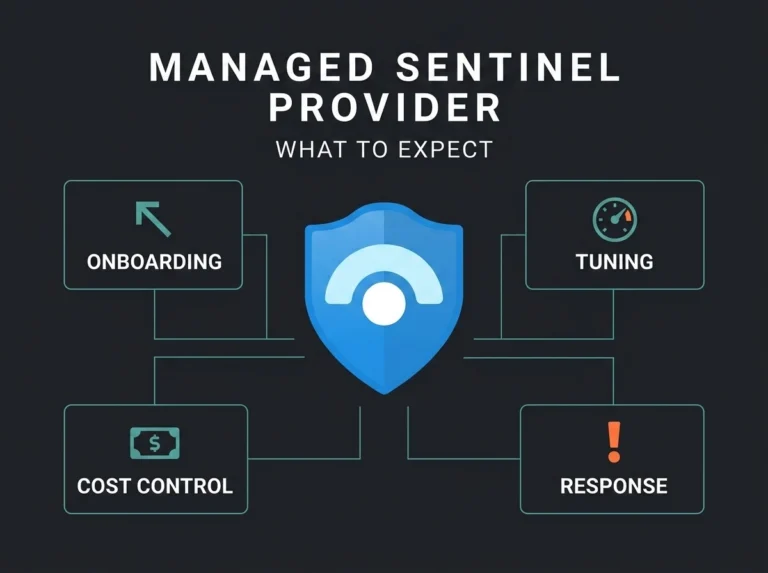
Falconer Security delivers combined MSSP and SOCaaS capabilities on the Microsoft security ecosystem. We bring the breadth of managed security services (Sentinel deployment and optimization, Secure Score improvement, M365 security hardening, compliance documentation) with the depth of real SOC operations (24/7 monitoring, human-led investigation, active threat response, custom detection rules). Getting Sentinel deployment right starts with the data sources you feed it, and the five Sentinel data connectors an SMB actually needs is a good starting checklist before you turn everything on.
The point of this model is that you don’t have to choose between breadth and depth. One security partner runs your Microsoft Sentinel environment, watches for threats around the clock, responds when incidents occur, and produces the compliance documentation your auditors ask for.
Frequently asked questions
What is the difference between SOC as a Service and an MSSP?
SOC as a Service (SOCaaS) is a provider-operated Security Operations Center focused on threat detection, investigation, and active response. An MSSP offers broader managed security services including firewall management, vulnerability scanning, compliance reporting, and security monitoring. The key distinction is who handles the confirmed threat. SOCaaS providers typically investigate and respond directly, while traditional MSSPs alert and escalate. A lot of modern providers now combine both.
Is SOC as a Service the same as MDR?
SOCaaS and Managed Detection and Response (MDR) overlap a lot. Both do 24/7 threat monitoring, investigation, and response. The practical distinction is that SOCaaS usually includes the full SIEM/SOAR platform as part of the service, while MDR may layer on top of tools you already own. The terms are increasingly interchangeable in practice. What matters is whether the provider actually investigates and responds, or just sends alerts.
How much does SOC as a Service cost?
SOCaaS pricing varies with data volume, endpoint count, and response scope. For SMBs, expect $3,000 to $15,000 per month depending on environment size and service level. That usually includes the SIEM platform, 24/7 monitoring, detection engineering, and incident response. Compared with building an internal SOC (minimum $500,000 to $800,000 per year in salaries alone), SOCaaS delivers equivalent capability for a fraction of the price. For a full breakdown of managed security pricing models, see our MDR pricing guide.
Do I still need internal IT staff if I use SOCaaS?
Yes. SOCaaS handles threat detection and response. You still need internal staff (or an MSP) to run IT operations, implement remediation actions, handle user support, and make policy decisions. Someone inside the organization also has to own the service relationship and approve response actions for your environment.
Does SOC as a Service help with NIS2 compliance?
SOCaaS directly covers several NIS2 requirements: incident detection and analysis (Article 21), incident response and containment, initial notification inside 24 hours, and documented incident handling procedures. NIS2 also requires supply chain risk management, security policies, and business continuity measures that extend past SOC operations. SOCaaS is a core piece of NIS2 compliance, not the whole picture.