





What Is a Managed Security Service Provider (MSSP)?

What is a MSSP? Your IT team already covers everything from onboarding laptops to troubleshooting the VPN. Hand them “detect and respond to sophisticated cyberattacks around the clock” on top of all that, and it becomes fairly obvious why so many organisations end up bringing in a managed security service provider. At Falconer Security we run MSSP services for SMBs and MSPs across Sweden and the Nordics, and this guide is the short version of what that actually means. We cover what an MSSP does, how it differs from an MSP or an MDR provider, and what to check for before you sign with one.
- MSSP versus MSP. An MSP keeps your systems running from a NOC; an MSSP keeps them secure from a SOC, with threat hunting, detection engineering, and incident response an MSP does not staff for.
- Typical SMB pricing. Expect EUR 1,500 to 4,000 per month for basic monitoring, EUR 3,000 to 8,000 for managed SIEM, and EUR 5,000 to 15,000 for a full 24/7 SOC with MDR.
- The in-house math fails. One experienced analyst costs SEK 600,000 to 900,000 per year and round-the-clock coverage needs five to six of them, which is why 59% of organisations report critical skills shortages.
- NIS2 raises the stakes. Essential entities face fines up to EUR 10 million or 2% of global turnover, and an MSSP is the fastest route to the required risk management measures.
- Vet the detection library. Ask any candidate MSSP to show coverage mapped to MITRE ATT&CK; a vague answer or a marketing deck in response is a red flag.
What is a managed security service provider (MSSP)?
A managed security service provider (MSSP) is a third-party company that monitors, manages, and improves an organisation’s cybersecurity posture on an ongoing basis. They aren’t one-off consultants with a project deadline. MSSPs deliver continuous protection: they run security operations centres (SOCs), manage detection tools, respond to incidents, and help meet regulatory requirements like NIS2 or GDPR.
The managed security services market is on course to hit roughly USD 41 billion in 2026 and grow to nearly USD 67 billion by 2030, according to MarketsandMarkets research. That trajectory reflects a fairly mundane reality: most organisations don’t have the budget or the talent to build a full security operation in-house, and the gap keeps widening.
What services does an MSSP provide?
“MSSP” is an umbrella term and the service list varies by provider, sometimes wildly. Most offer some mix of the following:
- 24/7 security monitoring: continuous surveillance of logs, alerts, and network activity from a dedicated SOC with coverage across shifts, weekends, and holidays.
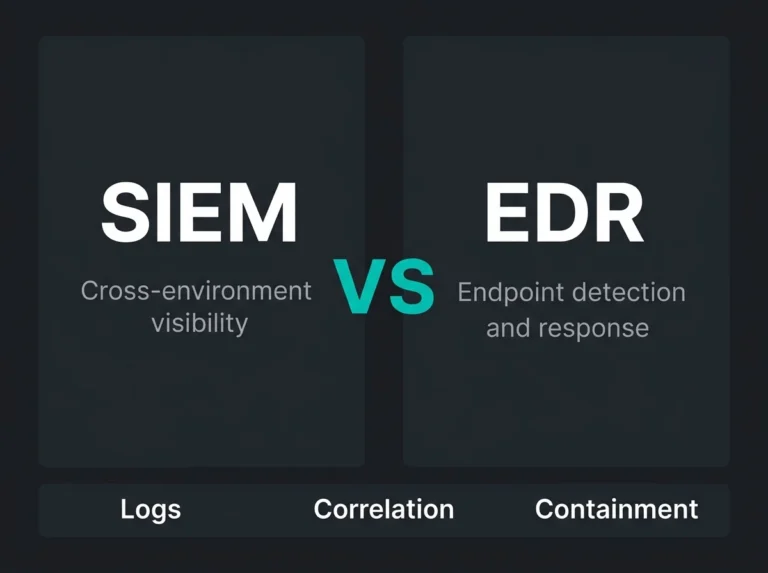
- SIEM management: deploying, tuning, and operating a security information and event management platform such as Microsoft Sentinel.
- Managed detection and response (MDR): active threat hunting, investigation, and containment across endpoint, network, and cloud layers.
- Vulnerability management: regular scanning, prioritisation, and remediation guidance for the weaknesses the scanner keeps surfacing.
- Firewall and network security management: configuration, monitoring, and policy management of perimeter defences.
- Incident response: coordinated investigation and containment when a breach happens, with forensic analysis and recovery support through to closeout.
- Compliance support: meeting regulatory requirements (NIS2, GDPR, ISO 27001) through log retention, reporting, and policy documentation.
- Email security: anti-phishing, anti-spam, and threat protection for platforms like Microsoft 365.
Falconer Security delivers managed security services built on the Microsoft security stack: Sentinel for SIEM, Defender XDR for endpoint and email protection, Entra ID for identity security. A Microsoft-native approach means fewer integration headaches if you’re already on Microsoft 365, which most of our clients are. For strategic security leadership alongside operational services, plenty of organisations pair an MSSP with an outsourced CISO. The combination tends to work better than either on its own.
MSSP vs MSP: what’s the difference?
This question comes up more than any other when a new prospect first calls us. Both are outsourced IT partners, and on the surface the services can overlap, but the focus areas don’t line up.
| Capability | MSP (Managed Service Provider) | MSSP (Managed Security Service Provider) |
|---|---|---|
| Primary focus | IT operations, uptime, helpdesk | Cybersecurity, threat detection, incident response |
| Operations centre | NOC (Network Operations Centre) | SOC (Security Operations Centre) |
| Typical services | Device management, patching, backups, cloud migration | SIEM, MDR, vulnerability management, incident response |
| Security depth | Basic: antivirus, firewall, patching | Advanced: threat hunting, detection engineering, forensics |
| Compliance | May assist with basic requirements | Deep compliance expertise (NIS2, GDPR, ISO 27001) |
| Staff expertise | IT generalists, system administrators | Security analysts, incident responders, threat hunters |
| Monitoring scope | System health, performance, availability | Security events, anomalies, threat indicators |
An MSP keeps your systems running. An MSSP keeps them safe. Plenty of organisations genuinely need both, and some providers sell a combined offering. The distinction still matters when you’re evaluating partners, though. If your MSP tells you they “also do security” but runs no SOC, employs no dedicated security analysts, and can’t show you a detection library, treat it as a red flag rather than a bonus feature.
MSSP vs MDR: how do they compare?
Another question we get constantly. MDR (managed detection and response) is technically a subset of MSSP services. In practice, plenty of MDR providers position themselves as a separate category, usually because their marketing wants them to. The practical differences:
| Dimension | Traditional MSSP | MDR Provider |
|---|---|---|
| Approach | Broad security management | Focused on detection and response |
| Alert handling | May pass alerts to your team | Investigates and responds on your behalf |
| Technology | Manages your existing tools | Often provides their own detection platform |
| Threat hunting | Not always included | Core capability |
| Response actions | Advisory (tells you what to fix) | Active (isolates hosts, blocks threats) |
| Scope | Network, cloud, compliance, identity | Primarily endpoint and workload focused |
For a deeper comparison, see our guide on MDR vs MSSP. The short version: if you want someone to run the whole security programme for you, you’re looking for an MSSP. If you specifically want detection and response layered onto an existing setup, MDR is probably the right fit. Many modern MSSPs, Falconer Security included, deliver both under one contract.
Why do organisations use an MSSP?
The cybersecurity skills gap keeps widening. According to the 2025 ISC2 Cybersecurity Workforce Study, 59% of organisations report critical or significant skills shortages in their security teams, and 33% cite budget as the primary driver. For SMBs in Sweden and the Nordics that math gets even tougher. Hiring a single experienced security analyst runs SEK 600,000 to 900,000 per year, and round-the-clock coverage means you need several of them on payroll at once.
The common reasons organisations end up at an MSSP’s door:
- Talent shortage: security analysts are expensive and genuinely hard to find, especially in the Nordics. An MSSP puts a trained team on your side on day one.
- 24/7 coverage: threats don’t respect business hours. An in-house SOC running around the clock needs five to six full-time analysts at a bare minimum, which isn’t realistic for most SMBs.
- Regulatory compliance: NIS2 requires organisations in essential and important sectors to implement cybersecurity risk management measures, with fines up to EUR 10 million or 2% of global turnover for essential entities. An MSSP gets you there without building everything from scratch.
- Cost efficiency: the IBM Cost of a Data Breach Report 2025 puts the global average breach at USD 4.44 million. An annual MSSP contract is typically a fraction of that number, and the insurance posture is easier to defend.
- Technology complexity: modern security stacks span SIEM, EDR, email gateways, identity protection, vulnerability scanners, and a handful of cloud-native tools that weren’t on anyone’s radar two years ago. Integrating and running all of that needs specialist knowledge, which is what an MSSP sells.
What to look for when choosing an MSSP
Not every MSSP is equal, and the pitch deck never tells you that. Falconer Security has evaluated and inherited client environments from plenty of providers, and the criteria that actually matter are these.
1. Technology alignment
If your organisation runs Microsoft 365, your MSSP needs real depth in the Microsoft security ecosystem: Sentinel, Defender XDR, Entra ID, Purview. A provider that insists on layering their own proprietary tools on top of your existing Microsoft stack adds complexity and licence cost without giving much back in return. Ask how many of their engineers hold current Microsoft security certifications and how long they’ve actually worked with Sentinel.
2. Transparency in detection coverage
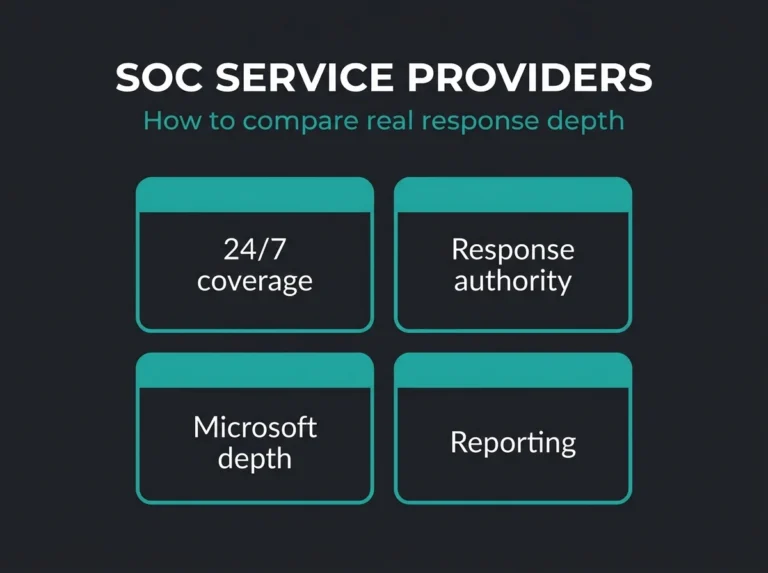
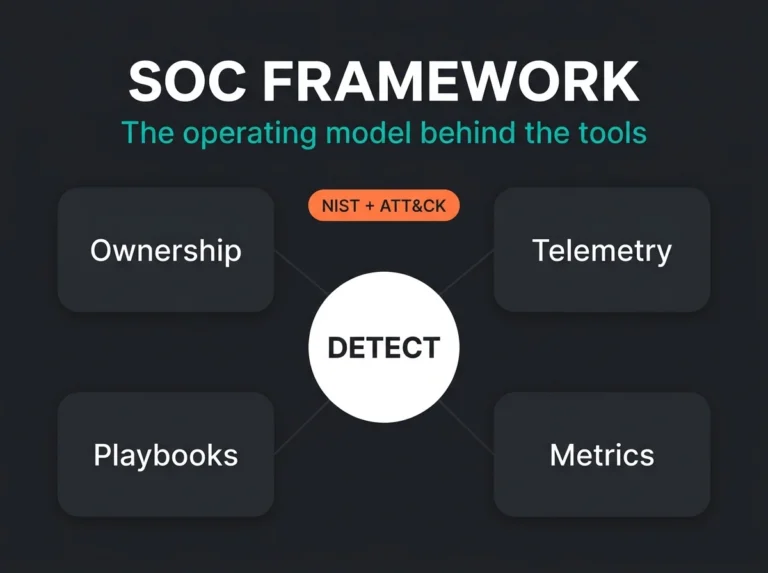
Ask a potential MSSP a simple question: what do you detect? Can you show me the detection library? A good provider will walk you through their coverage mapped to MITRE ATT&CK, per technique, with tuning notes. If the answer is vague or they redirect to a marketing deck, they probably aren’t detecting much.
3. Clear escalation and response processes
Knowing what happens when an alert fires is the entire point of the relationship. Does the MSSP investigate and respond, or do they forward an email and hope your team has time? The difference between a raw alert and a contextualised, investigated incident report with specific remediation steps is enormous, and it’s usually the thing that decides whether you renew.
4. Compliance and regulatory expertise
For EU organisations, your MSSP needs a working grasp of NIS2, GDPR, and the sector-specific regulations that actually apply to you. Ask for concrete examples of how they’ve helped existing clients meet NIS2 Article 21 requirements for risk management measures. Generic “we handle compliance” answers don’t survive contact with an auditor.
5. Pricing model
MSSP pricing varies widely. Some charge per device, others per user, and SIEM-based providers almost always charge by data ingestion volume. Make sure you understand the model and can project costs as your environment grows, because the answer is rarely “linearly” once ingestion enters the picture. For SIEM-based services, ask upfront about cost optimisation strategies. Bill shock is a standard story in this industry.
6. References and case studies
Ask for references from organisations similar to yours in size, industry, and geography. An MSSP with strong enterprise credentials may not be the right fit for a 200-person company in Stockholm, because the operational patterns and cost structures don’t match. Talk to the customers, not the sales team.
How an MSSP engagement typically works
If you’ve never worked with an MSSP before, the process looks roughly like this:
- Assessment: the MSSP evaluates your current security posture, identifies the gaps that matter, and proposes a service scope. At Falconer Security we start with a Microsoft 365 security assessment, because the Microsoft tenant is where most of the real problems tend to be hiding.
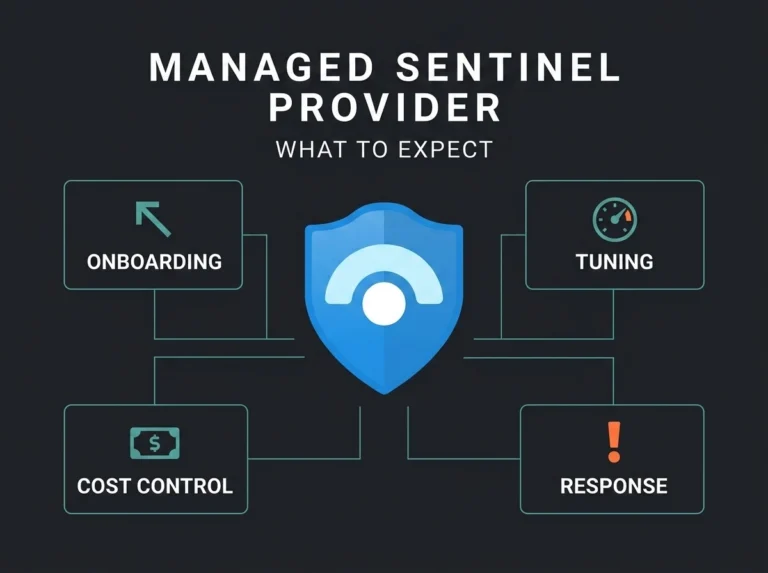
- Onboarding: the provider integrates with your environment. Log sources get connected, agents get deployed, detections get configured against baselines, and communication channels get set up (alert routing, escalation paths, incident comms).
- Steady-state monitoring: the SOC begins 24/7 monitoring. Alerts get triaged, investigated, and escalated according to playbooks agreed during onboarding.
- Continuous improvement: detection rules get tuned against your real environment over the first few months. False positives drop, coverage expands, and the MSSP reports regularly on security posture trends.
- Incident response: when a real incident hits, the MSSP leads or supports the response. They isolate affected systems, conduct forensic analysis, and help with recovery through to lessons learned.
MSSP pricing: what does it cost?
MSSP pricing depends on service scope, environment size, and the provider’s model. Typical ranges for SMBs:
| Service tier | What’s included | Typical monthly cost (SMB) |
|---|---|---|
| Basic monitoring | Log collection, alert forwarding, monthly reports | EUR 1,500 to 4,000 |
| Managed SIEM | Full SIEM management, detection engineering, tuning | EUR 3,000 to 8,000 |
| Full MSSP / MDR | 24/7 SOC, MDR, vulnerability management, incident response | EUR 5,000 to 15,000 |
These are broad ranges. Actual pricing comes down to user count, log volume, and service scope, and any provider who quotes a number without understanding those three things is guessing. For detailed pricing breakdowns, see our guides on SOC as a service pricing and MDR pricing.
Frequently asked questions
What is an MSSP in simple terms?
An MSSP (managed security service provider) is a company you hire to protect your business from cyber threats. They monitor your systems, detect attacks, and respond to security incidents on your behalf, usually through a 24/7 security operations centre.
What is the difference between an MSSP and an MSP?
An MSP manages your IT infrastructure (servers, networks, helpdesk), while an MSSP focuses specifically on cybersecurity (threat detection, incident response, compliance). An MSP keeps your systems running; an MSSP keeps them secure. Plenty of organisations use both.
Do SMBs need an MSSP?
Yes, in most cases. SMBs are increasingly targeted by attackers because they often lack dedicated security staff. Under the NIS2 directive, many SMBs in essential and important sectors now face mandatory cybersecurity requirements. An MSSP provides the expertise and 24/7 coverage that most SMBs can’t realistically build internally.
How does NIS2 affect the need for an MSSP?
NIS2 tells organisations in covered sectors to implement cybersecurity risk management measures including incident handling, business continuity, and supply chain security. Fines for essential entities can reach EUR 10 million or 2% of global turnover. An MSSP helps you implement and maintain those measures without building an in-house security programme from scratch.
What should I ask when evaluating an MSSP?
Key questions include: what detection technologies do you use; can you show your MITRE ATT&CK coverage; what is your mean time to detect and respond; do you actively respond to threats or just send alerts; how do you help with NIS2 and GDPR compliance; can you provide references from organisations similar to mine?