





Outsourced CISO: Pros, Cons, and Costs

Your board just asked who owns cybersecurity risk at the company. The IT manager shifted in his chair. The CFO looked at the CEO. Nobody had a clean answer. That scene plays out every week at mid-sized companies across Europe, and it is exactly why questions about outsourced CISO cost keep landing on someone’s desk.
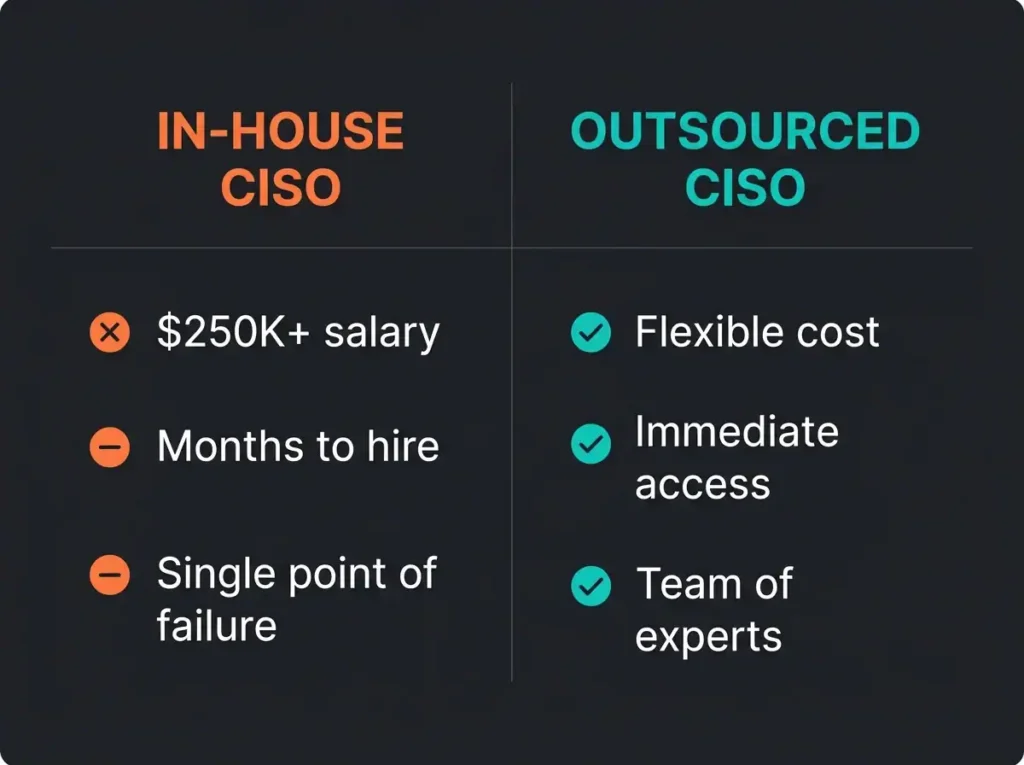
The short version of the role: strategic cybersecurity leadership, delivered on a part-time retainer rather than as a permanent hire. Falconer Security delivers outsourced CISO services (also called virtual CISO or vCISO) for organisations running Microsoft 365 and Azure. If you are in the 50 to 500 employee range, outsourcing gives you enterprise-grade security leadership without the roughly $385,000 annual salary that a full-time hire currently costs.
- Executive leadership on retainer. An outsourced CISO delivers security strategy, compliance guidance, and risk management for $3,000 to $12,000 per month depending on scope and company size.
- Priced by headcount. A company with 100 to 250 employees should budget $5,000 to $9,000 per month, against roughly $32,000 per month in base salary for a full-time CISO.
- Not a substitute for an MSSP. The outsourced CISO owns strategy and governance; 24/7 monitoring, triage, and containment still belong to your MSSP or MDR provider.
- Covers NIS2 governance. Article 20 holds management bodies liable for cybersecurity oversight and training, and an outsourced CISO fills that documented leadership role.
- Fast first results. Expect an assessment and roadmap within 30 to 60 days and quick wins within 90, with a mature programme taking 6 to 12 months.
What is an outsourced CISO?
At its simplest, an outsourced CISO (sometimes called a virtual CISO, fractional CISO, or CISO as a Service) is a senior cybersecurity professional working with your organisation on a part-time or retainer basis. They take ownership of security strategy, risk management, and compliance posture instead of sitting inside your org chart as a full-time employee. For more detail, see our guide on the CISO as a service model.
One key difference from a consultant: they do not hand over a report and leave. An outsourced CISO sits on your leadership team over time. They attend board meetings, set security direction, manage vendor relationships, and keep your cybersecurity program honest as threats change. Good security posture reporting is central to the role, because without it you end up with a CISO nobody can hold accountable.
Common terms explained
There are a handful of terms for what is basically the same job:
- Outsourced CISO: Broad term for any externally provided CISO function
- Virtual CISO (vCISO): Same role, delivered remotely (the most common label in the market)
- Fractional CISO: Emphasises the part-time nature of the engagement, typically a set number of days per month
- CISO as a Service (CaaS): Subscription-based model, often backed by a team rather than a single individual
In practice the labels are interchangeable. What actually matters is the delivery model, not the marketing.
Why companies outsource the CISO role
Three pressures keep pushing organisations toward outsourced security leadership. Regulators. Talent supply. And an attack surface that does not care how big your IT team is.
The talent gap is real
According to the ISC2 2025 Cybersecurity Workforce Study, there is a persistent global shortage of cybersecurity professionals, with 33% of organisations citing budget constraints as the primary driver. Experienced CISOs command an average salary of $385,052 per year in the US (as of March 2026), and total packages frequently clear $500,000 once bonuses and equity are included. For a 200-person company, that single hire is an enormous line item on its own.
Regulations demand it
Then there is the regulatory angle, which is where most of our current inbound calls start. The EU’s NIS2 Directive (Directive 2022/2555) raised the stakes. Article 20 states that “management bodies of essential and important entities” must “approve the cybersecurity risk-management measures” and “can be held liable for infringements.” Members of management bodies are also required to complete cybersecurity training. If you are in scope, having no designated security leader is not just risky. It is a compliance failure.
Cyber threats do not scale down
The IBM Cost of a Data Breach Report 2025 puts the global average cost of a breach at $4.44 million. Small and mid-sized businesses face the same threat actors as enterprises, with fewer resources to detect and respond. An outsourced CISO supplies the strategic oversight needed to build a proportionate, effective defence without pretending you have a Fortune 500 security budget.
What an outsourced CISO actually does
Scope varies by engagement. A competent outsourced CISO owns these core responsibilities, though depth and emphasis shift depending on where your programme is maturity-wise.
Security strategy and roadmap
- Assess your current security posture (tools, processes, gaps)
- Define a 12 to 24 month security improvement roadmap aligned with business objectives
- Prioritise investments based on risk, not vendor hype
- Present security strategy to the board in business terms
Risk management
- Maintain a risk register with identified threats, likelihood, and impact
- Conduct regular risk assessments
- Define risk appetite and acceptable risk thresholds with leadership
- Track risk mitigation progress against the roadmap
Compliance and governance
- Map your obligations under NIS2, GDPR, ISO 27001, SOC 2, or industry-specific regulations
- Develop and maintain security policies (acceptable use, incident response, data classification, access control)
- Prepare for audits and certifications
- Ensure management body training requirements are met (NIS2 Article 20)
Vendor and technology oversight
- Evaluate security tools and services (no conflicts of interest when vendor-agnostic)
- Manage relationships with MSSPs, MDR providers, and IT partners
- Review contracts and SLAs for security obligations
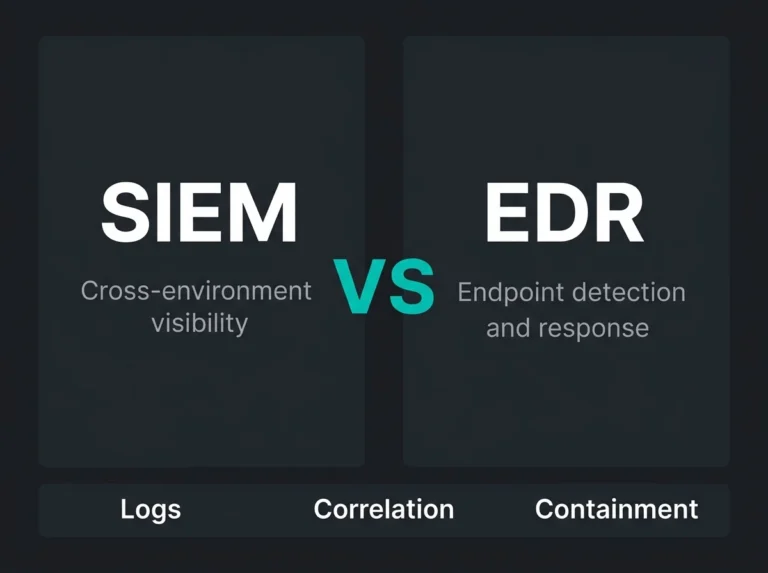
- Oversee technology deployments (SIEM, EDR, identity management)
Incident response leadership
- Develop and test incident response plans
- Lead response coordination during security incidents
- Conduct post-incident reviews and lessons learned
- Manage communication with stakeholders, regulators, and (if needed) law enforcement
Security awareness
- Design and oversee employee security training programs
- Run phishing simulations and measure improvement
- Build a security-conscious culture from the top down
Outsourced CISO costs: what to expect
Pricing depends on company size, regulatory complexity, and engagement depth. The ranges below are what the current market actually looks like based on public data and our own conversations with prospects.
| Company Size | Typical Monthly Cost | Engagement Model |
|---|---|---|
| Under 100 employees | $3,000 to $6,000 | 2 to 3 days/month, strategic oversight |
| 100 to 250 employees | $5,000 to $9,000 | 4 to 5 days/month, policy development + compliance |
| 250 to 500 employees | $8,000 to $12,000 | 6 to 8 days/month, full programme management |
| 500+ employees | $10,000 to $20,000+ | Near full-time, complex environments |
Do the maths against a full-time CISO at $385,000+ per year, which is roughly $32,000 per month in base salary before benefits, bonuses, or equity. Even at the top of the outsourced range you are saving 40% to 80% and getting experienced security leadership in the bargain.
Cost comparison: A full-time CISO costs approximately $385,000 to $470,000 per year in total compensation. An outsourced CISO for a 200-person company typically costs $60,000 to $108,000 per year, delivering the same strategic leadership at 15% to 28% of the cost.
Pros and cons of an outsourced CISO
Advantages
- Significant cost savings: 70% to 85% less than a full-time hire, with no recruitment costs, benefits, or equity dilution
- Immediate expertise: No 6-month ramp-up period. An experienced outsourced CISO brings cross-industry knowledge from working with several organisations at once
- Scalability: Increase or decrease engagement as needs change (pre-audit ramp-up, post-incident support, board meeting preparation)
- Objectivity: External perspective without internal politics. More willing to deliver uncomfortable truths about security gaps
- Broader perspective: Exposure to threat patterns across many organisations gives better threat intelligence than a single company view
- NIS2 compliance: Meets the requirement for management-level cybersecurity oversight and training coordination
Limitations to consider
- Not on-site daily: Limited physical presence means less visibility into day-to-day operations and team dynamics
- Shared attention: Your outsourced CISO serves multiple clients. During a major incident at another client, response times to you could slip
- Cultural integration: Takes longer to learn company culture, internal politics, and unwritten rules
- Execution gap: An outsourced CISO sets strategy, but someone internal still has to execute. Without a security team or managed services, recommendations can stall
- Institutional knowledge: If the engagement ends, some knowledge leaves with the CISO (mitigate this with proper documentation)
Outsourced CISO vs full-time CISO vs MSSP
These three options are often lumped together in procurement conversations. They solve different problems. Knowing where they overlap (and where they don’t) is what tells you which structure you actually need.
| Capability | Outsourced CISO | Full-Time CISO | MSSP/MDR Provider |
|---|---|---|---|
| Security strategy | Yes | Yes | No |
| Board reporting | Yes | Yes | No |
| Risk management | Yes | Yes | Limited |
| Policy development | Yes | Yes | No |
| Compliance management | Yes | Yes | Audit support only |
| 24/7 threat monitoring | Nopairs with MSSP | Noneeds SOC team | Yes |
| Incident response | Leadership + coordination | Leadership + coordination | Technical containment |
| Vendor management | Yes | Yes | No |
| Daily presence | Part-time | Full-time | Remote SOC |
| Typical annual cost | $36,000 to $144,000 | $385,000 to $500,000+ | $48,000 to $250,000+ |
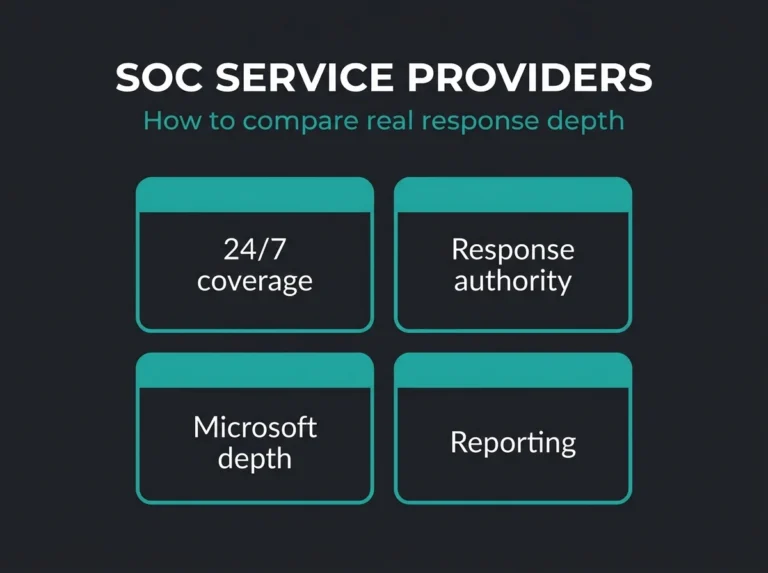
For most mid-sized companies, the strongest setup pairs an outsourced CISO for strategy with a managed security service provider (MSSP) or MDR provider for operational monitoring. The CISO sets direction and oversees the MSSP’s work. The MSSP runs 24/7 monitoring and response. Neither function replaces the other, and any vendor trying to sell you one as a substitute for the other is either confused or cutting corners.
How to choose an outsourced CISO provider
Outsourced CISO services are not a commodity. Before signing an engagement, run the provider through the following questions and watch how cleanly they answer.
Experience and fit
- Industry experience: Do they understand your regulatory environment (NIS2, GDPR, ISO 27001)?
- Technology alignment: If you are a Microsoft shop, do they have deep Microsoft 365 and Azure expertise?
- Size match: Have they worked with companies your size, or are they used to enterprise environments?
- References: Can they provide client references in your sector?
Delivery model
- Named individual or team? A team-based model gives you continuity if one person is unavailable
- Availability during incidents: What is the SLA for emergency response outside regular hours?
- Integration with existing providers: Will they work alongside your MSP, SIEM, or MDR provider?
- Reporting cadence: How often will you get security posture updates and board-ready reports?
Scope and boundaries
- Strategy vs. execution: Do they only advise, or will they help implement? Advice without execution support creates shelfware
- Policy templates vs. custom policies: Generic templates save time, but policies mapped to your business provide real protection
- Compliance support depth: Do they help prepare audit evidence, or just flag what is missing?
When an outsourced CISO makes sense
Situations where an outsourced CISO is the right call tend to look like this:
- You have 50 to 500 employees and no dedicated security executive
- NIS2, GDPR, or industry regulations require documented security governance
- Your board or investors are asking about cybersecurity risk and nobody has answers
- You are preparing for ISO 27001 certification or SOC 2 audit
- You recently had a security incident and lack strategic response capability
- You have an MSP or MSSP running operations but no one overseeing the programme
And the inverse. An outsourced CISO is probably not the right fit if you need a full-time executive embedded in daily operations, run a complex multi-national structure that demands constant attention, or already have a mature security program that only needs tactical execution rather than more strategy.
The Microsoft ecosystem advantage
If your company runs Microsoft 365 and Azure, then an outsourced CISO with genuine Microsoft-native expertise will deliver faster, cheaper results than one who defaults to third-party recommendations. Instead of proposing a new tool for every gap, they optimise what you are already paying for.
Specifically, an outsourced CISO who knows the Microsoft security stack can:
- Improve your Microsoft Secure Score by finding quick wins in Entra ID, Defender, and Purview
- Align your Microsoft 365 security configuration with CIS benchmarks and CISA baselines
- Oversee Microsoft Sentinel deployment and cost optimisation as your SIEM platform
- Make sure email security configurations (DMARC, DKIM, SPF) meet best practices
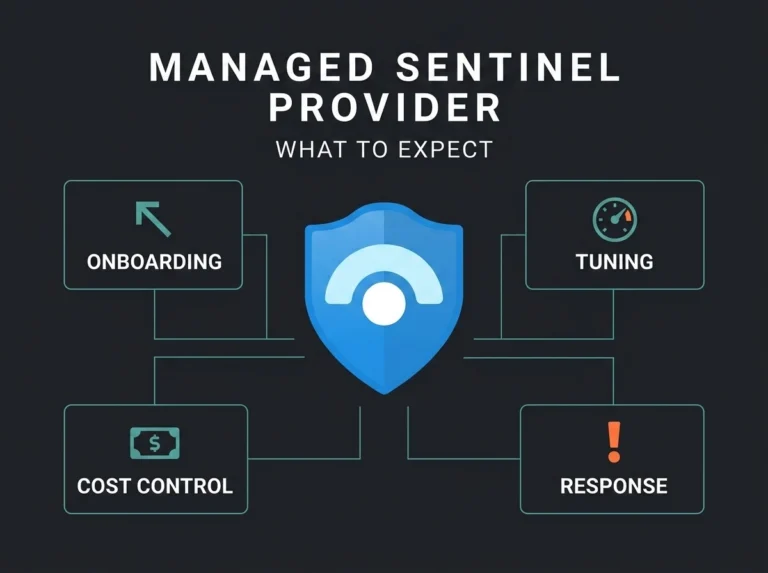
- Coordinate with your managed Sentinel provider for 24/7 detection and response
Skipping the Microsoft-native approach is how companies end up layering expensive third-party tools on top of security capabilities they are already paying for in their licensing. It is not a subtle mistake. It adds up to six-figure annual waste in the mid-market.
Frequently asked questions
What is the difference between an outsourced CISO and a vCISO?
There is no meaningful difference. “Outsourced CISO” and “virtual CISO (vCISO)” describe the same service: external, part-time cybersecurity leadership. “Fractional CISO” emphasises the part-time nature, while “CISO as a Service” implies a subscription or team-based model. Choose a provider based on capabilities, not their preferred label.
How much does an outsourced CISO cost per month?
Monthly costs typically range from $3,000 to $12,000 for SMBs, depending on company size, regulatory requirements, and engagement depth. A company with 100 to 250 employees can expect $5,000 to $9,000 per month. Compare that to roughly $32,000 per month for a full-time CISO salary alone.
Does an outsourced CISO replace the need for an MSSP?
No. An outsourced CISO handles strategy, governance, and oversight. An MSSP or MDR provider handles operational security monitoring and response. Most mid-sized companies need both: the CISO sets direction while the MSSP runs 24/7 monitoring, alert triage, and incident containment.
Is an outsourced CISO sufficient for NIS2 compliance?
An outsourced CISO addresses the governance requirements in NIS2 Article 20, which requires management-level approval and oversight of cybersecurity risk management measures. NIS2 also requires technical measures under Article 21, such as incident handling, supply chain security, and encryption. An outsourced CISO defines the strategy, but you will still need operational capabilities to implement it.
How long does it take an outsourced CISO to show results?
Expect a security assessment and initial roadmap within the first 30 to 60 days. Quick wins (policy gaps, configuration improvements, Secure Score increases) typically appear within 90 days. A mature security programme with documented policies, regular risk assessments, and audit readiness usually takes 6 to 12 months to establish.