





CISO as a Service: What SMBs Need to Know

Your company handles sensitive data, sits inside a regulated industry, and already knows cybersecurity matters. The problem is hiring a full-time Chief Information Security Officer. With average salaries over $385,000 per year in the US, that hire is out of reach for most small and mid-sized businesses.
CISO as a Service (CISOaaS) closes that gap. It gives you expert cybersecurity leadership without the full-time price tag. Falconer Security runs vCISO services built for SMBs on Microsoft 365 and Azure, with the strategic oversight that keeps a company secure, compliant, and ready for what’s next.
This guide covers what a vCISO actually does, what it costs, how it compares to a full-time hire, and what to look for when you’re choosing a provider.
- Fraction of a full-time hire. A vCISO retainer runs $3,000 to $12,000 per month, against an average full-time CISO salary above $385,000 per year.
- Typical SMB budget. Companies with 50 to 500 employees usually land at $5,000 to $9,000 per month, roughly $60,000 to $108,000 per year.
- Strategy, not operations. A vCISO designs the security program and reports to the board; 24/7 monitoring and response stay with your MSSP or MDR provider.
- Regulation demands it. NIS2 Article 20 holds management personally liable for security governance, and auditors want a named person behind your program.
- Faster to value. A vCISO onboards in weeks while a full-time hire takes 3 to 6 months to reach full effectiveness.
What is CISO as a Service?
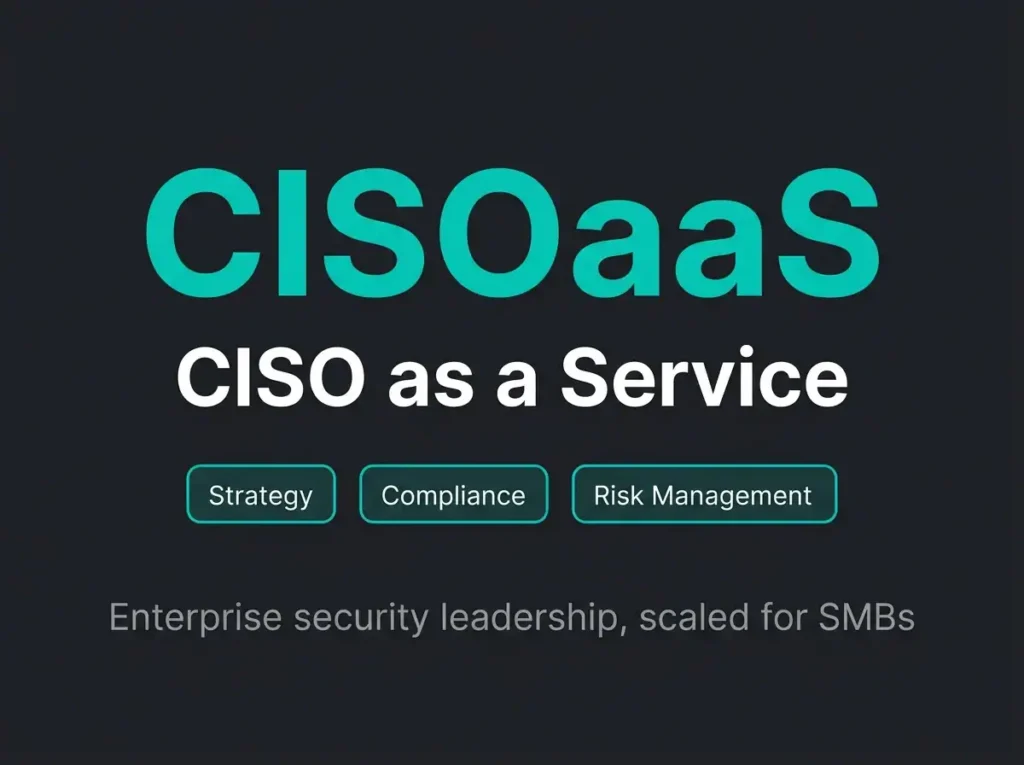
CISO as a Service (also called CISOaaS, virtual CISO, or vCISO) is a model where an external cybersecurity expert takes on the strategic leadership role of a Chief Information Security Officer on a part-time, retainer, or project basis. Instead of hiring a full-time executive, you get experienced security leadership scaled to your actual needs.
The idea is simple: a vCISO brings the same expertise as a traditional CISO (risk management, compliance oversight, security strategy) but works across several clients. That shared model is what keeps it affordable for organisations that need the expertise but can’t justify the executive salary.
Key distinction: A vCISO is a strategic leader, not an extra pair of hands for your IT team. They design your security program, set priorities, and report to your board. They don’t configure firewalls or monitor alerts.
Why SMBs need security leadership now
Three forces are pushing SMBs toward dedicated security leadership, in-house or outsourced.
The talent shortage is getting worse
The ISC2 2025 Cybersecurity Workforce Study reports that 33% of organisations cite budget as the primary reason their security teams are understaffed. Finding an experienced CISO is hard enough for large enterprises. For SMBs competing against bigger budgets, it’s close to impossible.
Regulations require it
The NIS2 Directive (Article 20) requires management bodies of essential and important entities to approve cybersecurity risk-management measures, oversee the implementation, and complete cybersecurity training. Management can also be held personally liable for non-compliance. If you’re in scope, someone has to be responsible for security governance.
The same pressure comes from HIPAA, SOC 2, ISO 27001, and sector-specific frameworks. Compliance auditors want a named person responsible for your security programme. A vCISO fills that role. Cyber insurance underwriters are increasingly asking for the same thing: named security leadership and documented governance.
Attackers don’t care about company size
The IBM Cost of a Data Breach Report 2025 puts the global average breach cost at $4.44 million. Small companies absorb smaller absolute losses, but the relative impact is much worse. A breach that’s a quarterly blip for a Fortune 500 can put an SMB out of business.
Without strategic security leadership, most SMBs operate reactively. They buy tools without a plan, ignore risks until something breaks, and hope the IT team can handle an incident they’ve never trained for.
What a CISO as a Service actually does
A vCISO’s responsibilities track those of a full-time CISO, scaled to the engagement. Here’s what a typical engagement covers:
Security strategy and roadmap
The vCISO reviews your current security posture, flags the gaps, and builds a prioritised roadmap. It’s not a generic checklist. It’s a plan tied to your industry, your tech stack, your budget, and your risk tolerance. For companies on Microsoft 365, that means mapping Microsoft’s native security tools (Defender, Entra ID, Purview) to your specific risks.
Risk assessment and management
Regular risk assessments find vulnerabilities before attackers do. The vCISO evaluates threats in your environment, quantifies risk in terms your leadership can actually use, and recommends controls in proportion to the risk.
Compliance and governance
Whether you’re working through NIS2 in Europe, HIPAA in healthcare, or SOC 2 for SaaS, the vCISO maps regulatory requirements to your existing controls, identifies the gaps, and builds a compliance roadmap. They prepare audit documentation and report compliance status to the board.
Vendor and technology oversight
SMBs tend to accumulate security tools without a coherent plan. The vCISO looks at your current stack, cuts the redundancy, and makes sure the tools work together. For Microsoft-centric environments, that means getting value out of the security features you already pay for before buying third-party tools.
Incident response planning
When (not if) a security incident happens, you need a plan that’s been tested. The vCISO writes incident response procedures, runs tabletop exercises, and makes sure your team knows what to do when alerts fire. This sits alongside operational services from your managed security provider.
Board and executive communication
Translating technical risk into business language is one of the most valuable things a vCISO does. Regular reporting to leadership and board members keeps security on the agenda and in the budget. Under NIS2, that board-level reporting isn’t just good practice. It’s a legal requirement.
CISO as a Service costs: what to budget
Pricing depends on the engagement model, scope, and company size. The common models look like this:
| Engagement Model | Typical Cost | Best For |
|---|---|---|
| Monthly retainer | $3,000 to $12,000/month | Ongoing strategic leadership (most common) |
| Hourly consulting | $200 to $350/hour | Specific questions or short-term needs |
| Project-based | $5,000 to $50,000+ | Risk assessments, compliance readiness, IR plans |
| Full-time CISO (comparison) | $300,000 to $500,000+/year | Large enterprises needing embedded leadership |
For most SMBs with 50 to 500 employees, a monthly retainer between $5,000 and $9,000 covers strategic oversight, quarterly risk reviews, compliance work, and executive reporting. That’s roughly $60,000 to $108,000 per year, well below the $385,000 average CISO salary before benefits and recruiting are factored in.
What drives pricing up: Regulated industries (healthcare, finance), larger employee counts, several compliance frameworks at once, and on-site presence requirements all push costs up. A company preparing for its first SOC 2 audit will pay more than one maintaining an existing programme.
For a deeper look at the costs for the operational side of outsourced security, see our guides on MDR pricing and SOC as a Service pricing.
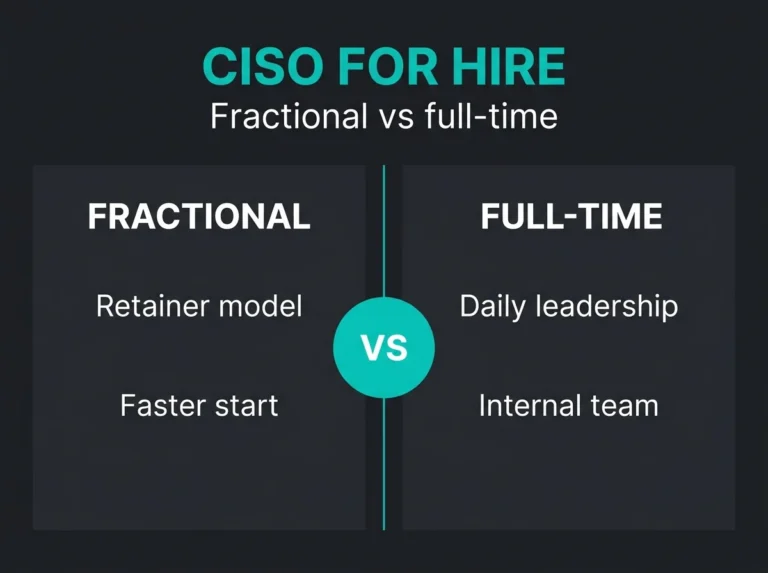
CISO as a Service vs. full-time CISO
Choosing between a vCISO and a full-time hire comes down to your size, budget, and security maturity.
| Factor | CISO as a Service (vCISO) | Full-Time CISO |
|---|---|---|
| Annual cost | $60,000 to $150,000 | $300,000 to $500,000+ |
| Availability | Scheduled hours, retainer-based | Full-time, embedded in organization |
| Experience breadth | Works across multiple industries and clients | Deep knowledge of one organization |
| Ramp-up time | Weeks (structured onboarding) | 3 to 6 months to full effectiveness |
| Objectivity | External perspective, fewer internal politics | May be influenced by internal dynamics |
| Scalability | Adjust scope up or down easily | Fixed cost regardless of demand |
| Best for | SMBs (50 to 500 employees) | Enterprises with large security teams |
The vCISO model works best when your organisation needs strategic direction but doesn’t have enough daily security work to justify a full-time executive. If you already have a security team that needs a leader, a full-time CISO is usually the right call. If you need someone to build the programme from scratch, a vCISO will get you there faster and cheaper.
How CISO as a Service works with managed security
A common misconception: that a vCISO replaces your MSSP or MDR provider. It doesn’t. The two are complements.
- The vCISO sets strategy: What risks to prioritise, which compliance frameworks to target, what security architecture to build
- The MSSP/MDR executes: 24/7 monitoring, alert triage, incident response, tool management
Think of it this way: the vCISO is the architect, the managed security provider is the builder. Without an architect, you get a house that might stand up but won’t meet code. Without a builder, you get beautiful blueprints that never become a house.
Falconer Security provides both. Our vCISO service runs strategy and governance, and our managed Sentinel service and MDR run the operational side. For organisations that want a single partner, combining them removes the coordination overhead of managing separate strategy and operations vendors.
For a detailed breakdown of how these services relate, see our guide to managed SIEM vs MDR vs MXDR.
How to choose a CISO as a Service provider
Not every vCISO provider is the same. Here’s what to evaluate:
Industry and regulatory experience
If you’re subject to NIS2, HIPAA, or SOC 2, your vCISO needs direct experience with those frameworks. Ask for specific examples of clients they’ve taken through compliance audits. General cybersecurity experience isn’t enough when the regulation has specific documentation and governance requirements.
Technology stack alignment
A vCISO who already knows your technology stack is far more effective than one learning it on your time. If you run Microsoft 365 and Azure, you want a provider who knows Defender XDR, Entra ID, Purview, and Sentinel natively. They should be able to point at which M365 security features you’re underusing before recommending third-party tools.
Scope and engagement model
Clarify what’s included. Some providers offer broad strategic services; others focus narrowly on compliance documentation. Ask:
- How many hours per month are included?
- Is board reporting included or extra?
- Do they run hands-on risk assessments, or do they rely on questionnaires?
- What happens during a security incident: do they lead response, or do they hand off?
Integration with operational services
The vCISO has to work cleanly with your existing security operations. If your MSSP and vCISO are different companies, ask how they’ve managed that relationship with other clients. Misaligned strategy and operations is one of the most common failure modes.
Providers that offer both strategic (vCISO) and operational (MDR, managed SIEM) services remove that coordination gap entirely.
Proven track record with SMBs
Some vCISO providers are enterprise consultancies that “also do SMB.” Their playbooks, pricing, and expectations often don’t translate. Look for providers built for the 50 to 500 employee range who understand SMB budget realities and lean IT teams.
When CISO as a Service makes sense
CISOaaS is the right model if:
- You have 50 to 500 employees and no dedicated security executive
- Your IT manager or CTO is “also doing security” without formal training
- You’re facing a compliance deadline (NIS2 transposition, SOC 2 audit, HIPAA review) and need someone to lead the effort
- Your organisation had a security incident and concluded reactive security isn’t enough
- You want to build a security programme but can’t justify a $300K+ executive hire
- You already have an outsourced CISO arrangement but want to evaluate whether your current provider is meeting your needs
If your security needs require daily, on-site executive presence, or you already employ a team of security analysts who need a full-time leader, a traditional CISO hire is probably the better fit.
Frequently asked questions
What is CISO as a Service?
CISO as a Service (CISOaaS) is a model where an external cybersecurity expert provides the strategic leadership of a Chief Information Security Officer on a part-time, retainer, or project basis. The vCISO builds your security program, manages risk, and oversees compliance without the cost of a full-time executive hire.
How much does a vCISO cost?
Most SMBs pay between $3,000 and $12,000 per month on a retainer model, depending on scope and company size. Annual costs typically range from $80,000 to $150,000, compared to $300,000 to $500,000+ for a full-time CISO when salary, benefits, and recruiting costs are included.
What is the difference between a vCISO and an MSSP?
A vCISO provides strategic security leadership: risk assessments, compliance roadmaps, board reporting, and security program design. An MSSP provides operational security services: 24/7 monitoring, alert triage, incident response, and tool management. Most SMBs need both. The vCISO sets the strategy; the MSSP executes it.
Does a vCISO help with NIS2 compliance?
Yes. NIS2 Article 20 requires management bodies to approve cybersecurity risk-management measures and undergo cybersecurity training. A vCISO helps organizations meet these governance requirements by building compliance roadmaps, conducting risk assessments, and preparing documentation for board-level approval.
When should an SMB hire a vCISO instead of a full-time CISO?
A vCISO makes sense when your organization has 50 to 500 employees, cannot justify a $300K+ executive salary, faces compliance deadlines (NIS2, HIPAA, SOC 2), or has security managed by IT staff who lack dedicated security expertise. If you need full-time, embedded security leadership with no other client commitments, a full-time CISO is the better choice.
Next steps
If your organisation needs cybersecurity leadership but isn’t ready for a full-time CISO, a vCISO can fill the gap. The right provider brings strategic expertise, compliance knowledge, and the outside perspective that comes from working across several industries and environments.
Falconer Security’s vCISO service is built for SMBs on Microsoft environments. We combine strategic security leadership with hands-on expertise in Microsoft 365, Azure, Sentinel, and Defender XDR. Whether you need a full security programme built from scratch or a strategic partner to strengthen what you already have, we can help.