





Benefits of Managed Security Services

A CTO at a Stockholm-based SaaS firm called me in November, panicking. Their internal security engineer had quit with two weeks’ notice. The board wanted a “plan”. What they actually wanted was someone to keep the Sentinel alerts triaged at 2am on a Saturday without hiring four more engineers. That is the real conversation most Swedish SMBs have when they start looking at the benefits of managed security services.
For a growing company, the question is not whether security matters. It is whether your internal team can sustain monitoring, incident response, hardening, reporting, and compliance work every week without something slipping. Managed security services solve the resourcing problem when they are scoped correctly. When they are not, they become another expensive subscription that nobody reviews.
Numbers to ground the argument. IBM’s Cost of a Data Breach Report 2025 puts the global average at $4.44 million per breach. ISC2’s 2025 Workforce Study shows budget constraints and skills gaps still compounding on defenders. Put the two together and outsourced security is no longer an enterprise-only procurement conversation. It is practical operating reality for small and mid-sized businesses.
- 24/7 coverage is a payroll problem. Staffing round-the-clock monitoring internally takes five to eight dedicated analysts; managed services plug you into machinery that already exists.
- You buy a skill mix, not a hire. Detection tuning, SIEM engineering, identity protection, and endpoint response are separate disciplines no single recruit covers.
- Quality over volume. A good service raises signal quality while cutting alert counts; in Microsoft-heavy environments the value is operating Sentinel and Defender, not buying another product.
- The benchmark is $4.44 million. IBM’s 2025 average breach cost gives the CFO a credible external number for what poor operations expose.
- You still own the risk. Managed services do not fix weak executive ownership, asset inventory, or identity hygiene, and NIS2 obligations stay with the regulated entity.
What managed security services actually are
Outsourced cybersecurity operations delivered by a specialist provider. Scope varies: continuous monitoring, detection engineering, triage, incident response, vulnerability management, endpoint coverage, security reporting, compliance support, managed SIEM, MDR. Some or all of these depending on the contract.
A good managed service is not a tool reseller in a different hat. It is an operating layer that keeps controls running, reviews alerts, tunes detections, and gives leadership a clearer picture of risk. For the service-provider definition first, start with our guide to what an MSSP is.
The five benefits of managed security services that matter in practice
These benefits are easiest to see when you compare them to the usual in-house reality: limited analyst time, patchy monitoring outside office hours, inconsistent alert tuning, too many manual tasks crowded onto a small team. That is where the value shows up.
Round-the-clock coverage without building a SOC
Coverage first. Most SMBs lack the headcount to monitor alerts, validate incidents, and coordinate response around the clock. That is not a carelessness problem. It is a payroll, hiring-timeline, and shift-design problem. Even a well-funded company struggles to staff 24/7 without five to eight dedicated analysts, which is a significant budget line for a 200-person firm.
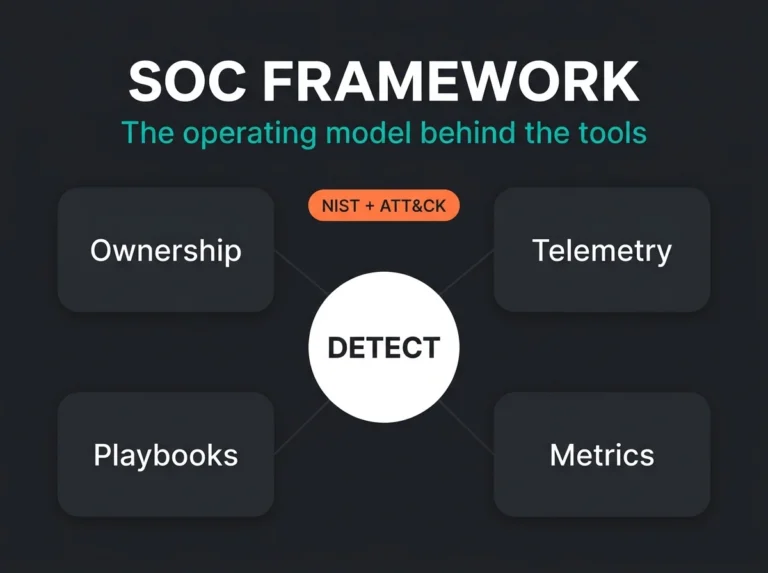
Managed services close the gap by plugging you into an operating model that already exists. Analysts, playbooks, escalation processes, handover protocols between shifts. You buy into the machinery instead of standing it up alongside every other IT priority. If you want that operating layer unpacked in more detail, compare managed SOC services with a virtual SOC model.
Why it matters: attackers do not work business hours. Microsoft reports that it processes 100 trillion security signals and screens 5 billion emails daily. Detection is a continuous function at that volume, not a once-a-day admin task.
Access to specialists you cannot hire fast enough
Security hiring is slow, expensive, and prone to disappointment. Even when recruitment works, one good hire does not give you the full stack of skills the job needs. Detection tuning is a different discipline from SIEM content engineering. Cloud telemetry is different from identity protection. Endpoint response is different from threat hunting. Reporting is different from everything.
This is where managed services typically outperform a thin internal team. You are not buying one person. You are buying access to a broader skill mix, including engineers who have seen the same failure patterns across dozens of client environments and can spot weak onboarding, noisy rules, poor logging, or missing response workflows in the first week.
ISC2’s 2025 study makes the same point in more formal terms: organisations are increasingly dealing with skills shortages, not just headcount shortages. For buyers, that means the fastest route to reduced risk is usually access to proven expertise, not another six-month hiring cycle that might fail.
Detection quality over alert volume
More alerts do not equal more security. Badly tuned controls produce analyst fatigue, slower response, and a false sense of coverage. One of the most underrated effects of a good managed service is that signal quality goes up while alert volume goes down. Detections get tuned. Known noise gets suppressed. The team spends its time on things that actually need action.
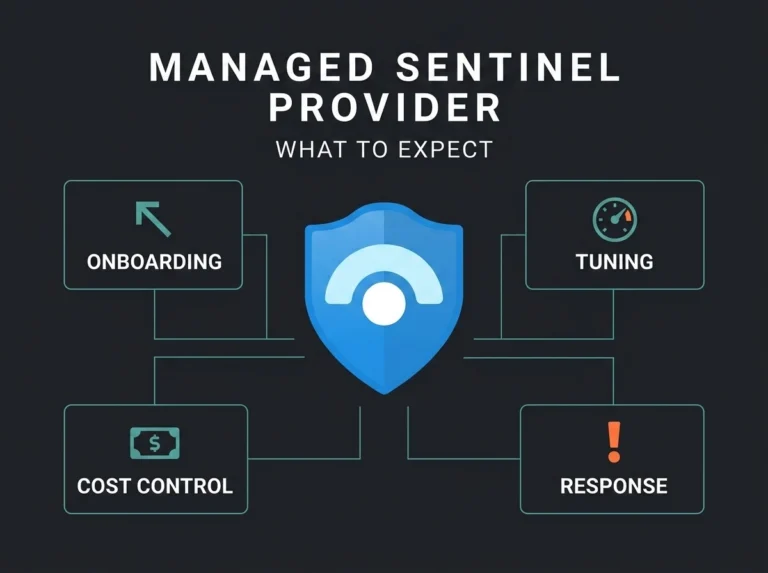
This matters specifically in Microsoft-heavy environments. If you already run Sentinel, Defender, or Entra, the value lives in ongoing engineering and triage, not in buying another product. That is the gap between tooling and operations, and it is where most SMB security programs stall.
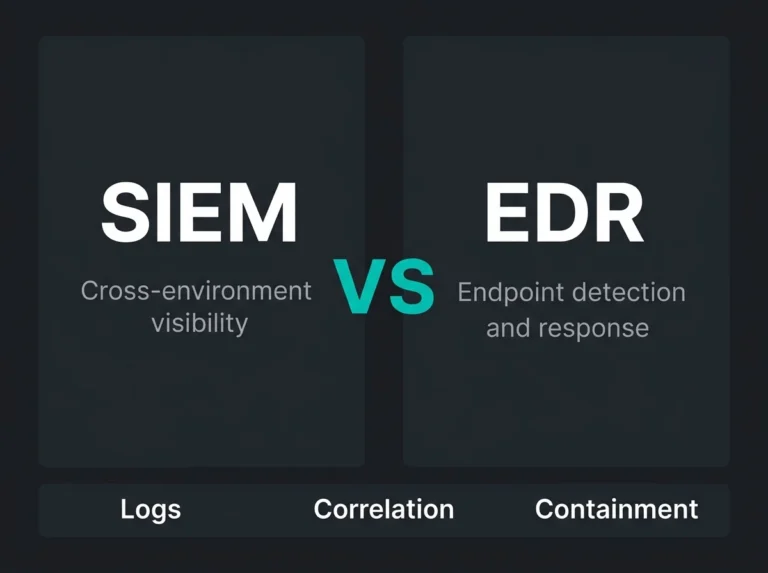
Deciding between endpoint-led response, SIEM-led visibility, or both? Compare MDR vs MSSP and SOC as a Service vs MSSP. The right model depends on whether your central problem is endpoint response, visibility, or a broader outsourced function.
Predictable operating cost
Building internally looks cheaper until you count everything. Licensing. SIEM ingestion. Engineering time. Coverage gaps. After-hours response. Reporting. Staff turnover. Training budget. The hidden cost of a senior engineer spending two days a week on alert triage that should take two hours.
Managed services do not make those costs disappear. What they do is make the cost predictable and make it easier to tie spend to outcomes on a monthly invoice. For an SMB with a finite security budget, that predictability is the difference between “we have a plan” and “we have a line item”.
Predictable cost also helps the business case. IBM’s 2025 breach research gives leadership a credible external benchmark for the financial exposure of poor operations, which is useful when the CFO wants to know why the managed-service line is larger than the antivirus line used to be.
Compliance and reporting readiness
Managed services do not make anyone automatically compliant. Any provider that suggests otherwise is overselling. What they offer is operational discipline: documented processes, better log coverage, clearer escalation, recurring reviews, and evidence that the controls are actually being monitored.
That matters under NIS2 and in customer due diligence. Article 21 of the NIS2 Directive requires appropriate and proportionate technical, operational, and organisational measures to manage cybersecurity risk. A managed service helps you execute and evidence those measures, particularly around incident handling, monitoring, vulnerability management, and supply-chain oversight. Executing them without a service is possible, just harder.
CISA’s Cybersecurity Performance Goals 2.0 point in the same direction: baseline governance, asset visibility, vulnerability mitigation, logging, incident planning, and managed-service oversight. All areas where an external provider can add structure, provided the contract defines what structure looks like.
In-house versus managed, side by side
| Area | In-house only | Managed security services |
|---|---|---|
| Coverage | Often limited to office hours or best-effort on-call | Designed for continuous monitoring and defined escalation |
| Skills | Depends on a few key hires | Access to broader analyst and engineering expertise |
| Detection tuning | Often inconsistent due to competing priorities | Usually part of service delivery and service reviews |
| Cost model | Salary, tooling, and project costs spread across budgets | More predictable recurring operating cost |
| Compliance evidence | Depends on internal process maturity | Can improve reporting cadence and control ownership |
What managed services do not fix
This is the section competitors skip. Managed services are useful. They are not magic. They do not fix poor executive ownership, weak asset inventory, broken identity hygiene, or unclear internal escalation paths. A provider who never asks about privileged access, business owners, critical assets, or who approves containment actions is running a service too shallow to matter.
Effective outsourcing still needs internal accountability. Someone on your side still needs to own priorities, approve risk treatment, and align the service with contracts, insurance requirements, and sector obligations. The provider runs the operating model. You still own the risk. Pretend otherwise and you will be surprised during the first real incident.
When managed services make sense
Probably a good fit if:
- Your security tooling is in place but nobody is consistently operating it.
- Your IT team can deliver projects. They cannot sustain monitoring on top of the day job.
- You need better reporting for leadership, customers, cyber insurers, or NIS2 preparation, and the current process is an ad-hoc spreadsheet.
- Best-effort security is not cutting it anymore. You need a defined service.
- You are trying to standardise detection and response across multiple clients or business units without cloning your best engineer five times.
Sound familiar? See our managed security services offering, our MDR service page, and the managed SOC buyer’s guide to work out which operating model matches your environment.
How to evaluate a provider
Do not ask about tools. Ask about operations. The quality of a managed service shows up in workflow design, in the way they communicate during an incident, and in how tightly the responsibility boundaries are drawn. When you interview a provider, here are the questions that separate operators from resellers.
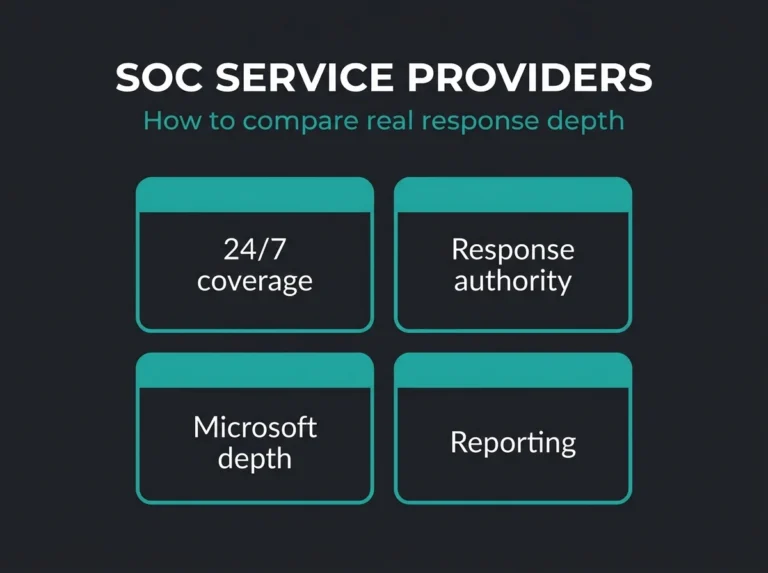
Coverage: what exactly is monitored, during what hours, and by whom. A provider that fudges the answer is fudging the service. Escalation: what triggers a customer notification, and how fast does it reach you. Tuning: who owns detection tuning and false-positive reduction, the provider or you. Response: what actions can the provider take directly without authorisation, and what needs your approval first. Reporting: are you getting useful monthly reporting, or just alert counts dumped into a PDF.
Compliance support: can the provider map activity to your audit and due-diligence needs, including NIS2 if you are a regulated entity. Commercial model: what is included in the recurring fee, and at what point does work start to become a separate project. A provider who is comfortable discussing service limitations is usually worth talking to. If everything sounds unlimited, it is not.
Where this leaves you
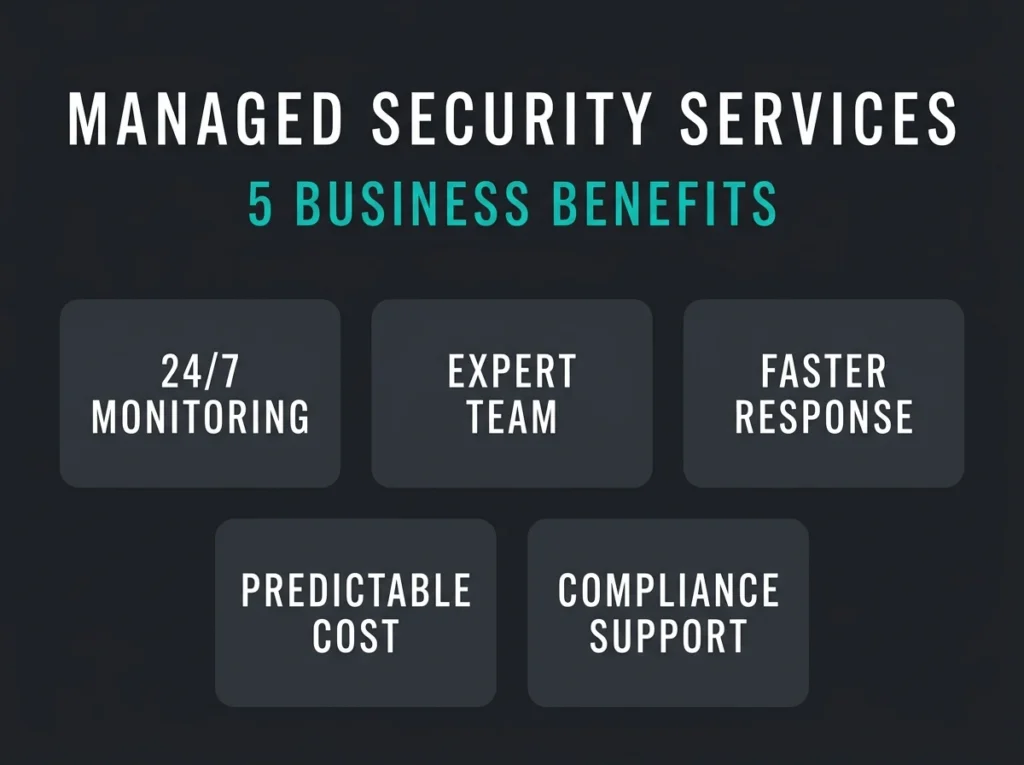
The benefits are practical, not abstract. Coverage without building a 24/7 team. Specialist skills without a multi-year hiring plan. Higher-quality detection instead of more alerts nobody reads. Predictable spend the CFO can forecast. Stronger support for compliance, reporting, and customer assurance.
For SMBs and MSPs, that is frequently the difference between owning security tools and operating a security program. If you want help assessing whether managed security services, MDR, or a managed SOC model is the right fit for your environment, talk to Falconer Security.
FAQ
What are the biggest benefits of managed security services?
Continuous monitoring, access to specialist expertise, improved detection quality, more predictable operating costs, and stronger support for compliance and reporting. In that order of impact for most SMBs.
Are managed security services the same as MDR?
No. Managed security services is the broader category. MDR is a more focused service centred on detecting and responding to threats, usually with strong endpoint coverage. An MSSP often delivers MDR as one component of a wider portfolio.
Do managed security services help with NIS2?
Yes, indirectly. They support NIS2 readiness by strengthening monitoring, incident handling, vulnerability management, and reporting. They do not transfer legal responsibility away from the regulated entity. You still own the obligation.
Are managed security services worth it for small businesses?
Usually yes, when the business cannot justify a full internal security operations team but still needs reliable monitoring, faster response, and better control over risk. Value depends on scope, service quality, and internal ownership. A poorly scoped contract is worse than no contract.
How do I choose the right managed security services provider?
Choose on operations, not on tools. Review coverage hours, escalation paths, tuning ownership, response authority, reporting quality, and how the provider supports your compliance and business requirements. Talk to references in your sector.