





Top MDR Vendors Compared: Buyer’s Guide for 2026

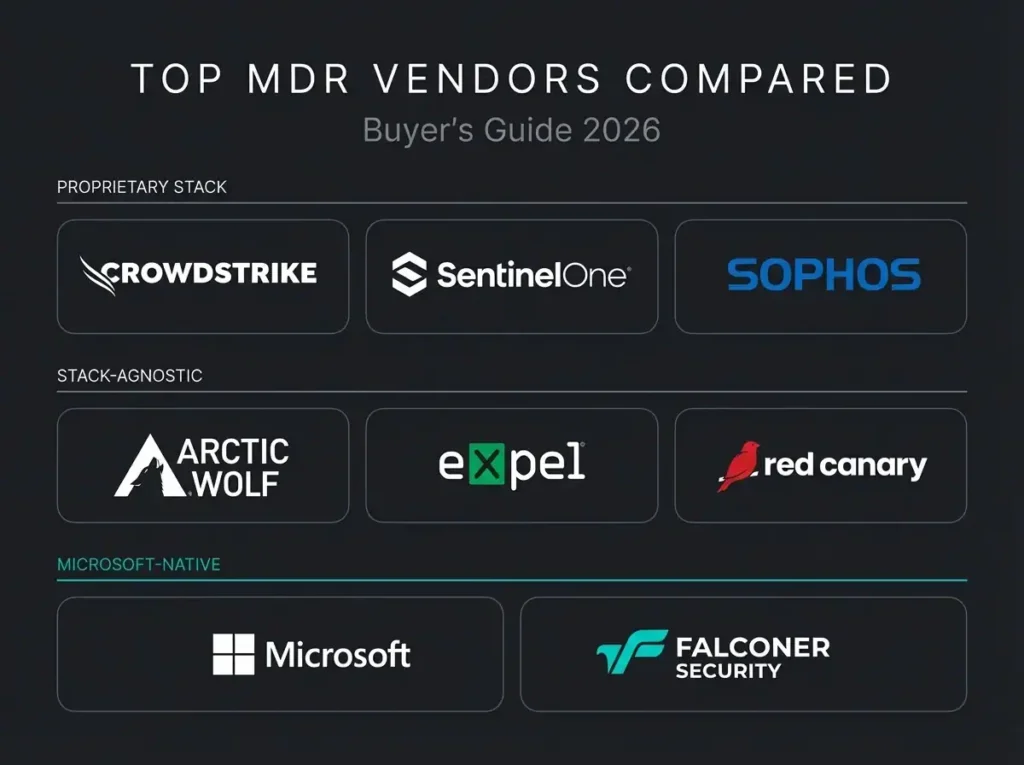
Every guide with MDR vendors compared side by side is written by an MDR vendor. CrowdStrike’s list puts CrowdStrike first. SentinelOne’s list puts SentinelOne first. We are no different: Falconer Security delivers MDR built on the Microsoft security stack, and this guide reflects that perspective. But we will be honest about where each vendor excels and where they fall short, especially for organizations running Microsoft 365 in Europe.
The MDR market is projected to grow from $5.09 billion in 2026 to $13.45 billion by 2031, a 21.45% annual growth rate. That growth has attracted dozens of vendors with overlapping claims. This guide helps IT leaders and MSP owners compare MDR vendors based on what actually matters for Microsoft-heavy SMBs: stack compatibility, active response capability, NIS2 compliance readiness, and total cost of ownership.
- Stack fit cuts the field in half. Proprietary-agent vendors like CrowdStrike, SentinelOne, and Sophos duplicate the Defender licensing that Microsoft 365 E3/E5 shops already pay for.
- Demand full containment. Average attacker breakout time is now 29 minutes, so an MDR that only notifies your team is monitoring with a premium label.
- Expect $8 to $35 per endpoint monthly. A 200-endpoint environment lands at roughly $19,000 to $84,000 per year, with Microsoft-native providers usually cheaper because they run licensing you already own.
- NIS2 is the EU blind spot. Most US-based vendors cannot produce Article 23 incident documentation for the 24-hour and 72-hour reporting deadlines; ask before you sign.
- Mind the 500-seat gap. Microsoft Defender Experts requires 500+ seats and gives guided response, which leaves 50-500 user organisations needing a Microsoft-native provider that contains threats directly.
What Matters When Choosing an MDR Vendor
Before comparing specific vendors, the evaluation criteria you set will determine your outcome. Use our MDR vendor evaluation checklist to score each provider systematically. Most comparison articles evaluate vendors on abstract concepts like “threat intelligence” or “AI-powered detection.” Here is what actually differentiates MDR providers in practice.
Does It Work With Your Existing Microsoft Stack?
This is the question that eliminates half the market immediately. If your organization runs Microsoft 365 E3/E5 with Defender XDR, you already own a detection platform. Choosing an MDR vendor that requires its own proprietary EDR agent means you are licensing two endpoint protection platforms and creating integration complexity for no security benefit.
MDR vendors fall into three categories:
- Proprietary-stack MDR (CrowdStrike, SentinelOne, Sophos): you deploy their agent, their SOC monitors it. Locks you into their ecosystem and duplicates your Microsoft licensing.
- Stack-agnostic MDR (Arctic Wolf, Expel, Red Canary): they integrate with your tools and add a SOC layer. Better, but integration depth with Microsoft varies widely.
- Microsoft-native MDR (Microsoft Defender Experts, Falconer Security): purpose-built for Defender XDR and Sentinel. Deepest integration, no duplicate licensing, full telemetry from endpoints, email, identity, and cloud apps.
For organizations already invested in Microsoft security, the math is straightforward: a Microsoft-native MDR provider uses what you already own and avoids paying twice for endpoint protection.
Active Response or Expensive Notification?
The core question: when your MDR vendor confirms an active ransomware attack at 2 AM on a Saturday, what specifically will they do?
If the answer is “we will notify your team with recommendations,” that is monitoring with a premium label. Genuine MDR means the provider’s analysts isolate compromised endpoints, disable breached accounts, block lateral movement, and contain the threat before your on-call engineer wakes up. According to the CrowdStrike 2026 Global Threat Report, the average breakout time is now 29 minutes. A notification-only MDR vendor gives attackers a head start your organization cannot afford.
NIS2 Compliance: The European Blind Spot
Most MDR vendors are US-based and built for US compliance frameworks (SOC 2, HIPAA, PCI-DSS). Organizations operating under the NIS2 Directive need incident documentation that supports 24-hour initial notification and 72-hour detailed reporting to national authorities. Ask your MDR vendor: “Can you produce an incident report that meets NIS2 Article 23 requirements?” If they have never heard of NIS2, that tells you everything about their EU readiness.
Pricing: Per-Endpoint, Per-User, or Flat Fee?
MDR pricing typically follows one of three models:
- Per-endpoint: $8 to $35/endpoint/month. Common with proprietary-stack vendors.
- Per-user: $15 to $50/user/month. Common with identity-inclusive MDR.
- Flat monthly fee: Fixed SOC fee based on environment size. Common with SIEM-based MDR providers.
For detailed pricing breakdowns, see our MDR pricing guide.
MDR Vendors Compared
| Vendor | Stack | Response Level | Min. Size | NIS2 Ready | Best For |
|---|---|---|---|---|---|
| CrowdStrike Falcon Complete | Proprietary (Falcon) | Full containment | 500+ endpoints | Limited | Large enterprises, multi-OS |
| Arctic Wolf | Agnostic (own overlay) | Guided response | 100+ users | Limited | Mid-market, concierge model |
| Sophos MDR | Sophos + third-party | Full (Complete tier) | No minimum | Limited | Budget-conscious SMBs |
| Microsoft Defender Experts | Microsoft-native | Guided response | 500+ seats | Partial | Large Microsoft enterprises |
| SentinelOne Vigilance | Proprietary (Singularity) | Full containment | Varies | Limited | SentinelOne customers |
| Expel | Agnostic (80+ tools) | Automated + guided | Varies | Limited | Transparency-focused teams |
| Red Canary | Agnostic (multi-EDR) | Full containment | Varies | Limited | Multi-vendor environments |
| Falconer Security | Microsoft-native | Full containment | 50+ users | Yes | Microsoft SMBs in Europe |
MDR Vendor Integration Capabilities Compared
Integration capability decides how much value an MDR service extracts from the tools you already run. The short version: CrowdStrike and SentinelOne require their own agent, Arctic Wolf, Expel, and Red Canary connect to whatever EDR you bring, and Microsoft-native providers operate the Defender and Sentinel deployment you already license. Here is the same vendor list broken down by what each one actually integrates with.
| Vendor | Microsoft Defender XDR | Microsoft Sentinel operations | Third-party EDR support | Email + identity telemetry | Multi-cloud coverage |
|---|---|---|---|---|---|
| CrowdStrike Falcon Complete | Replaced by Falcon agent | No, data export only | No | Identity via Falcon add-on, no native email | Yes, via Falcon Cloud Security |
| Arctic Wolf | Ingests Defender telemetry | No, own Aurora platform | Broad | Via integrations | Yes |
| Sophos MDR | Telemetry via integration pack | No | Yes, integration packs | Deepest with Sophos-native tools | Partial |
| Microsoft Defender Experts | Native | Not included, Defender workloads only | No | Yes, full Defender suite | Microsoft boundaries only |
| SentinelOne Vigilance | Replaced by Singularity agent | No | No | Limited, endpoint-focused | Partial, Singularity Cloud |
| Expel | Yes, native integration | Reads signals, does not operate it | Yes, 80+ integrations | Via integrations | Yes |
| Red Canary | Yes, supports Defender for Endpoint | Integrates, does not operate it | Yes, multi-EDR | Yes | Yes |
| Falconer Security | Native, we operate it | Yes, included, with custom KQL and cost tuning | Not needed, Defender-based | Yes, full Defender suite | Azure-native plus Sentinel connectors for AWS and GCP |
Two patterns stand out. Stack-agnostic vendors give you breadth: they connect to whatever you run today, which is valuable in mixed environments. Native vendors give you depth: they operate the platform rather than reading telemetry from it. And notice the Sentinel column. Only the Microsoft-native providers will run Microsoft Sentinel as part of the service, which matters if Sentinel is your SIEM: with everyone else you either operate it yourself or pay a second provider for managed SIEM.
Vendor-by-Vendor Analysis
CrowdStrike Falcon Complete
CrowdStrike is the dominant name in MDR for good reason. Falcon Complete combines world-class threat intelligence (tracking 281+ threat actors) with rapid containment, typically within 60 minutes. They offer a $1 million breach prevention warranty.
The catch for Microsoft shops: Falcon Complete requires deploying CrowdStrike’s own agent. If you already run Microsoft Defender for Endpoint (included in M365 E5), you are paying for two endpoint protection platforms. CrowdStrike’s enterprise pricing and annual contracts make it a poor fit for SMBs under 500 endpoints. And their compliance reporting is built around US frameworks, not NIS2.
Verdict: Excellent MDR, wrong fit for Microsoft-heavy European SMBs. If you are a 2,000-employee global enterprise with a mixed OS environment and no Microsoft E5 investment, CrowdStrike belongs on your shortlist.
Arctic Wolf
Arctic Wolf’s “Concierge Security” model assigns a dedicated team to each client and works with your existing tools rather than replacing them. Strong onboarding, personalized posture reviews, good for organizations with no security staff.
The catch: Response capability leans toward guided response, meaning Arctic Wolf investigates and recommends, but you often execute remediation yourself. Their platform overlay adds another tooling layer. Integration depth with Microsoft Defender and Sentinel varies. And like most US-based vendors, their reporting is not structured for NIS2 compliance.
Verdict: Good concierge model for mid-market. Less compelling if you need active containment at 2 AM or NIS2-structured reporting.
Sophos MDR
Sophos MDR Complete provides genuine active response at accessible pricing, making it one of the better options for budget-conscious SMBs. Third-party telemetry integration means you can keep non-Sophos tools. Strong MSP channel support.
The catch: The cheaper Essentials tier is notification-only, which is not MDR in any meaningful sense. Threat hunting depth does not match specialists like CrowdStrike. The deepest detection works with Sophos-native tools, so Microsoft Defender integration is a second-class experience. No NIS2-specific reporting.
Verdict: Solid budget option, especially the Complete tier. If Microsoft Defender is your primary EDR, you will not get the deepest integration here.
Microsoft Defender Experts for XDR
Microsoft’s own MDR service operates directly within the Defender XDR ecosystem with access to Microsoft’s unmatched threat intelligence (100 trillion security signals daily). No third-party agents, no data duplication.
The catch: 500-seat minimum for the full service experience. Requires E5 Security licensing. Response model focuses on guided response rather than direct containment in all cases. And critically, coverage stops at Microsoft boundaries: non-Microsoft firewalls, network appliances, and third-party cloud services are not covered.
Verdict: The natural choice for large Microsoft enterprises. But the 500-seat minimum and guided-response model leave a gap for SMBs that need someone to actually contain threats, not just recommend actions. This is exactly the gap Falconer Security fills.
SentinelOne Vigilance
SentinelOne Vigilance layers human analysts on top of the Singularity XDR platform. Strong autonomous response capabilities including ransomware rollback. Good attack chain visualization through Storyline technology.
The catch: Requires SentinelOne deployment. If you run Microsoft Defender, this means rip-and-replace. Focused primarily on endpoint telemetry; email and identity coverage requires additional integrations. No NIS2 reporting.
Verdict: If you already run SentinelOne, Vigilance is the logical MDR add-on. If you run Microsoft Defender, look elsewhere.
Expel
Expel differentiates through radical transparency. Their Workbench platform shows every investigation in real time: what analysts examined, what they concluded, and why. Integrates with 80+ tools including Microsoft Defender.
The catch: Custom pricing requires sales engagement (no public rates). You bring your own detection tools; Expel provides the SOC layer. Less brand recognition. US-focused compliance reporting.
Verdict: Strong choice for tech-forward teams that demand visibility into their MDR provider’s work. Less relevant for SMBs that need a turnkey solution.
Red Canary
Red Canary supports multiple EDR platforms with custom detection logic mapped to MITRE ATT&CK. Active remediation including endpoint isolation and account actions. Good cloud and identity detection alongside endpoint coverage.
The catch: Custom pricing. Primarily North American focus, which affects support hours and EU compliance awareness. Breadth of platform support means detection depth on any single platform may not match a vendor-native MDR.
Verdict: Good for multi-vendor environments. If you are standardized on Microsoft, a Microsoft-native provider will give you deeper detection.
Why Microsoft-Native MDR Makes Sense for Most SMBs
If your organization runs Microsoft 365 E3 or E5, you already own a significant portion of the detection stack. Microsoft Defender for Endpoint, Defender for Office 365, Defender for Identity, Defender for Cloud Apps, and Microsoft Sentinel provide endpoint, email, identity, and SIEM capabilities out of the box.
The missing piece is not more technology. It is the people and processes to operate that technology 24/7: SOC analysts writing detection rules, triaging alerts, investigating threats, and containing attacks.
A Microsoft-native MDR provider fills that gap without adding licensing complexity:
- No duplicate EDR licensing. You do not pay for CrowdStrike or SentinelOne on top of Defender.
- Deepest telemetry. Native access to Defender XDR signals across all workloads, plus Sentinel log data from firewalls, cloud infrastructure, and custom sources.
- Unified investigation. One platform for endpoint, email, identity, and cloud app threats. No correlation gaps between separate tools.
- SIEM and MDR in one service. Most MDR vendors monitor endpoints. Microsoft-native MDR can include Sentinel management, giving you SIEM operations and threat detection under a single provider.
How Falconer Security Delivers MDR
We built our MDR service specifically for organizations running Microsoft 365 and Azure. Here is what that means in practice:
- Full containment response. Our SOC analysts do not send notification emails. They isolate compromised endpoints, disable breached accounts, block lateral movement, and contain threats. At 2 AM. On weekends. On holidays.
- Microsoft Defender XDR + Sentinel. We operate your existing Microsoft security tools. Custom KQL detection rules tuned to your environment. Endpoint hardening recommendations. Sentinel cost optimization included.
- NIS2-ready from day one. Incident documentation structured for Article 23 reporting requirements: 24-hour initial notification, 72-hour detailed report, root cause analysis. Built for European regulatory reality.
- Built for 50 to 500 employees. No 500-seat minimums. No enterprise-only pricing. Security operations designed for the organizations that need MDR most but get priced out by the big vendors.
- Nordic presence. We work in your time zone, understand your regulatory environment, speak your language, and track the geopolitical cyber threats facing Nordic SMBs in 2026.
Bottom line: The best MDR vendor is the one that fits your existing stack, provides genuine active response, meets your compliance requirements, and is priced for your organization’s size. For Microsoft-heavy SMBs in Europe, that narrows the field considerably.
If you want to see what Microsoft-native MDR looks like for your environment, start with a security assessment. We will show you what your current Defender and Sentinel deployment is missing and what proper MDR coverage would look like.
MDR Vendor Selection Checklist
Use this checklist when evaluating any MDR vendor:
- Stack compatibility. Does the MDR vendor operate on your existing EDR/XDR, or require its own? Calculate total licensing cost including any duplication.
- Active response. Does the vendor contain threats directly (endpoint isolation, account disabling), or send recommendations you must execute?
- Coverage scope. Endpoints only, or endpoints + email + identity + cloud + network?
- 24/7 human analysts. Staffed around the clock, or automated alerting during off-hours?
- Proactive threat hunting. Scheduled hunting beyond automated detection rules?
- NIS2/EU compliance reporting. Can they produce documentation meeting Article 23 incident reporting timelines?
- Transparency. Can you see investigation details and analyst actions?
- Exit strategy. What happens to detection rules, data, and integrations if you switch?
Frequently Asked Questions
What is an MDR vendor?
An MDR (Managed Detection and Response) vendor provides outsourced security operations combining technology with human analysts. MDR vendors monitor your environment 24/7, investigate alerts, hunt for threats proactively, and respond to confirmed attacks. Unlike traditional MSSPs that forward alerts, MDR vendors take action to contain threats on your behalf.
How much do MDR vendors charge?
MDR pricing varies significantly by vendor and scope. Endpoint-focused MDR typically costs $8 to $35 per endpoint per month. For a 200-endpoint environment, that translates to roughly $19,000 to $84,000 per year. Premium vendors like CrowdStrike sit at the top end, while Microsoft-native providers often cost less because they operate your existing licensing rather than adding their own. See our detailed MDR pricing breakdown.
Do I need MDR if I have Microsoft Defender?
Microsoft Defender XDR provides detection technology, but technology without trained analysts operating it 24/7 leaves alerts uninvestigated. MDR adds the human layer: SOC analysts who monitor Defender alerts around the clock, investigate suspicious activity, and contain confirmed attacks. For a deeper look at why human-led MDR outperforms automated alternatives, see our comparison. The question is not whether you need MDR, but whether you choose Microsoft’s own Defender Experts (500+ seats, guided response) or a Microsoft-specialized MSSP like Falconer Security (50+ seats, full containment).
What is the difference between MDR and XDR?
XDR (Extended Detection and Response) is a technology platform that correlates security data across endpoints, email, identity, and cloud workloads. MDR is a service that provides human analysts to operate that technology. You can have XDR without MDR (self-managed), or MDR without XDR (analysts operating separate tools). The most effective approach combines both: an XDR platform like Microsoft Defender XDR operated by an MDR team providing 24/7 investigation and response.
Which MDR vendors support multiple EDR platforms?
Red Canary, Expel, and Arctic Wolf are built to operate on third-party EDR platforms, including Microsoft Defender for Endpoint, CrowdStrike Falcon, and SentinelOne. Sophos MDR accepts third-party telemetry through integration packs, though detection runs deepest on Sophos tools. CrowdStrike Falcon Complete and SentinelOne Vigilance monitor only their own agents. Microsoft-native providers like Defender Experts and Falconer Security operate the Defender platform you already license, so if your environment is standardized on Microsoft, platform breadth matters less than integration depth.
How does NIS2 affect MDR vendor selection?
The NIS2 Directive requires essential and important entities to implement incident detection and response capabilities, with initial notification within 24 hours and detailed reporting within 72 hours. Your MDR vendor must produce documentation meeting these timelines. Most US-based MDR vendors are not structured for EU regulatory compliance, which is a critical gap for European organizations.