





SIEM vs SOC: What’s the Difference?

If you’re comparing SIEM and SOC, you’re probably already feeling the problem. Alerts exist, logs exist, maybe Microsoft Sentinel is already collecting data, and yet nobody is fully confident about who is watching what after 17:00 or what happens when a high-risk incident lands on a Friday night.
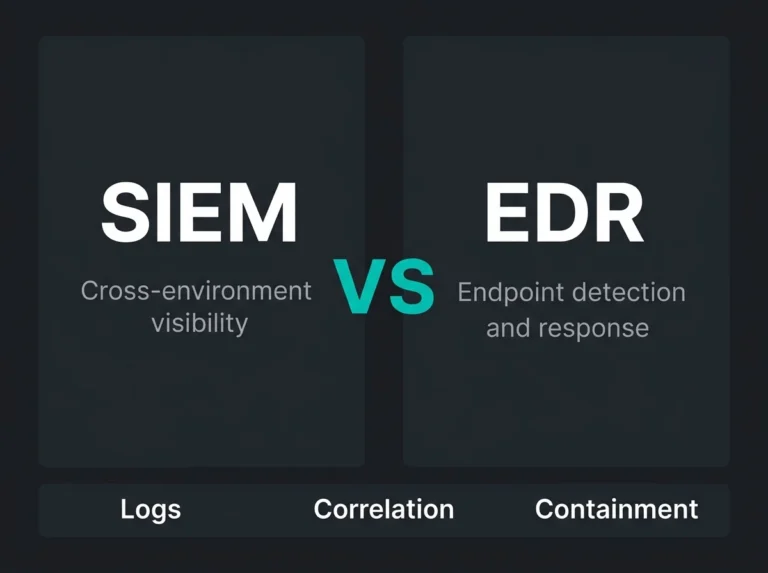
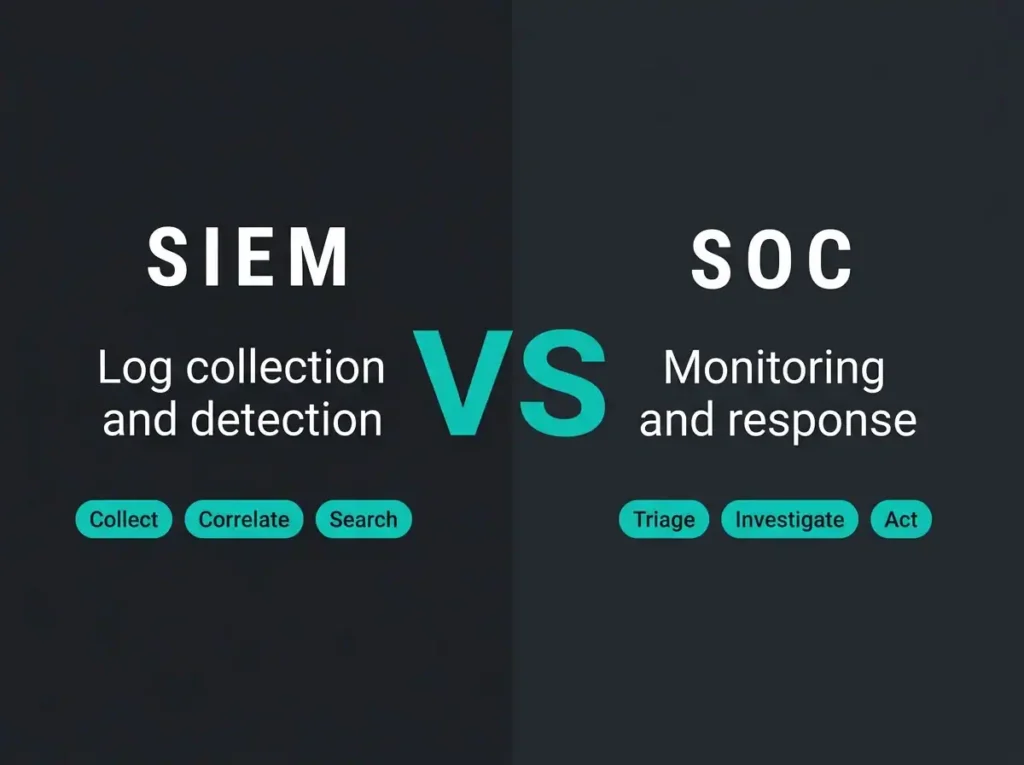
That confusion is common because SIEM and SOC get sold together, budgeted together, and talked about like they mean the same thing. They don’t. A SIEM is the platform. A SOC is the operating function that uses the platform, plus a pile of other tools and processes, to investigate and respond.
For Swedish SMBs and MSPs, the distinction matters because buying one without the other usually creates a blind spot. You can pay for log collection and still miss incidents. You can build an internal response process and still lack the telemetry to spot weak signals early enough.
This guide breaks down SIEM vs SOC in plain terms, shows where each one fits, and explains why most growing businesses end up needing both.
- SIEM is the platform, SOC is the function. A SIEM collects, correlates, and searches security data; a SOC is the people and process layer that triages, investigates, and responds.
- Visibility gap or response gap. If you do not know what is happening, fix SIEM maturity first; if alerts land but nobody acts after hours, the bigger gap is SOC capability.
- SMBs are targeted nearly four times more. Verizon’s DBIR finds small and medium businesses targeted almost four times more than large organizations, so “too small to watch” no longer holds.
- Most businesses end up with both. SIEM without a SOC becomes an alert cannon and SOC without a SIEM runs slow investigations; lean teams usually land on a managed or hybrid pairing.
- NIS2 mandates neither by name. The directive requires risk management and incident handling; SIEM supplies logging and evidence while SOC capability supplies response discipline.
SIEM vs SOC at a glance
| Area | SIEM | SOC |
|---|---|---|
| What it is | A security platform that collects, stores, correlates, and analyzes event data | A security operations function made up of people, workflows, and response processes |
| Primary job | Visibility, alerting, log search, detection logic | Monitoring, triage, investigation, containment, escalation, recovery coordination |
| Example | Microsoft Sentinel | Managed SOC analysts reviewing incidents and acting on them |
| Works without the other? | Yes, but often badly. It becomes an expensive log bucket or alert cannon. | Yes, but with weaker visibility and slower investigations. |
| Buying mistake | Assuming the tool itself equals 24/7 coverage | Assuming human analysts can compensate for missing telemetry and weak detections |
| Best fit | Centralized telemetry, compliance evidence, detection engineering | Operational response, threat triage, incident handling, continuous improvement |
What a SIEM actually does
A SIEM is where security data comes together. Microsoft says Microsoft Sentinel is a cloud-native SIEM that collects data across users, devices, applications, and infrastructure, then uses analytics, threat intelligence, hunting, and automation to support detection, investigation, and response.
That sounds broad because modern SIEM platforms are broad. In practice, most teams use a SIEM for five things:
- Collect logs from identity, endpoints, firewalls, SaaS, cloud workloads, and infrastructure
- Normalize and search that data
- Run detection rules and correlation logic
- Create alerts and incidents for analysts to review
- Keep historical evidence for investigations, reporting, and compliance
If you’re already running managed Sentinel, you know the upside. One place to investigate. One query language. One timeline across systems that normally live in separate consoles.
The catch is simple: a SIEM does not wake up stressed at 02:13, look at a suspicious sign-in chain, and decide whether to disable an account. People do that. Or they don’t, which is where the trouble starts.
Why SMBs buy a SIEM in the first place
Sometimes it’s driven by insurance or a customer requirement. Sometimes an MSP needs one console across multiple tenants. Often it’s operational pain. The team has too many tools and no good way to connect the dots.
Microsoft’s own docs lean into that point. Sentinel is built to ingest data across multicloud and multiplatform environments, then group alerts into incidents and support hunting and playbooks from the same platform. That’s valuable. It also creates a dangerous illusion: once the platform is live, leadership starts assuming the monitoring problem is solved.
I see this on assessments more often than people admit. The dashboard exists, the connector list looks impressive, and nobody has really decided who owns alert triage after hours.
What a SOC actually does
A SOC is the operating layer. Microsoft describes incident response planning as preparation for your Security Operations Center, with explicit roles for a technical incident leader, communications liaison, incident recorder, and forward planner in longer incidents. That tells you what a SOC really is: not a product, but a coordinated response function.
A functioning SOC usually handles:
- 24/7 or business-hours monitoring
- Alert validation and triage
- Investigation of suspicious activity
- Containment and escalation
- Threat hunting and tuning
- Reporting, lessons learned, and playbook updates
That can be internal, outsourced, or hybrid. Many SMBs land on some variation of managed security services because staffing a real SOC is expensive and awkward. The hard part isn’t only hiring analysts. It’s covering nights, weekends, holidays, handoffs, documentation, and sustained quality when the work gets repetitive.
Verizon’s DBIR page for the current report notes that small and medium businesses are being targeted nearly four times more than large organizations. That doesn’t mean every SMB needs an in-house SOC. It does mean the “we’re too small to be watched” argument has aged badly.
Why the SOC matters even with good tooling
Tools produce candidates. Analysts produce judgment.
A SIEM can tell you that a user authenticated from an unusual location, pulled down a large volume of mail, and created suspicious forwarding rules. A SOC decides whether that pattern is a traveling executive, a broken integration, or the opening move of a business email compromise.
It also deals with the messy parts technology doesn’t solve well:
- contacting the right internal owner quickly
- deciding whether to isolate, disable, block, or watch
- tracking evidence and timelines during an incident
- coordinating privacy, legal, or customer communication when needed
Those are operating decisions, not dashboard features.
SIEM vs SOC: the real differences
One is software. The other is a service function.
This is the cleanest distinction. SIEM is technology. SOC is people plus process, supported by technology. Competitor articles from Huntress, Exabeam, and Mezmo all make that point, and they’re right on the core definition. Where most of them stop short is the buyer question: which gap hurts your business more right now, missing telemetry or missing response ownership?
SIEM improves visibility. SOC improves outcomes.
That’s a little blunt, but it holds up. A good SIEM shows more. A good SOC acts faster and more consistently on what matters.
If your current pain is “we don’t know what’s happening,” SIEM is the first fix. If your pain is “we know something happened but nobody dealt with it fast enough,” you’re in SOC territory.
SIEM is easier to buy than to run well.
Most vendors make deployment sound like the hard part. It isn’t. Tuning connectors, cutting false positives, building detections tied to your environment, and keeping watchlists useful is where the work lives. Microsoft notes that watchlists in Sentinel are meant to enrich event data, reduce alert fatigue, and support detection rules and response workflows. That’s powerful, but only if someone maintains the lists and actually uses them in operations.
Otherwise you end up paying for capability you never operationalized.
SOC coverage is a staffing problem before it is a tooling problem.
Most internal teams can cover office hours. Fewer can cover nights. Very few can cover 24/7 well without burnout or shallow triage. That’s why companies comparing SOC as a Service vs MSSP often discover the same thing: the economics push them toward a managed model long before the technology does.
Friday evenings are where this becomes real. The finance team is offline, the IT lead is on a train, an account starts sending odd mail, and the question becomes brutally practical: who is actually responsible for the first 30 minutes?
Do you need both?
Usually, yes.
You can run a SOC without a SIEM, but investigations get slower because telemetry is scattered. You can run a SIEM without a SOC, but alerts pile up, detections go stale, and nobody really owns response. In both cases, the missing piece becomes obvious during the first serious incident.
For most SMBs, the more useful question is not “SIEM or SOC?” but “what combination fits our size, risk, and internal capacity?”
Common models look like this:
- SIEM only: workable for mature internal teams with security analysts on staff
- SOC only: workable when a provider brings its own tooling or your environment is simple
- Managed SIEM + managed SOC: the strongest fit for lean internal teams that still need continuous coverage
- Hybrid: provider handles monitoring and first response, internal IT owns remediation and business decisions
That hybrid model is where many Nordic SMBs land because it preserves control without pretending the internal team can provide round-the-clock analyst coverage.
How this ties to NIS2 and security governance
NIS2 does not tell you to buy a SIEM. It also does not tell you to name your service “SOC.” What it does require is risk management, incident handling, business continuity, and supply chain security measures. Those obligations sit much closer to operational capability than to a product checklist.
That is why the distinction matters for compliance. A SIEM helps with evidence, logging, detection inputs, and investigation data. A SOC helps with incident handling discipline, escalation, documentation, and response coordination. If you’re mapping controls to NIS2 requirements in Microsoft Sentinel, the technical side is only half the story.
Boards often ask whether a new platform purchase “covers” NIS2 exposure. Not on its own. You still need people, procedures, and tested response paths.
How to decide what to buy next
If you’re still unsure whether your bigger gap is SIEM or SOC, ask these questions:
- Do we have centralized telemetry across identity, endpoint, email, cloud, and network?
- Can we tell which alerts are truly urgent within 15 minutes?
- Who owns investigation after business hours?
- Can we prove what happened during an incident without jumping across six consoles?
- Are our detection rules tailored to our environment, or mostly vendor defaults?
- Can we sustain this during vacation periods and staff turnover?
If the first and fourth answers are no, start with SIEM maturity. If the second, third, and sixth answers are no, the bigger gap is SOC capability.
For Microsoft-heavy environments, that often leads to a conversation about custom detection engineering in Sentinel plus a managed response layer. That pairing closes a lot more risk than buying ingestion alone.
The short version
SIEM is where security data is collected, correlated, and searched. SOC is the function that monitors, investigates, and responds. One gives you visibility. One gives you operational follow-through.
If you only buy SIEM, you may end up with better graphs and the same response gaps. If you only buy SOC, your analysts may be working with thin context and slower investigations. Most businesses that are serious about security operations end up combining both, whether through an internal team, a managed provider, or a hybrid model.
That’s the practical answer behind the acronym debate.
FAQ
What is the difference between SIEM and SOC?
SIEM is a security platform that collects and analyzes logs and alerts. A SOC is the team or service function that monitors those alerts, investigates suspicious activity, and coordinates response.
Can you have a SOC without a SIEM?
Yes, but investigations are usually slower and less consistent because data is spread across multiple tools. A SIEM gives the SOC better visibility and historical evidence.
Can you have a SIEM without a SOC?
Yes, but many companies discover that alerts still go unanswered or detections stay untuned. A SIEM without operational ownership often becomes expensive shelfware.
Which matters more for an SMB: SIEM or SOC?
It depends on the gap. If you lack centralized visibility, SIEM usually comes first. If you already collect data but cannot respond quickly or after hours, SOC capability is the bigger need.
Is SIEM or SOC required for NIS2?
NIS2 does not mandate specific product names, but it does require cybersecurity risk management and incident handling. In practice, SIEM supports visibility and evidence, while SOC capability supports operational response and governance.