





Managed SIEM Services: What to Expect

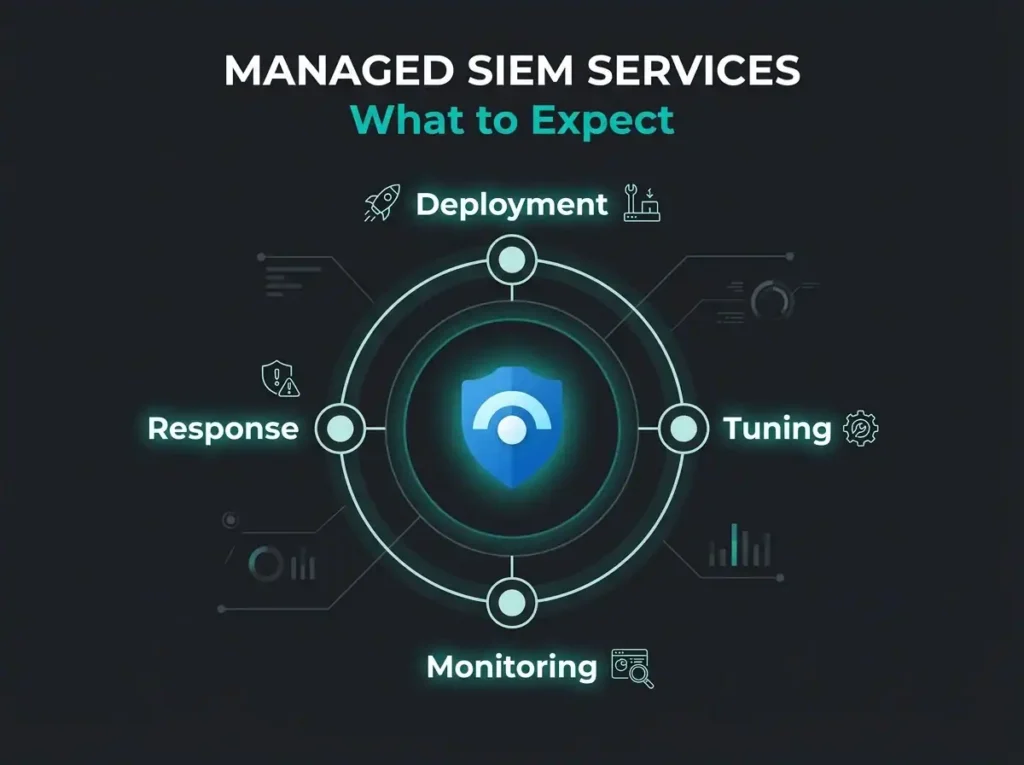
Your company bought a SIEM. The logs are flowing. Detection rules are firing. At 2 AM on a Saturday, when one of those rules trips on a compromised admin account, who answers the phone? If the honest answer is “nobody,” you don’t have a security monitoring programme. You have an expensive log storage system.
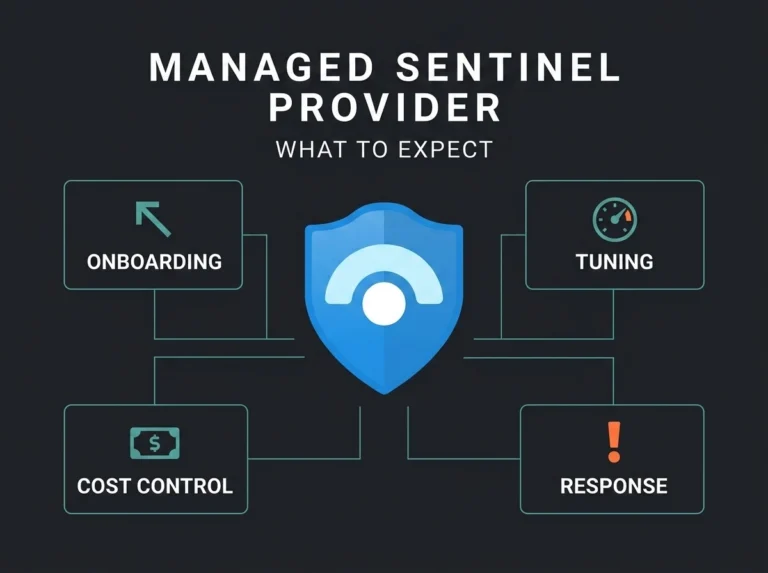
Managed SIEM services exist to solve exactly that problem. A managed SIEM provider runs your Security Information and Event Management platform on your behalf: watching alerts around the clock, tuning rules, investigating anything suspicious, escalating anything confirmed. Falconer Security delivers this on Microsoft Sentinel, built around organisations running Microsoft 365 and Azure.
Below, a walk through what “managed SIEM” actually includes, how it stacks up against running SIEM in-house, what you should expect of a provider, and what realistic costs look like for SMBs.
- The cost gap is stark. Full managed SIEM for a 50-500 employee environment runs $2,500 to $11,000 per month, while in-house 24/7 coverage needs four analysts plus a SIEM engineer at roughly $44,000 per month in salaries alone.
- Alerts are not response. If the provider only fires alerts and expects your team to investigate and act, you still need MDR or internal staff; clarify response scope and pre-approved containment playbooks before signing.
- Weeks, not months. A typical managed SIEM deployment for an SMB takes two to four weeks, against the months an in-house build spends on hiring, training, and playbooks.
- Your data stays yours. With Microsoft Sentinel the logs live in your Azure tenant, and the provider works through Azure Lighthouse permissions you grant and can revoke at any time.
- Demand cost engineering. Sentinel bills per GB ingested; a good provider actively cuts ingestion, and Falconer Security typically trims it 30 to 40% in the first 90 days.
What Are Managed SIEM Services?
Managed SIEM is an outsourced security operations model. A third party takes responsibility for deploying, configuring, monitoring, and maintaining the SIEM. Rather than hiring SOC analysts and SIEM engineers yourself, you bring in a provider that delivers those capabilities as a service.
Market sizing tells the same story. Fortune Business Insights valued global managed SIEM at $10.35 billion in 2025 and projects $12.15 billion in 2026. The growth isn’t mysterious. Most organisations simply don’t have the staff to operate a SIEM effectively on their own.
In the 2025 ISC2 Cybersecurity Workforce Study, 33% of organisations named budget constraints as the main driver of cybersecurity staffing shortages. For an SMB with 50 to 500 employees, hiring even one dedicated SOC analyst is a stretch. Hiring a full 24/7 team is off the table. Managed SIEM is how those organisations close the gap without pretending they can staff it.
What Managed SIEM Services Include
The label “managed SIEM” covers a spread of services. Some providers deliver little more than log monitoring with emailed alerts. Others run a full security operations function with active threat response attached. A real managed SIEM engagement should cover the capabilities below.
Platform Deployment and Configuration
The provider handles the initial SIEM build: wiring up data sources, configuring log ingestion, authoring detection rules, establishing alert workflows. On Microsoft Sentinel, that means setting up data connectors for Microsoft 365, Entra ID, Defender XDR, Azure resources, and whichever third-party systems are in scope (firewalls, VPN appliances, and the rest of the supporting cast).
24/7 Alert Monitoring and Triage
SOC analysts sit on the alert queue around the clock. When a rule fires, they work out whether it’s a genuine threat, a false positive, or expected behaviour that the rule is mislabelling. High-severity alerts (compromised accounts, ransomware indicators, data exfiltration patterns) are triaged in minutes, not hours. That SLA matters more than the marketing copy often admits.
Threat Investigation
When something looks suspicious, analysts dig. They correlate events across log sources, walk user behaviour timelines, pull in threat intelligence, and scope the potential incident. This is the human work that separates a managed service from a basic alerting tool. It’s also the work clients are really paying for, whether the contract says so or not.
Detection Rule Tuning
SIEM detections are not set-and-forget. New false positive patterns appear as environments change. Threat actors evolve techniques that slip past existing rules. A managed SIEM provider tunes detection content continuously, suppressing noise, refining alert logic, adding custom detections shaped by your environment. Increasingly that also pulls in AI-powered threat detection that improves as the platform learns the baseline.
Incident Escalation and Response
Once a threat is confirmed, the provider escalates with actual context attached: what happened, which systems are affected, what’s been done so far, what you should do next. Many providers also take direct response actions (isolating compromised devices, blocking malicious IPs, disabling accounts) under pre-agreed playbooks. Clarity on those playbooks is the difference between a service that helps in a crisis and one that forwards emails.
Reporting and Compliance
Regular reporting documents posture, alert volumes, incident trends, and detection coverage. The reports do double duty: they show your team which threats were handled, and they provide evidence for frameworks like NIS2, ISO 27001, SOC 2, and GDPR.
Managed SIEM vs. In-House SIEM
Running SIEM internally gives you full control. “Full control” is also another phrase for “full responsibility” (staffing, tuning, 24/7 coverage, the lot). The two models look very different in practice.
| Capability | In-House SIEM | Managed SIEM |
|---|---|---|
| Monitoring coverage | Business hours only (unless you staff a 24/7 SOC) | 24/7/365 by default |
| Staffing requirement | 3-5 SOC analysts minimum for round-the-clock coverage | Zero internal SOC hires needed |
| Detection engineering | Requires in-house SIEM expertise (KQL, rule logic) | Provider maintains and tunes detection rules |
| Time to value | Months (hiring, training, building playbooks) | Weeks (provider brings established processes) |
| Cost structure | High fixed cost (salaries, training, tooling) | Predictable monthly subscription |
| Scalability | Limited by team capacity | Provider scales with your environment |
| Threat intelligence | Must source and integrate separately | Included via provider’s multi-client visibility |
| Ongoing maintenance | Your responsibility (platform updates, connector fixes) | Provider handles platform operations |
The staffing reality: a single SOC analyst lands at $80,000 to $120,000 a year in salary alone. To sustain 24/7 coverage you need four or five analysts (once you account for shifts, holidays, and turnover), plus a SIEM engineer on top. That’s $400,000 to $700,000 a year in staffing before anyone’s bought a tool or a training course. Managed SIEM typically clears equivalent coverage at a fraction of the number.
Managed SIEM vs. MDR: How They Relate
Managed SIEM and Managed Detection and Response sit next to each other, but the labels aren’t interchangeable. The distinction matters once you’re evaluating proposals.
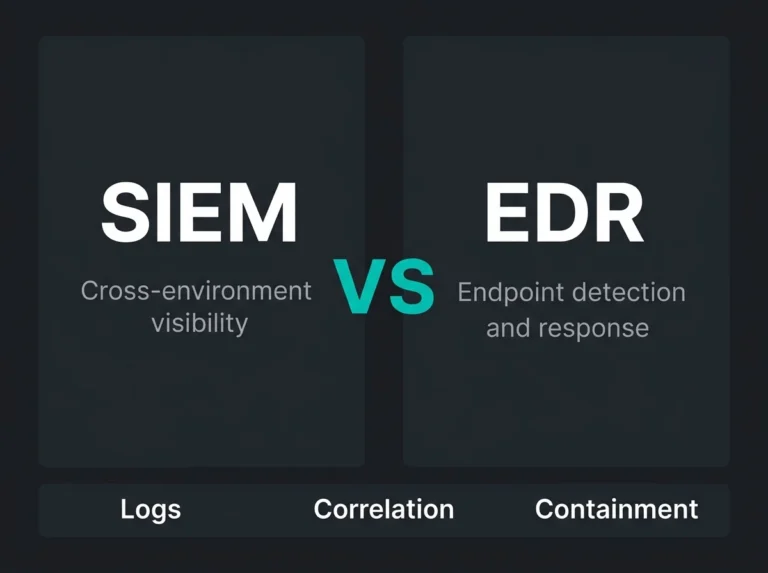
SIEM is the technology platform. It collects logs, correlates events, fires alerts. MDR is the service layer that operates security tools (the SIEM among them) to detect, investigate, and respond.
In the real world the line has blurred. Many managed SIEM providers now include response capabilities that overlap with MDR. Where the distinction still counts is in provider scope:
- Managed SIEM (monitoring focus): log collection, alert generation, triage, and escalation. Provider watches and informs. Your team acts.
- MDR (response focus): everything above plus active incident response. Provider watches, investigates, and acts on your behalf.
Most SMBs need both. If your managed SIEM provider only fires alerts and expects your team to investigate and respond, you still need internal security staff to carry the operational load. A full-service managed SIEM engagement that includes response (sometimes marketed as “managed SIEM with MDR” or simply “managed detection and response“) removes that gap at source.
What to Look for in a Managed SIEM Provider
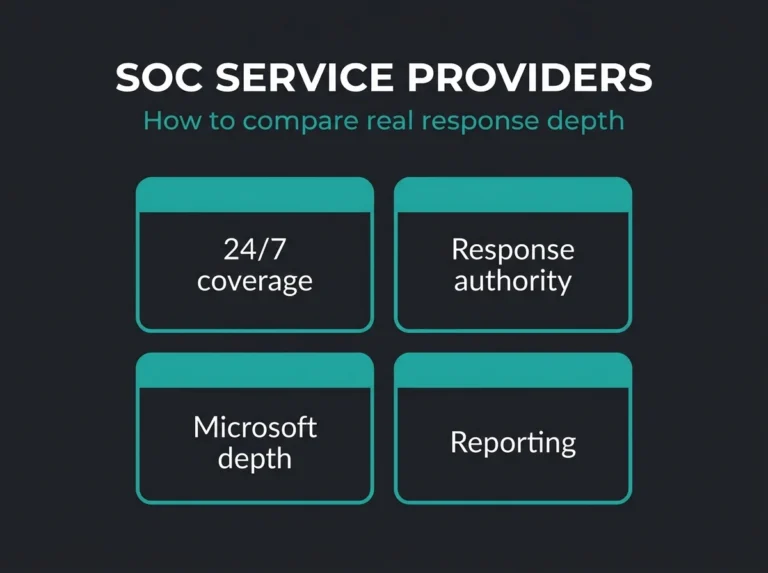
Picking a managed SIEM provider is a weighty decision. They’ll have deep access to your security data. They’ll be your first line against threats. Seven criteria matter more than the rest:
1. Platform Expertise
Do they actually specialise in your SIEM? A provider with genuine Microsoft Sentinel experience will write better detection rules, optimise costs more carefully, and troubleshoot quicker than a generalist juggling a dozen different SIEM products. Ask about KQL proficiency, data connector experience, and automation playbook work. Press for specifics.
2. Detection Coverage
How many detection rules does the provider maintain? More importantly, are those rules tuned for environments like yours, or are they templates lifted straight from the vendor catalogue? Effective detection leans on custom content informed by your business context, not generic out-of-the-box rules that fire on everyone.
3. Response Capabilities
What happens the moment a threat is confirmed? Is the provider sending an email and stepping back? Or performing actual response work (device isolation, account lockout, IP blocking)? Clarify scope and pre-approve specific containment actions inside a documented playbook so nobody is improvising at 03:14 on a Sunday.
4. Transparency and Reporting
You should be able to see what the provider is doing at any time. Look for real-time dashboards, a proper reporting cadence (weekly summaries, monthly executive reports), and clear SLAs on alert response. A provider that operates as a black box is a risk wrapped in marketing, not a solution.
5. Compliance Support
If you sit inside the scope of NIS2, ISO 27001, SOC 2, or similar frameworks, reporting should map to those requirements rather than forcing you to translate. Expect audit trails of monitoring activity, documented incident response, and evidence of continuous improvement.
6. Cost Optimisation
Platforms like Microsoft Sentinel bill on consumption (per GB of log data ingested). A good provider actively works your ingestion down: filtering noisy sources, applying data collection rules and tiered storage, and making sure you only ingest what provides security value. Cost engineering is part of the job, not an upsell.
7. Multi-Tenant Experience
For SMBs and MSPs, a provider that runs multiple client environments brings real leverage. They see threat patterns across their book. They write rules shaped by real incidents at other clients. And they develop operational efficiency that shows up as faster response times and lower per-hour costs, which is what you actually want from a service.
What Managed SIEM Costs for SMBs
Managed SIEM pricing varies with environment size, data volume, and service scope. Below is the working range SMBs with 50 to 500 employees can expect in practice.
| Cost Component | Typical Range (Monthly) | Notes |
|---|---|---|
| SIEM platform (Sentinel) | $500 to $3,000 | Depends on daily log ingestion volume (GB/day) |
| Managed service fee | $2,000 to $8,000 | 24/7 monitoring, tuning, incident response |
| Total monthly cost | $2,500 to $11,000 | Full managed SIEM for 50-500 employee environment |
Now hold that number next to the in-house alternative. Four SOC analysts at $100,000 plus a SIEM engineer at $130,000 comes to $530,000 a year, which is roughly $44,000 a month in staffing alone. Managed SIEM reaches equivalent or better coverage at a fraction of the number.
For a deeper breakdown of security operations pricing, including how SOC as a Service compares, see the dedicated pricing guide. It also helps to compare the operating model in SIEM vs SOC and the service wrapper in managed SOC services, because pricing only makes sense once the delivery scope is clear.
Cost optimisation matters: Falconer Security typically trims Sentinel ingestion costs by 30 to 40% in the first 90 days of an engagement through data collection rule optimisation, log filtering, and tiered storage. Often enough, the managed fee covers itself on platform savings alone before anyone has had to defend the invoice internally.
Why Microsoft Sentinel for Managed SIEM
If you run Microsoft 365 and Azure (and most Nordic SMBs do), Microsoft Sentinel is the natural managed SIEM platform. A few reasons:
- Native integration: Sentinel connects directly to Microsoft 365, Entra ID, Defender for Endpoint, Defender for Office 365, and Azure services without third-party connectors or fiddly configurations.
- Cloud-native architecture: no on-prem hardware to stand up or maintain. It scales with your environment automatically. Our guide to cloud-native SIEM unpacks what that actually means in practice.
- Consumption-based pricing: you pay for the data you ingest. No per-seat licensing, no minimum platform commitments.
- Built-in SOAR: Logic Apps automation drives response playbooks without bolting on extra tools.
- Multi-tenant support: Azure Lighthouse lets MSSPs run multiple client Sentinel workspaces from one pane of glass, which cuts operational overhead and lifts service quality in the same motion.
Per Microsoft, Sentinel delivers cloud-native SIEM and SOAR with AI-driven analytics. Organisations collect data at cloud scale, detect with built-in analytics and threat intelligence, and investigate and respond with automation.
Frequently Asked Questions
What is the difference between managed SIEM and SIEM as a Service?
The terms often get used interchangeably. Managed SIEM usually refers to a service where a provider operates a SIEM platform (which may be yours or theirs) on your behalf. SIEM as a Service (SIEMaaS) usually implies the provider also owns and hosts the SIEM platform. In practice, with cloud-native platforms like Microsoft Sentinel, the distinction has largely disappeared. The platform runs in your Azure tenant, and the provider manages it remotely.
How long does it take to deploy managed SIEM services?
A typical deployment for a 50 to 500 employee organisation takes two to four weeks. That covers connecting core data sources (Microsoft 365, Entra ID, Defender suite), deploying detection rules, configuring automation playbooks, and establishing escalation workflows. For a step-by-step view, see our MSSP onboarding checklist for Sentinel. Complex environments with heavy third-party integrations may stretch to six or eight weeks.
Can I keep control of my data with managed SIEM?
Yes. With Microsoft Sentinel, all log data stays inside your Azure tenant under your ownership and control. The managed SIEM provider reaches in through delegated permissions (typically Azure Lighthouse) that you grant and can revoke whenever you like. Your data never leaves your tenant.
Do I still need internal IT staff with managed SIEM?
You won’t need dedicated security operations staff, but you do need someone internally to serve as the point of contact for escalations and to make business decisions during incidents (for example, whether to shut down a system or force a password reset across the user base). Most SMBs assign this to the IT manager or a senior IT administrator.
Is managed SIEM enough, or do I also need MDR?
It depends on the provider. A full managed SIEM engagement that covers alert monitoring, threat investigation, and active incident response effectively delivers what MDR provides. If the provider only fires alerts and expects you to own investigation and response, you’ll still need MDR or internal staff to plug the gap. Always clarify response scope before signing a contract.