





SOC as a Service Pricing: What Does It Actually Cost?

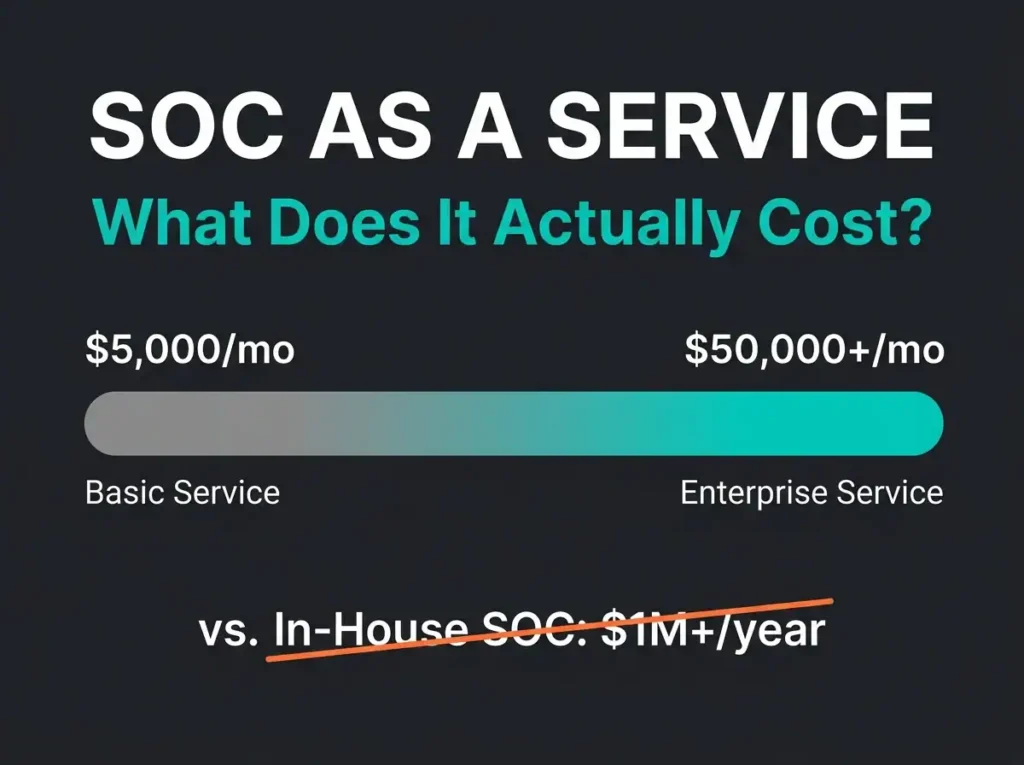
SOC as a Service pricing runs between $10 and $25 per monitored asset per month for most small and mid-sized businesses. For a typical 200 to 500 endpoint environment, that’s roughly $3,000 to $15,000 per month. Building the same capability in-house costs $1 million to $2 million annually once you add staffing, infrastructure, and technology. The math isn’t close.
But “SOC as a Service pricing” is never one number. It ranges from basic log monitoring with email alerts at the low end, to a fully staffed security operations center with 24/7 threat hunting and incident response at the high end. This guide breaks down what drives the cost, what each tier actually includes, and how to tell whether you’re paying for real security operations or just a pretty dashboard. For the fundamentals of what the service includes beyond price, see our complete guide to SOC as a Service for SMBs.
- Per-asset benchmark. Expect $10 to $25 per monitored asset per month, which puts a 200 to 500 endpoint environment at roughly $3,000 to $15,000 monthly.
- Most SMBs pick standard. The $5,000 to $12,000 tier buys 24/7 analyst monitoring, alert triage, incident escalation, and monthly reporting.
- In-house math fails. An internal 24/7 SOC runs $855,000 to $2.23 million per year against $60,000 to $240,000 for SOCaaS, a 70 to 90 percent saving.
- Watch the hidden lines. Onboarding can add $5,000 to $25,000 one-time, and providers that bill incident response separately charge $250 to $400 per hour.
- Ask the analyst ratio. Depth of human coverage is the biggest price differentiator; a 1:5 analyst-to-client ratio and a 1:50 ratio are different products at the same acronym.
What SOC as a Service actually costs
SOC as a Service (SOCaaS) pricing tracks three things: scope of monitoring, number of protected assets, and the depth of human analyst involvement. Below are the realistic ranges at current market prices.
| Service Tier | Monthly Cost (200 endpoints) | What You Get |
|---|---|---|
| Basic monitoring | $2,000 to $5,000 | Log collection, automated alerting, basic dashboards. Limited or no human analyst involvement. |
| Standard SOCaaS | $5,000 to $12,000 | 24/7 monitoring by security analysts, alert triage, incident escalation, monthly reporting. |
| Advanced SOCaaS / MDR | $10,000 to $20,000 | Full threat hunting, custom detection rules, incident response, SIEM management, compliance reporting. |
| Dedicated SOC team | $20,000 to $40,000+ | Named analysts assigned to your environment, custom playbooks, embedded in your workflows. |
Most SMBs land in the standard tier at $5,000 to $12,000 per month. That covers the core need: someone competent watching your environment around the clock who tells you when something is actually wrong, instead of just forwarding automated alerts for you to decode.
SOC as a Service typically costs between $10 and $25 per monitored asset per month for SMBs, compared with $1 million to $2 million annually for an equivalent internal SOC operation.
What drives SOC as a Service pricing
Per-asset monthly cost depends on several factors. If you understand them, you can compare quotes that look wildly different on the surface but often cover the same scope underneath.
Number of monitored assets
Most SOCaaS providers price per endpoint, per user, or per device. More assets, higher cost. Volume discounts typically kick in above 250 to 500 endpoints. A 100-endpoint environment might pay $15 to $25 per asset. A 1,000-endpoint environment can usually negotiate down to $8 to $12 per asset.
Data ingestion volume
If your SOC provider uses a cloud-native SIEM like Microsoft Sentinel or Splunk Cloud, the platform charges for data volume. Sentinel uses consumption-based pricing at roughly $2.46 per GB ingested (pay-as-you-go), with commitment tiers bringing that down to $1.50 to $2.00 per GB at higher volumes. Some SOCaaS providers bundle SIEM licensing into their fee. Others pass it through separately. Always clarify which.
Depth of human analyst coverage
This is the biggest single differentiator in SOCaaS pricing. A service that runs automated rules and sends email alerts when thresholds trip costs far less than one staffed with Level 1, Level 2, and Level 3 analysts reviewing every alert, correlating events, and proactively hunting.
Ask the provider directly: How many analysts are assigned to my environment? What’s the analyst-to-client ratio? A 1:5 ratio versus 1:50 decides whether your alerts get real human attention or sit in a queue.
Compliance requirements
Organizations under NIS2, GDPR, ISO 27001, or industry-specific regulation need SOC services that include audit-ready reporting, evidence collection, and documented incident response processes. These compliance add-ons run 15 to 30 percent over baseline SOCaaS pricing. For regulated industries, they’re not optional.
Technology stack integration
A SOCaaS provider that plugs into your existing Microsoft 365, Entra ID, Defender XDR, and Sentinel environment costs less to deploy than one that wants to replace your stack. Providers with native Microsoft integrations onboard faster and avoid the duplicate tooling costs of dragging their own SIEM along.
Internal SOC vs SOC as a Service: the real cost comparison
The case for SOC as a Service gets obvious once you price out what building the same capability internally actually takes.
| Cost Component | Internal SOC (Annual) | SOCaaS (Annual) |
|---|---|---|
| Security analysts (6-8 for 24/7 coverage) | $540,000 to $1,200,000 | Included |
| SOC manager | $120,000 to $180,000 | Included |
| SIEM platform licensing | $50,000 to $300,000 | Often included or bundled |
| Threat intelligence feeds | $20,000 to $100,000 | Included |
| Security tooling (EDR, SOAR, ticketing) | $30,000 to $150,000 | Included or BYO |
| Training and certifications | $15,000 to $40,000 | Included |
| Facilities and infrastructure | $50,000 to $200,000 | N/A |
| Recruitment (ongoing turnover) | $30,000 to $60,000 | N/A |
| Total | $855,000 to $2,230,000 | $60,000 to $240,000 |
Staffing is where the internal SOC economics collapse for SMBs. Genuine 24/7 coverage needs a minimum of six analysts working in shifts. At an average salary of $90,000 to $150,000 per analyst (regional and seniority-dependent), payroll alone runs $540,000 to over $1 million annually. The 2025 ISC2 Cybersecurity Workforce Study confirms that skills shortages now outweigh headcount shortages as the primary workforce challenge. Hiring and keeping qualified SOC analysts is harder than it used to be.
A 24/7 internal SOC needs a minimum of six analysts, a SOC manager, SIEM infrastructure, and threat intelligence subscriptions. For most organizations, total annual cost falls between $855,000 and $2 million.
SOCaaS pricing models explained
Providers structure pricing differently. Knowing which model your vendor uses is how you predict costs and avoid surprises.
Per-asset or per-endpoint pricing
The most common model. You pay a fixed monthly fee per monitored endpoint, user, or device. It’s predictable and easy to budget. Typical range: $10 to $25 per asset per month. Works well for organizations with stable, well-defined asset inventories.
Consumption-based pricing
You pay based on the volume of log data ingested or the number of security events processed. This mirrors how the underlying SIEM platforms like cloud-native SIEMs bill. The upside: you only pay for what you use. The risk: costs can spike during security incidents when log volumes surge at the worst possible moment.
Tiered subscription pricing
Providers offer predefined packages (Bronze, Silver, Gold, or similar) with increasing levels of service. Each tier adds capability. Basic monitoring at the bottom, full incident response and threat hunting at the top. This model makes vendor comparisons easy but limits customization.
Flat-rate pricing
A fixed monthly fee regardless of asset count or data volume. Predictable, but usually limited to smaller environments. Flat-rate providers often cap the number of assets or data volume included in the fee.
Hidden costs to watch for
The quoted monthly price rarely tells the full story. These line items frequently surface after the contract is signed.
Onboarding and deployment fees
Initial setup, SIEM configuration, data connector deployment, and baseline tuning can cost $5,000 to $25,000 as a one-time fee. Some providers amortize that over the contract term. Others bill it upfront. Providers with native Microsoft integrations generally charge less for onboarding, because hooking up Sentinel data sources takes minimal custom work.
Incident response costs
Some SOCaaS providers detect and alert, then bill incident response separately. If the base package covers monitoring but invoices incident response at $250 to $400 per hour, a single serious incident can add $10,000 to $50,000 to your subscription. Always confirm whether IR is included or an add-on.
SIEM licensing passed through
If the SOCaaS provider runs a Sentinel workspace inside your Azure subscription, you pay Microsoft directly for data ingestion. That’s not inherently bad. You own the data and the workspace. It does mean the SOCaaS fee is only one part of your total cost. A managed Sentinel service that includes cost optimization can cut this SIEM component by 30 to 40 percent.
Technology add-ons
EDR agents, vulnerability scanners, SOAR platforms, and threat intelligence feeds may be bundled or billed separately. A provider quoting $8 per asset might exclude EDR, which adds another $5 to $10 per endpoint per month from a separate vendor. Compare total cost of ownership, not just the SOCaaS line item.
How to evaluate SOCaaS pricing quotes
When comparing SOC vendors, normalize the quotes by asking:
- What’s included in the base price? Monitoring, detection, triage, response, reporting? Get specifics.
- Is SIEM licensing included? If not, estimate your data ingestion costs separately.
- What’s the analyst-to-client ratio? Lower ratios mean more attention per customer. Ask for the number, not a vague “dedicated team” claim.
- Are incident response hours included? If capped, how many per month, and what’s the overage rate?
- What are the contract terms? Monthly, annual, multi-year? Early termination fees?
- What’s the onboarding timeline and cost? How long before you have operational monitoring?
- Does the service integrate with your existing tools? Native integrations with Microsoft 365, Defender, and Sentinel reduce deployment cost and time.
The cheapest quote is rarely the best value. A $6-per-asset service with automated-only detection and no IR is a fundamentally different product than a $15-per-asset service with 24/7 human analyst coverage and proactive threat hunting. They look similar on a spreadsheet. They behave very differently at 2 AM on a Saturday. If you need a clearer picture of what that higher-service tier should include, start with our breakdowns of managed SOC services and virtual SOC delivery models.
SOC as a Service vs related security services
SOCaaS overlaps with several other managed security service models. Knowing the differences is how you buy the right service.
| Service | What It Does | Typical Monthly Cost |
|---|---|---|
| SOC as a Service | Full security operations: monitoring, detection, triage, response, reporting | $5,000 to $20,000 |
| MDR (Managed Detection and Response) | Threat detection and response focused on endpoints and specific data sources | $3,000 to $15,000 |
| Managed SIEM | SIEM platform management, detection rule tuning, cost optimization | $2,000 to $10,000 |
| MSSP | Broad managed security including firewall management, vulnerability scanning, SOC | $5,000 to $25,000 |
The lines between these services are blurring. Many SOCaaS providers now deliver MDR capabilities, and MDR vendors increasingly run full SOC operations. Focus on what you need (detection? response? compliance?) rather than on which acronym the vendor happens to use in marketing.
When you’re evaluating SOC as a Service pricing, compare total cost of ownership including SIEM licensing, incident response, and onboarding. The base per-asset subscription is only one number among several.
When SOC as a Service is worth the investment
SOCaaS makes financial and operational sense for organizations that meet any of the following:
- You lack internal security operations staff. With zero or two security professionals on payroll, building 24/7 monitoring in-house is not viable. SOCaaS gives you that capability immediately.
- You have to comply with NIS2, GDPR, or industry regulations. These frameworks require security monitoring, incident detection, and documented response capabilities. SOCaaS delivers all three with audit-ready evidence.
- Your IT team handles security as a side responsibility. IT generalists managing security part-time miss threats. SOCaaS gives you dedicated security focus without hiring specialists.
- You operate in a Microsoft 365 and Azure environment. SOCaaS providers with Microsoft expertise plug into your existing Sentinel, Defender, and Entra ID deployments. You get more value from licenses you already pay for.
- You want predictable security costs. SOCaaS converts the variable, unpredictable cost of in-house security operations into a fixed monthly expense that scales with the organization.
Frequently asked questions
How much does SOC as a Service cost per month?
SOC as a Service typically costs between $3,000 and $20,000 per month for SMBs, depending on monitored asset count, service tier, and coverage scope. Per-asset pricing sits in the $10 to $25 range per endpoint per month. Basic monitoring services sit lower. Advanced services with 24/7 human analyst coverage, threat hunting, and incident response cost more.
Is SOC as a Service cheaper than building an internal SOC?
Yes, significantly. An internal SOC with 24/7 coverage costs $855,000 to over $2 million annually once you account for analyst salaries, SOC management, SIEM licensing, threat intelligence, training, and infrastructure. SOC as a Service delivers equivalent capability for $60,000 to $240,000 annually. That’s a 70 to 90 percent cost reduction.
What is included in SOC as a Service pricing?
Standard SOCaaS pricing includes 24/7 security monitoring, alert triage and investigation, incident escalation and response guidance, regular reporting, and access to a team of security analysts. Advanced tiers add proactive threat hunting, custom detection rules, SIEM platform management, compliance reporting, and dedicated incident response hours. SIEM licensing may be included or billed separately depending on the provider.
How do I compare SOC as a Service pricing between vendors?
Compare total cost of ownership, not base subscription price. Ask whether SIEM licensing is included, how many incident response hours are covered, what the analyst-to-client ratio looks like, and what onboarding will cost. Normalize the quotes to a per-asset per-month figure that includes every component, so you’re comparing apples to apples.
What is the difference between SOC as a Service and MDR?
SOC as a Service covers security operations end to end: monitoring, detection, triage, response, and reporting across your whole environment. MDR (Managed Detection and Response) typically focuses on threat detection and response for specific data sources like endpoints or cloud workloads. SOCaaS is broader in scope. MDR may go deeper within its focused areas. Many vendors now blend the two approaches into one offering.