





MDR vs MSSP: Which Security Service Do You Need?

Your MSSP sends you a daily email. “247 alerts detected, 12 high severity, 3 critical.” Then silence. No investigation, no context, no action. You forward it to IT. They have no idea what to do with it. The critical alerts sit there until Monday morning, and by Monday morning the attacker has been inside for 72 hours.
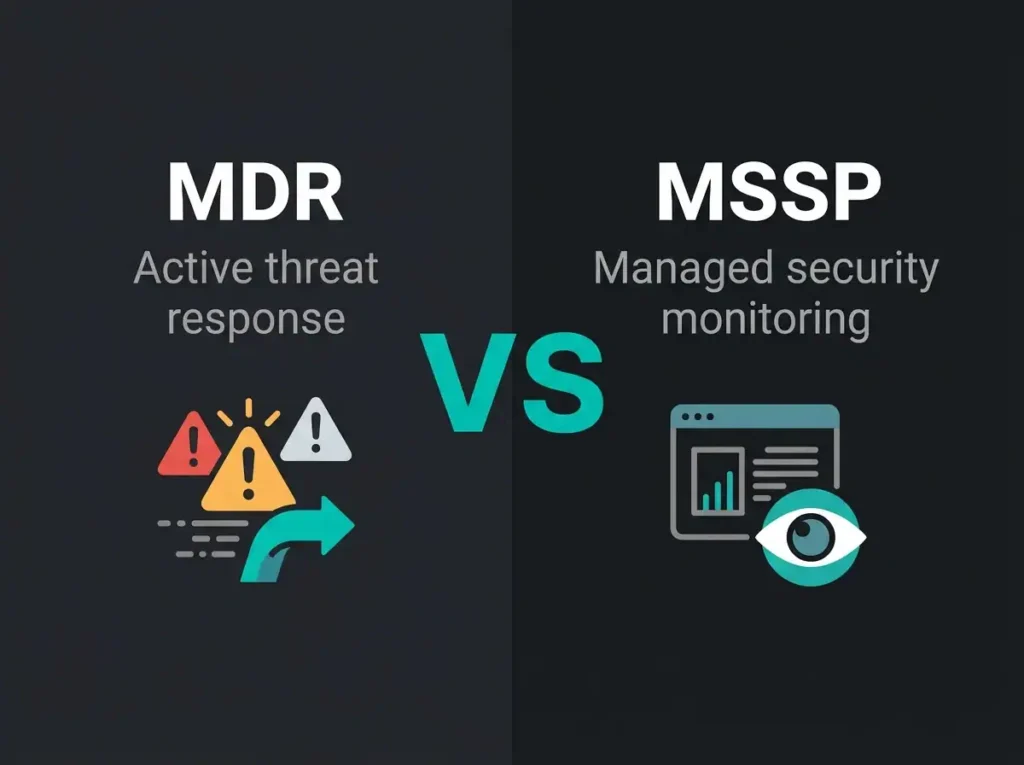
This is the MDR vs MSSP divide in a nutshell: the whole difference between an MSSP and an MDR provider. Both are outsourced security services. One monitors and alerts. The other detects, investigates, and contains. If you assumed “managed security” meant somebody was actually handling threats, the gap between those two is the gap between a text message and a security service.
- Notification versus resolution. An MSSP monitors your stack and forwards alerts; an MDR provider investigates, contains the attack, and briefs you afterward.
- The metrics tell the story. MDR providers are measured on MTTD and MTTR; MSSPs are measured on uptime and alert delivery.
- Response capability has a price tag. IBM’s 2025 breach report found organizations with tested incident response saved $1.49 million per breach on average.
- MDR replaces an unbuildable SOC. Round-the-clock coverage in-house needs 5 to 6 analysts at $500,000 to $800,000+ per year in salary alone.
- Judge by the 2 AM test. If a critical alert gets you an email, you have monitoring; pick an MSSP for compliance breadth, MDR for threats your team cannot handle alone.
What Is an MSSP?
A Managed Security Service Provider (MSSP) runs and monitors your security infrastructure. The model emerged in the late 1990s when ISPs started offering managed firewall services, and it kept growing outward from there. Think of an MSSP as the security equivalent of an MSP: they keep your security tools running, configured, and monitored. For a longer treatment, see our guide on what an MSSP actually does, and if you are weighing that model against building an in-house SOC, our MSSP vs SOC comparison breaks down which fits which business.
Typical MSSP scope:
- Security device management. Firewall administration, VPN configuration, intrusion detection/prevention system management, and endpoint protection deployment.
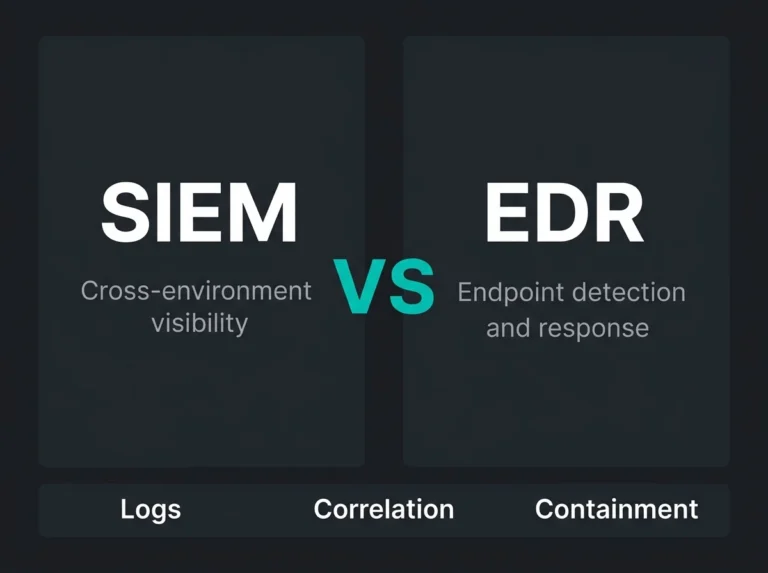
- Log monitoring and alerting. Collecting security logs from across your environment, correlating events, and firing alerts when something looks suspicious. Usually SIEM-based, with platforms like Microsoft Sentinel.
- Vulnerability management. Regular vulnerability scanning, patch verification, and risk reporting.
- Compliance reporting. Documentation and audit trails for frameworks like NIS2, GDPR, ISO 27001, and PCI DSS.
- Security configuration and hardening. Reviewing and strengthening your environment against known attack patterns, including Microsoft 365 configuration baselines.
Most MSSPs work on a shared responsibility model. They provide the tools, the monitoring, and the alerts. When a real threat appears, the response falls to you. The MSSP tells you what happened. Figuring out what to do about it? That’s your job.
What Is MDR?
Managed Detection and Response (MDR) is built on a single premise. Detection without response is just notification.
MDR providers combine technology with human analysts who actively hunt for threats, investigate alerts, and take containment actions when an attack is confirmed. The category emerged because organizations discovered that a SIEM full of alerts did not equal security. According to (ISC)², the global cybersecurity workforce shortage sits at 4.8 million professionals. Most SMBs cannot staff a Security Operations Center, so alerts pile up uninvestigated. MDR fills that gap by selling you the analysts, not just the platform.
Typical MDR scope:
- 24/7 threat monitoring and detection. Real-time analysis of endpoint, network, identity, email, and cloud telemetry by trained SOC analysts. Not just automated rules firing off.
- Threat hunting. Proactive searching for indicators of compromise and attacker behavior the automated rules miss. This is an analyst actively looking, not a system waiting.
- Investigation and triage. When an alert fires, MDR analysts work out whether it’s a true positive, map scope and impact, and document findings. This is the step MSSPs typically skip.
- Active response and containment. Isolating compromised endpoints, blocking malicious IPs, disabling compromised accounts, executing containment playbooks. The provider acts on your behalf rather than notifying you.
- Remediation guidance. After containment, detailed guidance on root cause, affected systems, and steps to prevent a repeat.
The success metric is where this gets interesting. MDR providers are measured on mean time to detect (MTTD) and mean time to respond (MTTR). MSSPs are measured on uptime and alert delivery. Different metrics, different outcomes.
MDR vs MSSP: Key Differences
| MSSP | MDR | |
|---|---|---|
| Primary focus | Security infrastructure management and monitoring | Threat detection, investigation, and response |
| Approach | Preventive and reactive: configure defenses, alert on anomalies | Proactive: hunt threats, investigate alerts, contain attacks |
| Response capability | Alert forwarding. Customer handles investigation and response | Full investigation and active containment by provider’s SOC team |
| Threat hunting | Rarely included. Detection relies on automated rules and signatures | Core capability. Analysts proactively search for hidden threats |
| Technology stack | Broad: firewalls, SIEM, IDS/IPS, vulnerability scanners, endpoint protection | Deep: EDR/XDR, SIEM with custom detection rules, SOAR, threat intelligence feeds |
| Coverage | Often business hours with optional 24/7 add-on | 24/7/365 as standard |
| Compliance support | Strong: audit documentation, regulatory reporting, policy management | Limited: focused on detection/response metrics rather than compliance frameworks |
| Typical pricing | Per-device or per-user monthly fee. Broader scope, lower cost per function | Per-endpoint or flat monthly SOC fee. Narrower scope, higher depth per function |
Alert Forwarding vs Active Response
This is the one that matters. An MSSP notices a suspicious PowerShell execution on a domain controller at 2 AM and sends you an email. An MDR provider notices the same activity, investigates the process chain, determines it’s credential harvesting, isolates the endpoint, blocks lateral movement, and calls you in the morning with a summary of what happened, what they did, and what you need to do next.
The gap between “we sent you an alert” and “we stopped the attack” is where breaches happen. IBM’s 2025 Cost of a Data Breach Report found that organizations with incident response teams and regularly tested plans saved an average of $1.49 million per breach versus those without. MDR gives you that response capability without building it in-house.
Breadth vs Depth
MSSPs cover more ground. Firewalls, vulnerability scans, compliance reporting, security policy configuration, log monitoring. If you want one provider running your entire security infrastructure, an MSSP is built for that scope.
MDR goes deeper on a narrower slice. An MDR provider may not touch your firewalls or run your vulnerability scans, but they will detect the attacker who got past the firewall and is moving laterally through your network. Their mission is specific: find threats, stop them.
Proactive vs Reactive
MSSPs are structurally reactive. They configure defenses and wait for alerts. When a rule triggers, they forward. That model handles known threats with known signatures. It fails against novel techniques, living-off-the-land attacks, and slow-moving adversaries who don’t trip automated detection.
MDR providers are proactive by design. Their analysts conduct threat hunting, looking for evidence of compromise the automated rules haven’t flagged yet. The difference is like checking whether your alarm went off versus walking through your building looking for intruders. Threat hunting catches the attacks signature-based detection misses.
Compliance Support
Here’s one area where MSSPs have the advantage. They’re structured to produce audit documentation, keep compliance dashboards updated, and generate the reports auditors and regulators require. If your primary driver is NIS2 documentation, GDPR audit trails, or ISO 27001 evidence, an MSSP’s reporting discipline is often what you actually need. The same applies to cyber insurance requirements, where documented controls and audit evidence directly affect coverage eligibility.
MDR providers focus on outcomes. Threats detected, incidents contained, MTTD and MTTR trending downward. Some MDR providers offer compliance reporting as an add-on. It is not their core competency and you can feel the difference in the output.
When You Need an MSSP
An MSSP is the right choice when:
- You need broad security infrastructure management. One provider managing firewalls, endpoint protection, vulnerability scanning, and SIEM. Not just threat detection.
- Compliance is the primary driver. Your industry requires heavy audit documentation, regulatory reporting, and policy management. MSSPs are shaped for this work.
- You have internal security resources. Your team can investigate and respond to the alerts the MSSP generates. What you need is better monitoring and tooling, not an outsourced SOC.
- Budget demands broad coverage at lower cost. MSSP pricing stretches further per dollar for organizations that need foundational security management.
When You Need MDR
MDR becomes essential when:
- You lack internal incident response capability. Your team cannot investigate alerts, scope incidents, or contain threats. What you need is someone who will act, not just notify.
- You face sophisticated threats. Advanced attackers using living-off-the-land techniques, fileless malware, and credential-based attacks. Signature-based detection was never going to catch them.
- You need 24/7 coverage you cannot staff. Building a SOC takes a minimum of 5-6 analysts for round-the-clock coverage at $500,000 to $800,000+ per year in salary alone. MDR provides equivalent coverage for a fraction of that cost.
- You’ve had a breach and want to prevent the next one. Post-breach, organizations realize monitoring without response is insufficient. MDR is what closes the gap between detection and action.
- NIS2 requires incident response capability. NIS2 mandates incident detection and response for essential and important entities, with initial notification required within 24 hours. MDR provides the documented response capability that satisfies the requirement.
Do You Need Both?
Most organizations need elements of both. The market is converging anyway. Plenty of MSSPs now sell MDR as a service tier, and plenty of MDR providers have expanded into broader security management. The useful question isn’t “MSSP or MDR?” It’s: “does my provider actually investigate and respond to threats, or just forward alerts?”
A practical model for SMBs:
- Your MSP handles IT operations. Tenant management, helpdesk, endpoint deployment, patching.
- Your MSSP or MDR provider handles security operations. 24/7 monitoring, detection, incident response, vulnerability management, compliance reporting.
- Both coordinate on hardening. The security provider identifies gaps through security assessments. The MSP implements the fixes.
The question worth asking when you evaluate providers is not whether they call themselves MSSP or MDR. It’s what happens at 2 AM when a critical alert fires. If the answer is “we send you an email,” you have monitoring. If the answer is “we investigate, contain, and brief you in the morning,” you have protection.
How Falconer Security Delivers MDR
Falconer Security delivers managed detection and response on the Microsoft security stack. Our SIEM is Microsoft Sentinel, with custom detection rules tuned to each client environment. Microsoft Defender XDR covers endpoint, email, and identity.
Our approach pairs MSSP breadth with MDR depth:
- 24/7 SOC monitoring with human analysts investigating every critical and high-severity alert
- Active threat response. We isolate endpoints, block accounts, contain threats. We don’t just send notifications.
- Proactive threat hunting across Microsoft Sentinel and Defender XDR telemetry
- NIS2 and GDPR compliance documentation built into reporting
- Microsoft 365 hardening based on CISA security baselines and findings from our own assessments
Frequently Asked Questions
What is the main difference between MDR and MSSP?
An MSSP monitors your infrastructure and sends alerts when something is detected. An MDR provider goes further: SOC analysts investigate the alerts, decide whether threats are real, contain active attacks, and deliver remediation guidance. The short version: MSSPs notify you of problems. MDR providers resolve them.
Is MDR more expensive than MSSP?
MDR typically costs more per function, because the price includes human investigation and active response. MDR covers a narrower scope (detection and response) while MSSPs cover broader security management (firewalls, vulnerability scanning, compliance). Total cost depends on what you need. If you don’t have internal incident response capability, MDR’s price tag usually pays for itself against breach risk and against the $500,000 to $800,000+ per year cost of building an internal SOC.
Can an MSSP provide MDR?
Yes. Plenty of MSSPs now offer MDR as an added tier. The market is converging. MSSPs are adding detection and response, and MDR providers are extending into broader security management. When you evaluate a provider, ask specifically about their investigation and response process. Do they have SOC analysts investigating alerts 24/7, or are they relying on automated alerting with your team as the fallback? Our MDR vendor evaluation checklist has a structured scoring framework. The label matters less than the actual capability.
Do I need MDR if I already have a SIEM?
A SIEM collects and correlates security data. It does not investigate alerts or respond to threats. Without trained analysts working the SIEM 24/7, the alerts go uninvestigated. MDR provides the human expertise to actually operate it. Organizations running Microsoft Sentinel often pair it with MDR, which is what makes the SIEM investment worth paying for.
Does NIS2 require MDR?
NIS2 does not specifically mandate MDR. It does require essential and important entities to implement incident handling capabilities. Detection, analysis, containment, recovery, with initial notification within 24 hours. For most SMBs, meeting that bar without MDR or an internal SOC is impractical. MDR provides the documented detection and response capability NIS2 compliance demands.