





Geopolitical Cyber Threats in 2026: What Nordic SMBs Need to Know

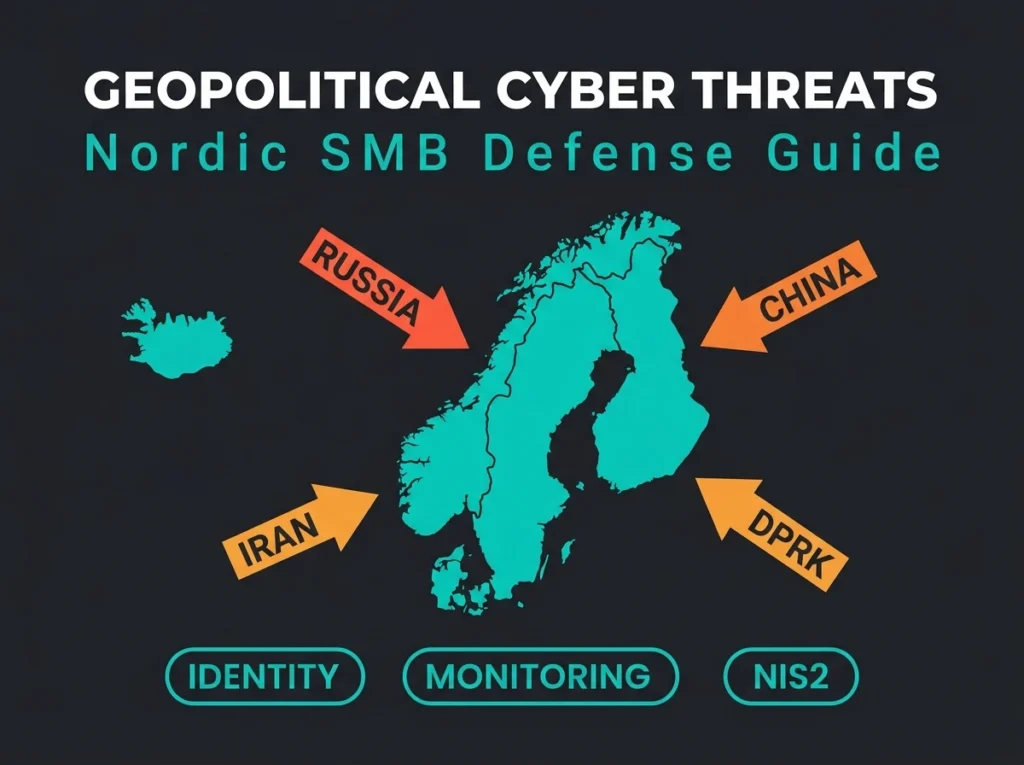
A recurring conversation with Nordic SMBs Falconer Security meets starts with some version of “We’re too small for nation-states to care about us.” In 2026, that’s wishful thinking: geopolitical cyber threats have moved decisively downmarket. State-sponsored groups from Russia, China, Iran, and North Korea are already routing through small and mid-sized businesses to reach bigger prizes, to harvest intelligence, and to grind away at local economies.
The numbers back up the shift. The World Economic Forum’s Global Cybersecurity Outlook 2026 reports that 64% of organisations now factor geopolitically motivated cyberattacks into their risk planning. For Nordic SMBs operating inside NATO’s newest member states, with supply chain ties into critical sectors and advanced technology, that exposure is real and climbing.
- SMBs are now targets. 64% of organisations factor geopolitically motivated cyberattacks into their risk planning, and state-sponsored groups deliberately route through smaller suppliers to reach larger prizes.
- Supply chain risk doubled. Third-party access featured in 30% of confirmed breaches in the Verizon 2025 DBIR, up from 15% the year before.
- Breakout time is 29 minutes. CrowdStrike tracks more than 281 threat actors, and the average gap between initial access and first lateral movement has collapsed to under half an hour.
- Sweden leads Nordic incident counts. DNV Cyber tracked 60 Swedish cyber incidents in 2025, and the Cybersäkerhetslagen (2025:1506) pulls MSPs and managed IT services directly into NIS2 scope.
- Basic controls deflect most campaigns. Phishing-resistant MFA, around-the-clock monitoring, and Microsoft 365 tenant hardening close the gaps that the majority of state-sponsored attacks exploit.
Why Geopolitical Cyber Threats Now Target SMBs
Targeting has drifted downmarket from Fortune 500 firms and government agencies. It didn’t happen by accident. Three bits of strategic logic explain the drift.
Supply Chain Access
Attack the 50-person engineering supplier rather than the defence contractor. It’s a quieter path into the high-value network and the supplier’s security posture is usually thinner. In the Verizon 2025 DBIR, 30% of confirmed breaches involved third-party access (up from 15% the year before, which doubles the problem in a single cycle). Nation-state groups exploit this dynamic on purpose, not as an accident.
Valuable Data with Weaker Defences
SMBs sit on regulated client information, intellectual property, and operational data, but their defences are noticeably lighter than enterprise equivalents. The VikingCloud 2026 SMB threat report puts it starkly: 84% of SMBs self-manage cybersecurity, and 28% admit the person responsible lacks sufficient training. To a state-sponsored adversary, that profile is an open invitation.
Economic and Strategic Disruption
Hitting smaller firms erodes the local economy and doubles as a proving ground for techniques that will later scale up. According to the Orange Cyberdefense Security Navigator 2026, cybercrime now sits “at the epicentre of geopolitical dynamics,” with state actors, criminal crews, and hacktivists swapping tools, infrastructure, and objectives often enough that the labels have started to blur.
The Nordic Threat Picture in 2026
Nordic businesses operate inside a concentrated threat environment. Sweden, Finland, and Norway sit on NATO’s northern flank, which keeps the region in the sights of Russian state-sponsored operations. According to the DNV Cyber Nordic Resilience Report 2026, Sweden absorbed 60 tracked cyber incidents in 2025. Finland absorbed 44. Denmark, 41. Norway, 21. The gap is not small.
What Nordic SMBs deal with today lands at the intersection of several forces. Geopolitical tension is driving state-sponsored activity upward. NIS2 has widened the definition of “essential” and “important” organisations, pulling more mid-sized firms into scope. And the wider cybersecurity workforce shortage makes a meaningful in-house defence unrealistic for most companies below the enterprise line.
Key Finding: one in five Swedish citizens says cyber incidents have affected their everyday life, per DNV Cyber’s 2026 research. The blast radius reaches well past IT teams into day-to-day business and public services.
Sweden’s National Cybersecurity Strategy 2025 to 2029
In February 2026 the Swedish government published its National Cybersecurity Strategy 2025 to 2029. It rests on three pillars: systematic cybersecurity work, stronger knowledge and skills development, and better capability to prevent and manage incidents. The whole thing is anchored in the NIS2 “all-hazards” view and frames cybersecurity as a national defence matter rather than an IT one.
The Swedish Cybersecurity Act (Cybersäkerhetslagen 2025:1506), which transposes NIS2 into Swedish law, now applies to essential and important entities across energy, transport, healthcare, digital infrastructure, and managed IT services. That last sector is worth sitting with for a moment: MSPs and MSSPs serving Swedish organisations fall directly inside the scope of the law, not outside it.
Four Geopolitical Threat Actors Targeting the Nordics
Which actors are actually active here shapes how you prioritise defence. Below is the working picture most Nordic SOCs deal with.
| Threat Actor | Primary Objectives | Common Tactics | Nordic Relevance |
|---|---|---|---|
| Russia (APT28, APT29, Sandworm) | Espionage, critical infrastructure disruption, political influence | Phishing, supply chain compromise, wiper malware, identity attacks | High: NATO flank, energy infrastructure, government targets |
| China (APT40, Volt Typhoon) | Industrial espionage, pre-positioning in critical infrastructure | Living-off-the-land, credential theft, long-dwell-time intrusions | Medium-High: Technology firms, maritime sector, telecom |
| Iran (APT33, APT35) | Retaliation, economic disruption, intelligence gathering | Destructive malware, ransomware-as-cover, social engineering | Medium: Energy sector, organisations with Middle East ties |
| North Korea (Lazarus Group) | Financial theft, cryptocurrency theft, sanctions evasion | Supply chain attacks, fake job recruitment, cryptocurrency targeting | Medium: Financial services, technology companies |
The CrowdStrike 2026 Global Threat Report now tracks more than 281 threat actors, with 24 fresh groups catalogued in 2025 alone. Average breakout time (the gap between initial access and first lateral move) has dropped to 29 minutes. That is less time than it takes most SOCs to grab coffee and open a ticket.
How State-Sponsored Attacks Reach SMBs
Nation-state groups rarely walk straight at an SMB. The attack chain usually follows one of three well-worn patterns.
1. Supply Chain Compromise
The attacker compromises a software vendor, MSP, or service provider serving multiple SMBs downstream. A single breach at the centre propagates outward to dozens or hundreds of victims who never heard of the attacker. SolarWinds and Kaseya made this model famous. Nordic MSPs that run Microsoft 365 tenants for a client book are exactly this kind of high-leverage target, whether they like it or not.
2. Credential Harvesting at Scale
Phishing campaigns now blanket thousands of organisations simultaneously. According to the Microsoft Digital Defense Report 2025, AI-driven phishing runs three times more effective than the traditional stuff. Once valid credentials are in hand, the attacker logs in rather than breaks in. The perimeter defences you paid for simply don’t see the intrusion.
3. Hacktivist Cover Operations
State-sponsored groups increasingly hide behind hacktivist personas for deniability. DDoS waves hitting Nordic organisations, website defacements, data leaks credited to “hacktivist” collectives: a significant share of this trails back to state intelligence services. The Orange Cyberdefense Security Navigator 2026 documents the convergence of criminal groups, state actors, and hacktivists as one of the defining features of current threat activity, rather than a curiosity at the edges.
What Nordic SMBs Should Do About Geopolitical Cyber Threats
You don’t need a government-sized budget to defend against state-sponsored threats. The inconvenient truth for attackers is that the majority of their campaigns exploit basic gaps: weak authentication, unpatched systems, unmonitored environments. Closing those gaps deflects most attacks no matter who is behind them.
Start with identity
Identity is the front door for state-sponsored groups. The PwC Annual Threat Dynamics 2026 calls identity-centric attacks the defining pattern in current activity. The baseline every organisation should hit: phishing-resistant MFA across every account; conditional access policies that block high-risk locations; monitoring for impossible travel and anomalous sign-ins; and legacy authentication protocols disabled everywhere they still lurk.
Microsoft Entra ID conditional access sits inside Microsoft 365 Business Premium, so most Nordic SMBs already have the toolkit without having to go and buy it.
Monitor around the clock
State-sponsored attackers operate outside business hours on purpose. If your monitoring stops when the office lights go off, you are blind during the hours these groups are most active, which is exactly the design goal of their tradecraft. A managed SIEM service built on Microsoft Sentinel gives you continuous monitoring, detection, and automated response across the Microsoft stack without standing up an internal SOC.
Harden the Microsoft 365 tenant
Most Nordic SMBs live inside Microsoft 365, so tenant hardening is the layer where small choices compound. The usual gaps: overly permissive sharing, audit logging turned off or never turned on, and security defaults that quietly leave doors ajar. A structured Microsoft 365 security assessment surfaces and closes these before an attacker does the inventory for you.
Manage supply chain risk
Every third-party vendor with access to your environment is a potential entry point. Vet them for security maturity, keep administrative access at the minimum the integration actually needs, and wrap privileged access in PAM. The WEF Global Cybersecurity Outlook 2026 found that CEOs of highly resilient organisations embed security inside procurement processes (70%) and prioritise supplier maturity assessments (59%). The rest mostly discover supplier risk during an incident, which is the expensive way.
Build and test incident response
When a geopolitically motivated attack lands, the speed of the response decides the damage. With breakout time at 29 minutes on average, organisations need written incident response plans that have actually been tested through tabletop exercises. A vCISO service builds and maintains the capability without carrying the cost of a full-time security executive on payroll.
NIS2 and Geopolitical Risk: The Regulatory Connection
NIS2 is not a paperwork exercise. It was written in direct response to geopolitical cyber risk. The directive asks organisations in essential and important sectors to implement risk management measures that cover “all hazards,” and state-sponsored threats are squarely inside that scope.
For Swedish SMBs, NIS2 compliance today means a handful of practical obligations. You need security monitoring and incident detection (where managed Sentinel delivers direct value). You need incident reporting capability that hits the 24-hour initial notification requirement. You need supply chain risk assessments across your ICT service providers. And you need business continuity planning that takes cyber incidents seriously rather than treating them as an IT annex.
Organisations that treat NIS2 as a checkbox miss the point. The regulation exists because the threats it describes are real, growing, and require structured defensive responses that the market was not producing on its own.
The Role of Managed Security in Geopolitical Defence
Defending against state-sponsored threats requires capabilities most SMBs cannot build internally. Twenty-four-hour monitoring. Threat intelligence integration. Detection engineering. Rapid incident response. That is what managed security service providers exist to deliver.
Falconer Security provides Microsoft-native managed security services built for exactly this type of threat activity. Our managed detection and response service combines continuous Microsoft Sentinel monitoring with expert threat hunting and incident response. Nordic SMBs get security operations capability at the level geopolitical threats demand without standing up an internal SOC.
Frequently Asked Questions
Why would nation-states target small businesses?
Nation-state groups target SMBs for supply chain access into larger organisations, for valuable intellectual property and regulated data, and for economic disruption. Automation and ransomware-as-a-service have made mass targeting cheap, which has quietly retired the “too small to target” assumption.
How does the Russia-Ukraine conflict affect Nordic businesses?
Nordic countries on NATO’s northern flank face elevated risk from Russian state-sponsored cyber operations. Sweden recorded 60 tracked cyber incidents in 2025. Russian groups target energy infrastructure, government agencies, and organisations supporting Ukraine, with spillover effects rippling through supply chains.
Does NIS2 require SMBs to defend against nation-state attacks?
NIS2 asks organisations in essential and important sectors to implement risk management measures covering “all hazards,” which explicitly includes state-sponsored threats. The Swedish Cybersecurity Act (Cybersäkerhetslagen 2025:1506) transposes these requirements into Swedish law and applies across energy, transport, healthcare, digital infrastructure, and managed IT services.
What security controls are most effective against geopolitical threats?
Phishing-resistant MFA, around-the-clock security monitoring, endpoint hardening, and supply chain risk management block the majority of state-sponsored attacks. These controls target the actual tactics nation-state groups rely on: credential theft, phishing, supply chain compromise, and exploitation of environments nobody was watching.
Can SMBs afford to defend against nation-state threats?
Yes. Managed security services provide enterprise-grade detection and response at a fraction of the cost of building internal SOC capabilities. Most nation-state attacks exploit basic security gaps that are inexpensive to close: MFA, patching, monitoring, and access controls. A focused, risk-based approach delivers outsized protection regardless of company size.