





SOC Vendors: How to Compare and Choose

Most SOC vendor lists are written by SOC vendors. You already know how those end. The author’s own service wins. Pricing stays vague. The awkward trade-offs never make it into the comparison table, and the reader walks away having learned nothing that survives the first real procurement meeting.
A buyer’s lens is different. If you run IT at a Swedish mid-market firm, or you’re the owner of an MSP trying to decide who actually watches the alerts at 03:00, the questions you want answered are uncomfortable ones. Can this provider monitor my environment without a three-month onboarding? Will they investigate a fifty-alert cluster on a Sunday morning, or will they page me to do it? Do they fit the stack I already paid for? That third question is the one most vendor comparisons quietly skip past.
Two numbers are worth keeping in mind before you meet anyone. Microsoft’s 2025 Digital Defense Report attributes 28% of the breaches Microsoft Incident Response investigated to phishing or social engineering. IBM’s Cost of a Data Breach Report 2025 puts the global average breach cost at $4.44 million. Picking the wrong SOC vendor is not a procurement nuisance. It is operational risk that lands on a balance sheet.
This guide compares SOC vendors the way a buyer needs to compare them. It is aimed at organisations in Sweden and the Nordics running Microsoft 365, Defender XDR, and Sentinel, because that is where most of our assessments end up. If you are still working out the service model itself, read the guides to SOC as a Service vs MSSP, managed SIEM vs MDR vs MXDR, and SIEM vs SOC first.
- Stack fit beats brand. If you already own Microsoft 365, Defender XDR, or Sentinel, the best SOC vendor is the one that operates those tools properly, not the one selling parallel infrastructure.
- The stakes are on the balance sheet. IBM’s 2025 report puts the average breach at $4.44 million, and Microsoft attributes 28% of investigated breaches to phishing or social engineering.
- Verdicts by buyer type. Huntress fits lean SMBs, Arctic Wolf suits mid-market concierge buyers, CrowdStrike Falcon Complete only pays off if Falcon is already deployed, and Sophos MDR coverage depends entirely on the tier you buy.
- Response authority goes in writing. Pin down before the contract whether the provider can isolate hosts, disable accounts, revoke sessions, and block IOCs without calling you first.
- Demand two matching references. A vendor that cannot name two recent customers of your size and stack is guessing about your deployment.
What good SOC vendors actually do
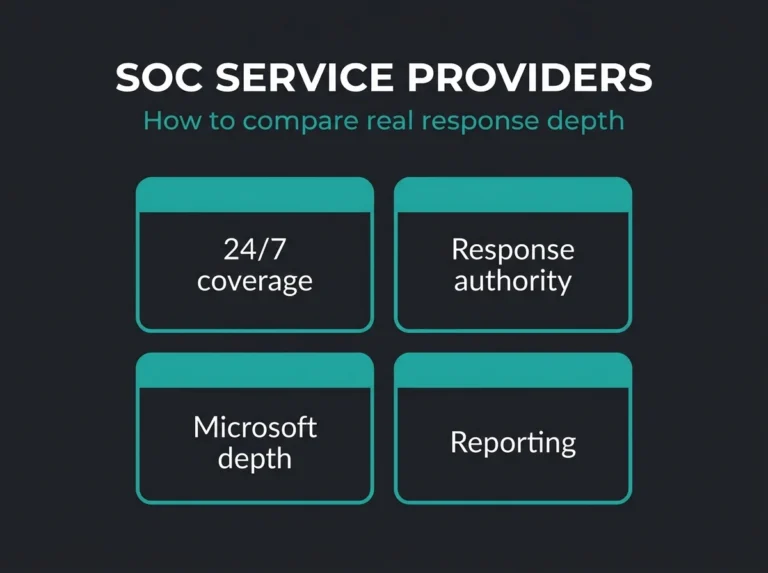
Forwarding alerts is not a SOC. A SOC vendor is the bundle of four things: people who know what a real alert looks like, a process disciplined enough to survive a Friday night, telemetry broad enough to see what matters, and response authority signed in writing before the incident starts. Get any one of those wrong and the contract value drops to zero the first time you need it.
This matters more when internal teams are already thin. ISC2’s 2025 Cybersecurity Workforce Study says skills and staff shortages continue to raise cyber risk and challenge business resilience. Most mid-market companies that get hit badly are not tooling casualties. They are staffing casualties, and a SOC vendor is supposed to absorb that staffing gap.
Five questions tend to separate the real providers from the polished ones.
- Which telemetry do they actually cover, and can they prove it with a live example from another client?
- Do they investigate alerts or just escalate them? An email saying “we saw activity” is not investigation.
- What response actions can they execute without calling you first? Host isolation, account disable, session revoke, IOC block.
- How visible is the work? You should be able to read an analyst’s note from a 04:00 Tuesday investigation without filing a ticket.
- Does the service fit the stack you already run? Replacing a working Microsoft deployment to accommodate a vendor is usually a signal to walk.
SOC vendors compared: best fit by buyer type
| Vendor | Best fit | Service model | Stack fit | What to watch |
|---|---|---|---|---|
| Huntress | SMBs and lean IT teams | Managed SOC with strong human support | Best where endpoint and M365 protection are central | Not the broadest option for complex multi-tool enterprises |
| Arctic Wolf | Mid-market teams wanting concierge guidance | MDR and outsourced security operations | Works across endpoint, cloud, and network telemetry | Response ownership and data access should be clarified early |
| CrowdStrike Falcon Complete | Large organisations standardised on CrowdStrike | 24/7 MDR with platform-native response | Strongest if Falcon is already deployed | Often expensive and less attractive for Microsoft-first SMBs |
| Sophos MDR | SMBs and mid-market buyers needing packaging flexibility | 24/7 MDR with multiple response modes | Good for mixed environments, especially with Sophos tooling | Tier differences matter: confirm exactly what response is included |
| Falconer Security | Microsoft 365 and Sentinel-centric SMBs and MSPs | Managed SOC layered on Defender XDR and Sentinel | Best when you want to maximise existing Microsoft investment | Less relevant if you want a non-Microsoft-first operating model |
How the leading SOC vendors differ
Huntress
A hundred threat experts. Four million endpoints. Under one percent false positive rate. Those are the numbers Huntress puts on its 24/7 SOC page, and to be fair, I have seen the analyst notes. They tend to be readable, specific, and free of the templated filler that makes most ticket systems hostile to busy IT managers. For a 40-person firm with a stretched generalist running everything, Huntress earns its keep on M365 and endpoint telemetry alone. The edge cases appear once you want visibility deep into custom SIEM log sources or a regulated compliance estate. Ask where their coverage stops, not where it starts.
Arctic Wolf
The word Arctic Wolf uses for itself is “concierge,” which in practice translates to a named human you can call and a provider that tries to improve your maturity as well as watch your queue. The official MDR page lines up neatly with what mid-market companies ask for after their first incident. Sit alongside my tools. Do not rip anything out yet. Tell me what to fix next quarter. Buyers often skip two questions they’ll regret missing later: who owns the containment decision, and what access do you retain to your own telemetry when the contract ends?
CrowdStrike Falcon Complete
If Falcon is already the centre of gravity, CrowdStrike‘s own 24/7 MDR is the path of least friction. One vendor, one tightly integrated platform, autonomous response at scale, full-cycle remediation. The trouble starts when Falcon is not already the centre of gravity. A Microsoft-heavy mid-market buyer who signs up for Falcon Complete is not buying a SOC. They’re buying a tooling migration with a SOC bolted on the far side of it, and the Microsoft licensing does not magically refund itself.
Falconer Security
Our own pitch is the least neutral thing in this list, so you should read it accordingly. Falconer Security is built for firms already running Defender XDR, Microsoft 365, and Sentinel, or planning to build around them. The operating model is not “replace your platform.” It is “operate what you already paid for properly”: widen telemetry coverage, tune detections until the noise stops, cut the Sentinel ingestion waste that everyone’s inherited deployments carry, and put human analysts behind the alerts with containment authority agreed up front. The fit is wrong for firms whose primary stack is anything else.
Sophos MDR
Packaging flexibility is the thing Sophos does better than most of its peers. The service combines AI-assisted detection with human analysts, multiple tiers, and a choice of how much authority you hand over. That last point is what makes Sophos easy to shortlist for SMBs that want the option to start conservative and expand. It’s also the exact spot where due diligence gets sloppy. Two buyers on the same Sophos MDR logo sheet can have wildly different response coverage depending on which tier they bought. Read the SKU, not the brochure.
What most SOC vendor comparisons miss
Tool fit. That’s the omission. Most comparison roundups imagine a buyer with a blank environment and a generous budget, which is not a real buyer. If you already own Microsoft 365 Business Premium, E5 Security, Defender for Endpoint, or Microsoft Sentinel, the “best” SOC vendor for you is often the one that can operate those tools properly, not the one that wants to sell you parallel infrastructure.
Nordic buyers have a second consideration the American comparison sites ignore. NIS2 does not hand you a product list, but it does push regulated and important entities into stronger incident handling, visibility, governance, and supplier oversight. On our assessments, providers that can’t produce a plausible escalation playbook on request are the same ones who later struggle to hand over clean evidence when the regulator wants to see it. A polished sales demo does not survive a real incident report audit.
For Microsoft-aligned organisations, there are real advantages to picking a partner fluent in cloud-native SIEM operations, Defender XDR telemetry, and the commercial realities of Sentinel ingestion. That is usually a better use of budget than paying for an overlapping platform. Before committing to any vendor-led architecture decision, read the Microsoft Sentinel pricing and cost optimisation guide.
How to shortlist SOC vendors without wasting a quarter
Use a scorecard before any sales call. It keeps the conversation honest, forces like-for-like comparisons, and stops demo theatrics from pulling you off-course.
Score the telemetry coverage first, everything else second
Write down every log source that actually matters in your environment: endpoint, identity, Microsoft 365, Azure, firewall, email, SIEM. If a vendor cannot monitor the sources you care about, the rest of their capability doesn’t matter. Stop the evaluation there.
Define response authority in writing
What can the provider do without calling you first? Isolate a host. Disable an account. Block an IOC. Kill a process. Quarantine an email. Revoke a risky session. If any of those answers are vague or “case by case,” the service is lighter than the marketing says. Pin this down before the contract, not after the breach.
Platform-native or platform-overlay?
Neither model wins automatically. A platform-native provider moves faster because they control the product they’re operating on. An overlay provider gives you flexibility when your stack is heterogeneous. The right pick depends on what you already own and how sticky the existing contracts are.
Inspect the operating model, not the dashboard
Ask to see a real incident timeline. Analyst notes. Escalation workflow. Customer reporting cadence. Dashboards are cheap. A disciplined operating model is the thing you’re actually paying for, and it’s the thing a slide deck cannot fake.
Regional and regulatory fit
For European buyers: evidence retention, incident communications, data residency, supplier accountability. Ask how each of these works in practice, not just whether it is “supported.” The answer tells you whether the provider has done this before or is about to learn on your incident.
One last check, and it’s the one that filters the shortlist fastest. Ask each vendor for two recent customer examples matching your environment size and stack. A provider who is excellent for a 5,000-seat enterprise can still be the wrong fit for a 150-seat Microsoft-first business with one stretched IT manager. If they cannot name two similar customers, they are guessing about your deployment.
The Falconer view: what makes the best SOC vendor for Microsoft-centric SMBs
For SMBs and mid-market firms in Sweden, the best SOC vendor is rarely the biggest logo on the shortlist. It’s the one who can run the stack you already own, close the detection gaps you already have, and give you usable response coverage without dragging you through a platform replacement first.
Microsoft-native delivery keeps making sense for this market because the telemetry footprint is hard to match: identity, endpoint, email, cloud, all in one signal graph. The tooling only earns its cost when someone is actively operating it. A strong provider combines managed SIEM services, managed detection and response, and practical guidance around Microsoft 365 security assessment work. They sell you operating discipline, not another console.
If you are comparing SOC vendors this quarter, lead with service model and stack fit. The brand comes after.
FAQ: SOC vendors
What is the difference between SOC vendors and MDR vendors?
The overlap is heavy. Plenty of SOC vendors deliver their service as MDR, and plenty of others call it SOC as a Service. The useful distinction is operational scope: what telemetry they monitor, how they investigate incidents, and whether they can respond directly without waiting on a customer ticket.
Which SOC vendors are best for Microsoft environments?
Microsoft-heavy buyers get the cleanest outcome from providers that can operate Defender XDR and Sentinel deeply, rather than bolting a separate platform on top. Fewer duplicate tools, and usually better visibility across Microsoft 365, identity, endpoint, and cloud events.
Do SOC vendors include incident response?
Some do, some do not. Many vendors investigate and contain routine threats but treat major incident response as a separate retainer or add-on. Always check what’s included in the base service and what triggers extra cost, because discovering this mid-incident is expensive.
How should Nordic companies evaluate SOC vendors under NIS2?
Documented processes. Clear escalation paths. Evidence retention. Supplier accountability. Reporting discipline. NIS2 is not a product checklist, but it rewards operational maturity and traceable incident handling, and punishes the opposite.
Should you replace your existing tools when buying a SOC service?
Not automatically. If your Microsoft or EDR tooling is solid, replacing it just to buy a SOC adds cost and disruption. In most cases the smarter move is picking a provider who can operate the stack you already have.