





What Is a vCISO? Virtual CISO Explained for SMBs

Sensitive client data, Microsoft 365 everywhere, NIS2 deadlines on the wall calendar. You already know you need security leadership, ideally from a vCISO. A full-time Chief Information Security Officer runs €200,000 or more before benefits, and for most SMBs that number doesn’t work.
That gap is what the virtual CISO role is for. At Falconer Security we run vCISO engagements for SMBs and mid-market companies who want executive-level security ownership without carrying a full-time hire on the org chart.
Below: what the role is, how the work actually breaks down day to day, what you should expect to pay, and the signals that tell you it’s time to hire one.
- Retainer beats salary. A vCISO runs €3,000 to 12,000 per month against €200,000 to 350,000+ per year for a full-time CISO, roughly 20-40% of the fully loaded cost.
- Typical SMB engagements. Most Falconer Security vCISO clients pay €4,000 to 8,000 per month for security strategy, NIS2 guidance, Microsoft 365 oversight, and quarterly board reporting.
- NIS2 expects a named lead. The directive demands documented security governance with penalties up to €10 million or 2% of global turnover, and a vCISO fills the named role without a full-time hire.
- Strategy is not operations. A vCISO sets direction and owns compliance; pair it with MDR or managed SIEM for 24/7 detection and response, because neither does the other’s job.
- Speed is part of the value. A vCISO starts in days to weeks, while hiring a full-time CISO typically takes three to six months.
What is a vCISO?
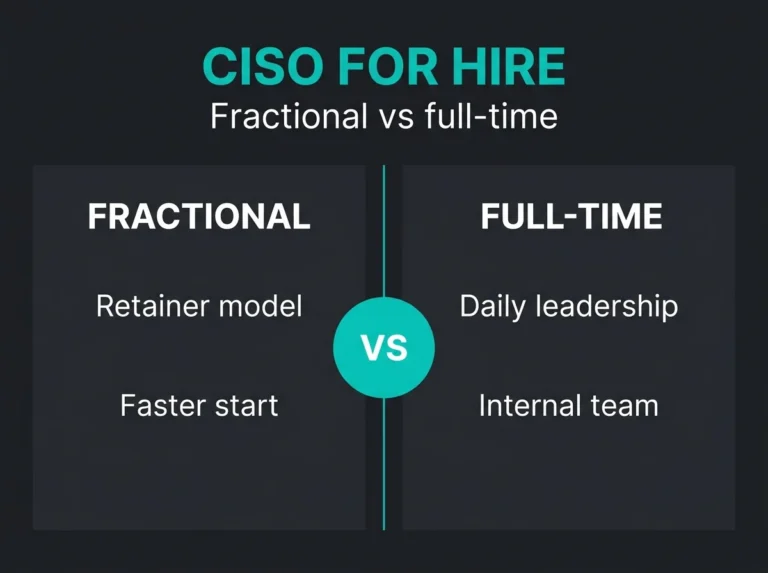
A virtual CISO is an outsourced cybersecurity executive running your security strategy part-time, on contract, or fractionally. Some firms call the role a fractional CISO. Others call it an outsourced CISO. Same job as the full-time version: risk management, compliance, building the programme, reporting to the board.
The engagement is what changes. A full-time hire costs €200,000 to €350,000 in salary (then benefits, then equity). A vCISO is a retainer. Typical range sits between €3,000 and €12,000 a month, scope-dependent.
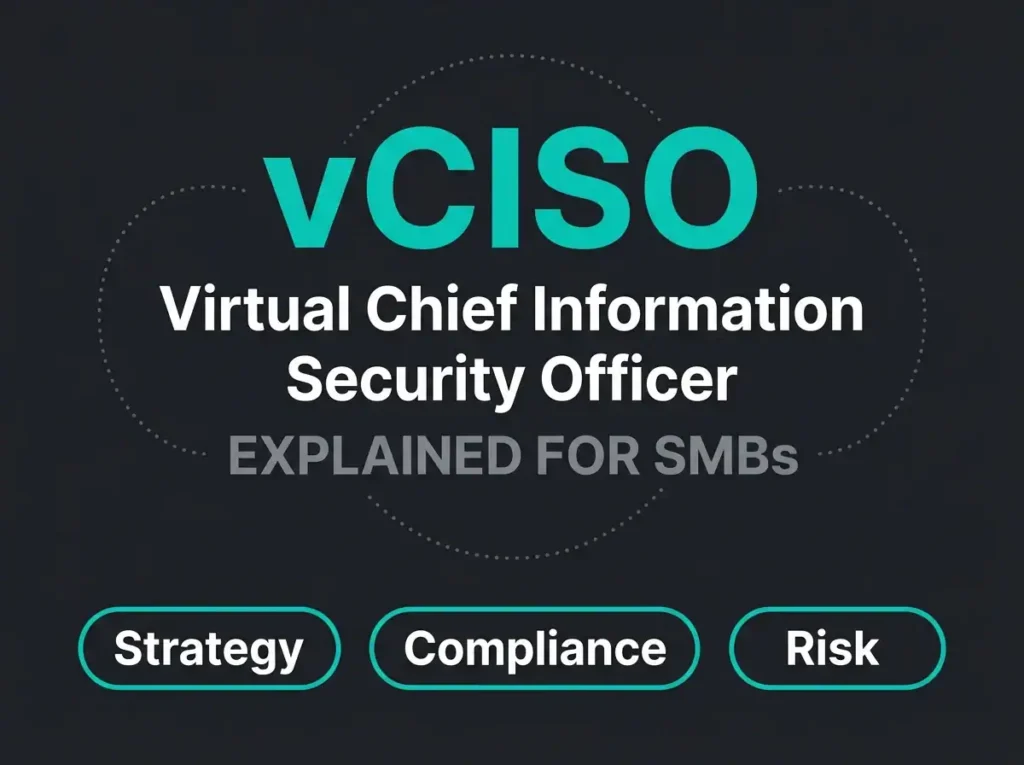
A virtual CISO (vCISO) is an outsourced cybersecurity executive who provides strategic security leadership, compliance guidance, and risk management on a flexible, fractional basis. Falconer Security delivers vCISO services tailored to SMBs working through NIS2 compliance and Microsoft 365 security.
vCISO vs full-time CISO: key differences
Most of the responsibility column looks identical. What moves is the delivery.
| Factor | Full-Time CISO | Virtual CISO (vCISO) |
|---|---|---|
| Annual cost | €200,000-350,000+ | €36,000-144,000 (retainer) |
| Hiring timeline | 3-6 months | Days to weeks |
| Availability | Full-time, single organisation | Part-time, scheduled hours |
| Industry breadth | Deep in one organisation | Cross-industry experience |
| Scalability | Fixed cost regardless of need | Scale hours up or down |
| Compliance expertise | Varies by individual | Often multi-framework (NIS2, ISO 27001, GDPR) |
| Board reporting | Yes | Yes |
| Best for | Large enterprises (500+ employees) | SMBs, mid-market, growing companies |
Per the ISC2 2025 Cybersecurity Workforce Study, 33% of organisations can’t fund the headcount their security teams need, and 29% can’t pay the rates required to hire the skills they need. The vCISO arrangement is a workable answer for companies sitting in that bucket.
What does a vCISO actually do?
Six areas. How the clock gets divided among them depends on the state of your current programme when we walk in.
1. Security strategy and roadmap
First job: look at where the security posture actually sits today, name the gaps honestly, then build a prioritised roadmap. Not a generic framework checklist. A plan tied to your actual business risks, your regulatory obligations, and whatever budget you can realistically sign off on.
In Microsoft 365 shops that usually means a pass over your M365 security configurations, Entra ID conditional access, and Defender XDR coverage.
2. Risk assessment and management
Run regular risk assessments so you find the vulnerabilities before attackers or auditors do. The vCISO maintains the risk register, ranks items by business impact, and reframes technical risk in language the executive team can actually act on.
3. Regulatory compliance
NIS2, GDPR, ISO 27001, sector-specific rules. All of them expect documented security programmes. Your vCISO maps the existing controls against whichever framework applies, identifies the gaps, and steers the remediation work.
For Swedish and Nordic companies, NIS2 is the main pressure point right now. It covers essential and important sectors, requires cybersecurity risk management measures, and comes with penalties up to 2% of global annual turnover or €10 million.
4. Security policy development
Acceptable use. Incident response. Access control. Data handling. Third-party risk. Someone has to draft those policies, keep them reviewed, and update them when either the threat picture or the regulation moves. That’s the vCISO.
5. Incident response planning
When something goes wrong, how fast you react determines how expensive it gets. Your vCISO writes the incident response plan, runs the tabletop exercises, sets escalation and communication paths, and makes sure the staff can actually execute when the pressure is real.
The IBM Cost of a Data Breach Report 2025 puts the global average breach cost at $4.44 million. Organisations that had tested their IR plans landed well under that average. In our experience that gap tends to close or widen based on one specific thing: whether the plan has been rehearsed, not just written.
6. Security awareness training
Phishing still gets in the door more than anything else. The Verizon 2025 DBIR puts stolen credentials at 88% of system intrusion breaches. A vCISO builds the awareness programme, runs the phishing simulations, and turns the workforce from the softest target into part of the defence.
When does your organisation need a vCISO?
Not every company does. Five situations where the investment earns back its retainer.
You have NIS2 or other compliance deadlines
NIS2 expects documented cybersecurity governance with a named security lead. No in-house CISO? A vCISO fills that named role at a fraction of the fully-loaded cost and builds out the compliance programme in parallel.
You’ve outgrown “IT handles security”
Your IT team keeps things running. Security strategy, risk management, and compliance governance are a different trade. The moment security decisions need someone who can sit in a boardroom and translate a risk register, rather than patch a server, you need a vCISO.
You’re preparing for a security audit
Clients, partners, or cyber insurance underwriters have started asking to see the evidence of your security programme. A vCISO builds the audit-ready documentation, puts controls in place, and handles the stakeholder conversations. Our vCISO engagements typically bundle in the Microsoft 365 security assessment so the evidence base is there from week one.
You had a security incident
After a breach, three things need to happen: understand what actually went down, fix the root cause, and make sure it doesn’t repeat. The vCISO runs the post-incident review, tightens the controls that failed, and handles rebuilding confidence with clients and the board.
Your budget doesn’t support a full-time hire
In Sweden, a full-time CISO earns SEK 1.5 to 2.5 million per year before benefits. If your security budget isn’t close to that number, a vCISO gives you executive-level leadership at roughly 20-40% of the fully-loaded full-time cost.
How much does a vCISO cost?
Price depends on engagement scope, company size, and how much regulatory complexity you’re carrying. Three models cover most of the market.
| Pricing Model | Typical Range | Best For |
|---|---|---|
| Monthly retainer | €3,000-12,000/month | Ongoing security leadership |
| Hourly advisory | €200-300/hour | Ad hoc guidance, board presentations |
| Project-based | €5,000-50,000+ | Compliance projects, audit preparation |
For reference: a full-time CISO in North America earns $230,000 to $350,000+ annually according to Glassdoor 2026 salary data. European pay tracks close to that at senior levels. A vCISO retainer at €6,000 to €8,000 per month delivers equivalent strategic output at roughly 30% of the cost.
Falconer Security reports that most SMB vCISO engagements fall between €4,000 and €8,000 per month, covering security strategy, NIS2 compliance guidance, Microsoft 365 security oversight, and quarterly board reporting.
What to look for in a vCISO provider
Not every vCISO service looks the same under the hood. A few things separate actual practitioners from checklist-runners.
Industry-specific experience
Someone who already knows your regulatory terrain (NIS2 for essential services, GDPR for processors, ISO 27001 for enterprise clients) starts producing value in week one. Generic security advice burns months.
Technical depth, not just strategy
Strategy without execution is a slide deck. You want a provider who can actually assess your Microsoft 365 security configuration, look hard at your SIEM deployment, and put specific technical control recommendations on paper, not vague framework gestures.
Clear deliverables and reporting
Monthly reports. Updated risk register. Compliance gap tracking. Board-ready summaries. The vCISO should be demonstrating measurable progress, not handing you comfort.
Integration with your existing team
A vCISO works alongside your IT team, not in place of it. Strategic direction sits with the vCISO. Day-to-day operations stay with the team you already have. If there’s no internal security staff at all, a vCISO pairs well with managed detection and response (MDR) on the operational side.
vCISO vs other security services
The vCISO handles strategic leadership. Everything else on the list below is operational. Knowing which is which tells you where to spend next euro.
| Service | What It Does | Replaces vCISO? |
|---|---|---|
| vCISO | Security strategy, compliance, risk management, board reporting | N/A |
| MDR | 24/7 threat monitoring, detection, and response | Nooperational, not strategic |
| SOC as a Service | Security operations centre monitoring | Nomonitors alerts, not strategy |
| Penetration Testing | Point-in-time vulnerability assessment | Notesting, not leadership |
| Security Assessment | Configuration review and gap analysis | Noassessment, not ongoing governance |
Most SMBs land on a vCISO plus either MDR or a managed SIEM. Strategy and compliance path sit with the vCISO. Detection and response sit with the operational provider. You need both, and honestly neither one does the other’s job well.
Frequently asked questions
What is a vCISO?
A virtual CISO (vCISO) is an outsourced cybersecurity executive who provides strategic security leadership, compliance guidance, risk management, and board reporting on a part-time or fractional basis. The role covers the same strategic functions as a full-time CISO at a fraction of the cost, typically via monthly retainers between €3,000 and €12,000.
How much does a vCISO cost?
Most vCISO engagements cost between €3,000 and €12,000 per month on retainer, compared to €200,000-350,000+ annually for a full-time CISO. Hourly advisory pricing sits at €200-300 per hour. Project-based work for specific initiatives like NIS2 compliance or audit preparation usually lands between €5,000 and €50,000+.
What is the difference between a vCISO and a full-time CISO?
The responsibilities are the same: security strategy, risk management, compliance oversight, policy development, incident response planning, board reporting. What differs is the engagement model. A full-time CISO is a permanent employee tied to one organisation. A vCISO works fractionally or on contract, typically across several clients, which produces cross-industry pattern recognition a single-employer CISO doesn’t get.
Does my company need a vCISO for NIS2 compliance?
NIS2 requires organisations in essential and important sectors to implement cybersecurity risk management measures, including named security governance. The directive doesn’t require the literal CISO job title, but it expects the security leadership functions a vCISO delivers. For companies without an in-house CISO, a vCISO is the most cost-effective way to meet NIS2’s governance expectations.
Can a vCISO work with my existing IT team?
Yes. Strategic direction and compliance oversight belong to the vCISO. Day-to-day operations stay with your IT team. The vCISO mentors the team on security practices, sets priorities from the risk assessment, and keeps technical decisions aligned with business objectives and regulatory obligations.