





CISO for Hire: Fractional vs Full-Time

If you’re searching for a CISO for hire, you’re usually dealing with the same problem: the board wants accountable security leadership, regulators expect oversight, and the internal team is already stretched. Hiring a full-time CISO might be right for some companies. For a lot of SMBs, MSPs, and regulated mid-market teams, it is more role than they can justify every day of the week, especially when the immediate pressure is getting through a security assessment and remediation plan rather than building a full executive department.
A CISO for hire is a contracted security leader who handles governance, risk, policy, executive reporting, and security program direction without joining as a permanent full-time employee. In practice, that usually means a fractional CISO, an interim CISO, or a retained vCISO arrangement.
For most companies under enterprise scale, the real decision is not whether security leadership matters. It does. The decision is whether you need a full-time executive on payroll, or whether a fractional model gives you better coverage for the money you can actually spend.
- A CISO for hire is contracted leadership, not headcount. The model covers governance, risk, policy, and board reporting through a fractional, interim, or retained vCISO arrangement instead of a full-time executive.
- Fractional fits intermittent decisions. Companies with 100 to 800 employees, lean IT teams, and audit or NIS2 pressure usually need direction more than a 40-hour-per-week security executive.
- Go full-time when leadership is a daily job. Multiple regions, an internal security team that needs an executive above it, and regular board engagement all point to a permanent hire.
- Demand concrete deliverables. A useful engagement produces a risk review, a 12-month roadmap with owners, policy cleanup, and board reporting in business terms, not just advisory calls.
- Delay has a price too. IBM puts the average breach at 4.44 million dollars, and the real alternative to hired leadership is usually drift: delayed decisions and a stack nobody steers.
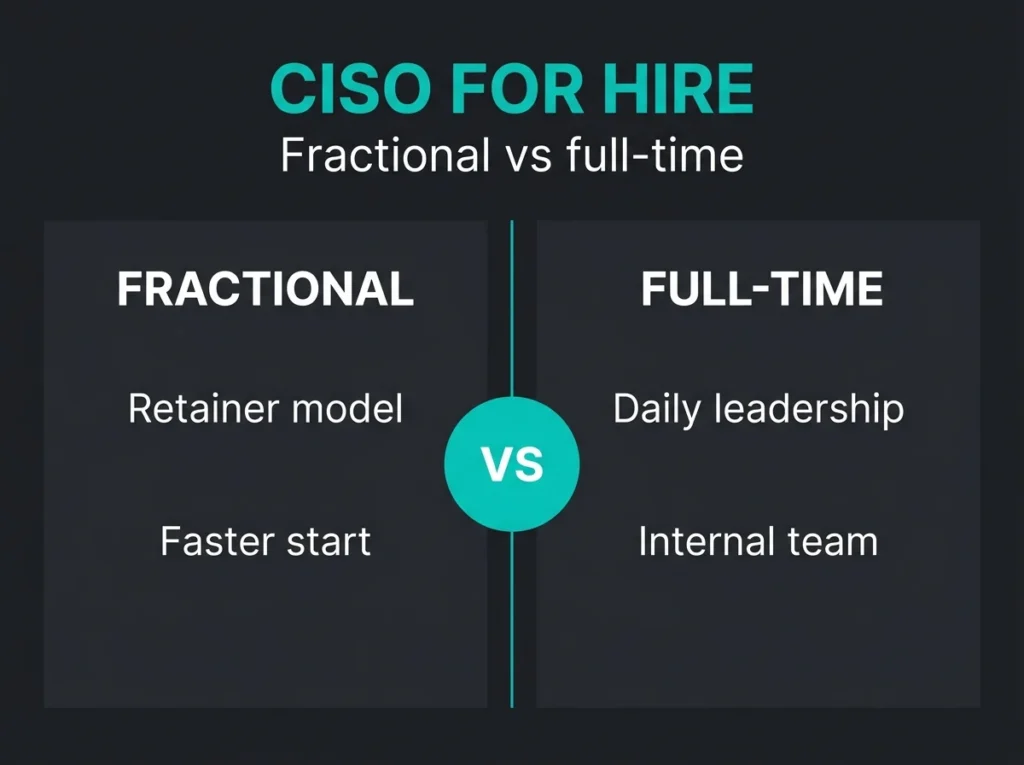
Fractional CISO vs full-time CISO at a glance
| Question | Fractional CISO | Full-time CISO |
|---|---|---|
| Best fit | SMBs, multi-site companies, fast-growing firms, regulated teams that need senior guidance but not a 40-hour-per-week security executive | Larger organizations with complex internal operations, multiple business units, international obligations, or a dedicated security department |
| Cost model | Retainer or part-time engagement with predictable scope | Salary, employer costs, bonuses, recruiting time, and leadership overhead |
| Speed to start | Usually faster, especially when a compliance deadline or incident is driving the need | Usually slower because hiring an executive takes time, internal alignment, and onboarding |
| Scope | Strategy, risk governance, board reporting, roadmaps, policy, vendor review, and program oversight | All of the above plus daily internal leadership, staff management, and deep ownership of security operations |
| When it breaks down | If the company expects daily hands-on operational management from a part-time adviser | If the organization is too small to keep a senior executive fully utilized |
Why companies look for a CISO for hire in the first place
Most companies do not wake up one morning and casually decide to add executive security leadership. Something forces the issue. A customer questionnaire gets more aggressive. Cyber insurance renewals get tighter. A board member asks who owns cyber risk. An acquisition is coming. NIS2 lands on the radar. Suddenly “we have an IT manager who handles security too” sounds thin.
NIST’s Cybersecurity Framework 2.0 puts governance first for a reason. It treats cybersecurity as an organizational risk management issue, not just a technical one. That matters because firewalls and EDR tools do not answer the board’s questions about risk acceptance, policy exceptions, reporting lines, third-party exposure, or who signs off on the roadmap.
There is also a resource problem. According to the 2025 ISC2 Cybersecurity Workforce Study, 33% of organizations say they do not have the budget to adequately staff their cybersecurity teams, and 29% say they cannot afford to hire people with the skills they need. I see that pattern constantly: the company does not lack awareness, it lacks room in the budget for a permanent senior security leader.
Short version: a CISO for hire makes sense when the business needs executive-level security judgment, but does not yet need or cannot yet support a full-time CISO on payroll.
When a fractional CISO is usually the smarter choice
A fractional model works well when the security program needs direction more than headcount. That is common in companies with 100 to 800 employees, a lean IT team, and a pile of obligations that all smell like “leadership” but do not add up to a full executive workload.
Typical cases look like this:
- A company preparing for ISO 27001, NIS2, customer audits, or board scrutiny
- An MSP that needs security leadership, policy governance, and service packaging without building a full security executive function internally
- A Microsoft-heavy business that already has tooling in place but lacks a security roadmap, ownership model, and reporting cadence
- A firm between CISOs after a resignation, acquisition, or reorganization
- A business that needs someone to challenge vendors, review risk decisions, and translate technical issues into business language
The advantage is not just lower cost. It is focus. A good fractional CISO is hired to move specific decisions forward: define the governance model, set priorities, establish metrics, clean up policy sprawl, support procurement, and give executives a sane view of risk. That is often more valuable than hiring a full-time leader too early and then expecting them to invent enough work to justify the seat.
Competitor pages tend to oversell flexibility as the whole story. The better reason is simpler: part-time security leadership works when the business has intermittent high-value decisions, not constant executive security work.
When a full-time CISO is the better call
There is a point where the fractional model becomes too light. If the company has multiple regions, a dedicated internal security team, regular M&A activity, heavy product security requirements, or complex incident response obligations, a full-time CISO starts to look less optional.
You should lean toward a permanent hire if most of these are true:
- You need daily leadership over internal security, compliance, and engineering functions
- You already have managers who need a security executive above them
- Your board expects regular direct engagement and formal reporting
- You are carrying material cyber risk across subsidiaries, manufacturing, healthcare, finance, or critical services
- You need deep internal political ownership, not outside advisory influence
NIS2 pushes this further for in-scope entities. Article 20 of Directive (EU) 2022/2555 says management bodies must approve cybersecurity risk-management measures and oversee their implementation. That does not literally require a full-time CISO, but it does mean leadership accountability cannot be hand-waved away. At some size and complexity level, a permanent executive owner is the cleaner model.
What a good CISO for hire should actually deliver
This is where a lot of buyers get burned. They hire a vCISO and get slide decks. Or they hire a strong technical security person and get no board traction. A useful CISO for hire should leave the company with decisions made, ownership clarified, and a program that feels less chaotic after 90 days than it did before.
At minimum, expect these outputs:
- A current-state risk and maturity review tied to business priorities
- A 12-month security roadmap with sequenced initiatives, owners, and trade-offs
- Policy and governance cleanup, including exceptions and escalation paths
- Board or leadership reporting that explains risk in business terms
- Third-party and procurement input for major security tooling or service decisions
- Support for compliance efforts, insurance renewal questions, and customer security reviews
If the provider cannot explain how they handle prioritization, executive reporting, and accountability, you are probably buying a consultant with a nicer title.
Buyer rule: if you need someone to own governance, direction, and executive communication, hire a CISO for hire. If you need someone to tune alerts all day, that is a different role.
Cost is not just salary: it is timing, focus, and breach exposure
Security leadership decisions usually get framed as salary math. That is too narrow. Delay has a cost too.
The IBM Cost of a Data Breach Report 2025 says the global average breach cost is $4.44 million. The 2026 Verizon DBIR also shows that stolen credentials, phishing, and ransomware still sit right in the center of real-world breach patterns. If the business lacks someone who can push MFA coverage, policy enforcement, vendor review, incident readiness, and accountability across departments, that gap turns into operational risk faster than most finance teams expect.
That does not mean every company should panic-hire a full-time CISO. It means the cost comparison should be honest. The alternative to a part-time security leader is not “free.” It is usually drift: delayed decisions, weak governance, fragmented ownership, and a security stack nobody is really steering.
For many mid-sized firms, a retained model is the bridge that keeps the program moving until the business genuinely grows into a permanent executive hire.
How to decide between fractional and full-time
Use this practical filter.
If you should start with fractional
You need senior leadership, but not daily management. You have compliance pressure, cyber insurance pressure, board pressure, or customer pressure, but the internal security team is small. You need better governance within the next quarter, not a six-month executive search.
If you should hire full-time now
You already have a multi-person security function, the organization is spread across regions or regulated lines of business, and security decisions show up every day at executive level. In that case, renting the role for a few hours a week will start to feel cramped pretty quickly.
If you are in the messy middle
Start with a fractional engagement and define an exit trigger. That might be headcount growth, a post-acquisition integration phase, or a point where the company has enough internal security staff to justify a permanent leader. This is often the least romantic answer, but it is the one that wastes the least money.
Common mistakes when buying CISO services
- Confusing strategy with operations: a CISO for hire should guide the program, not replace your SOC or MDR provider
- Buying vague access instead of concrete deliverables: meeting time alone is not a security program
- Expecting one person to fix governance, compliance, architecture, and daily incident handling at once
- Ignoring cultural fit: if the adviser cannot hold their ground with leadership, the roadmap dies in a drawer
- Picking a provider who only knows one framework or one vendor stack when your business problem is broader than that
If your team is already dealing with compliance, insurance, and customer assurance requests, the provider should be comfortable moving between executive meetings and technical follow-ups without turning either into theater. That sounds obvious. It is not common.
The Falconer view
Falconer Security’s bias is pretty simple: buy the smallest security leadership model that still gives you real accountability. For many SMBs, that means starting with a CISO as a Service engagement, then growing into a permanent hire only when the workload, reporting demands, and internal team structure clearly justify it.
If you are already comparing models, it also helps to understand the adjacent terms people throw around loosely. Our guides on CISO as a Service, what a vCISO actually is, and outsourced CISO trade-offs cover the parts most buyers tend to blur together.
If the driver is regulatory or program maturity rather than title shopping, start with governance. NIST CSF 2.0’s Govern function is still one of the cleanest ways to sanity-check whether the business has actual security leadership or just scattered activity.
FAQ
What does “CISO for hire” usually mean?
It usually means a contracted security leader brought in on a part-time, interim, or retained basis to handle governance, risk, policy, executive reporting, and strategic security decisions without joining as a permanent employee.
Is a fractional CISO the same as a vCISO?
Usually, yes in practical buying terms. Providers may use different labels, but both typically describe an external senior security leader who works with your company on a retained or part-time basis.
When should an SMB hire a full-time CISO instead?
An SMB should look at a full-time CISO when security decisions require daily executive ownership, the company already has an internal security function to lead, or regulatory and operational complexity outgrow a part-time model.
Can a CISO for hire help with NIS2 and customer due diligence?
Yes, if the engagement is scoped properly. A good provider should help management oversee risk measures, improve governance, structure reporting, and support security questionnaires, audits, and compliance workstreams.
What should be included in a CISO for hire engagement?
At minimum: risk review, roadmap, policy governance, leadership reporting, vendor and procurement input, and clear ownership of follow-up actions. If the scope is just advisory calls with no outputs, it is probably too thin.