





Security Operations Center Framework: What SMBs Actually Need

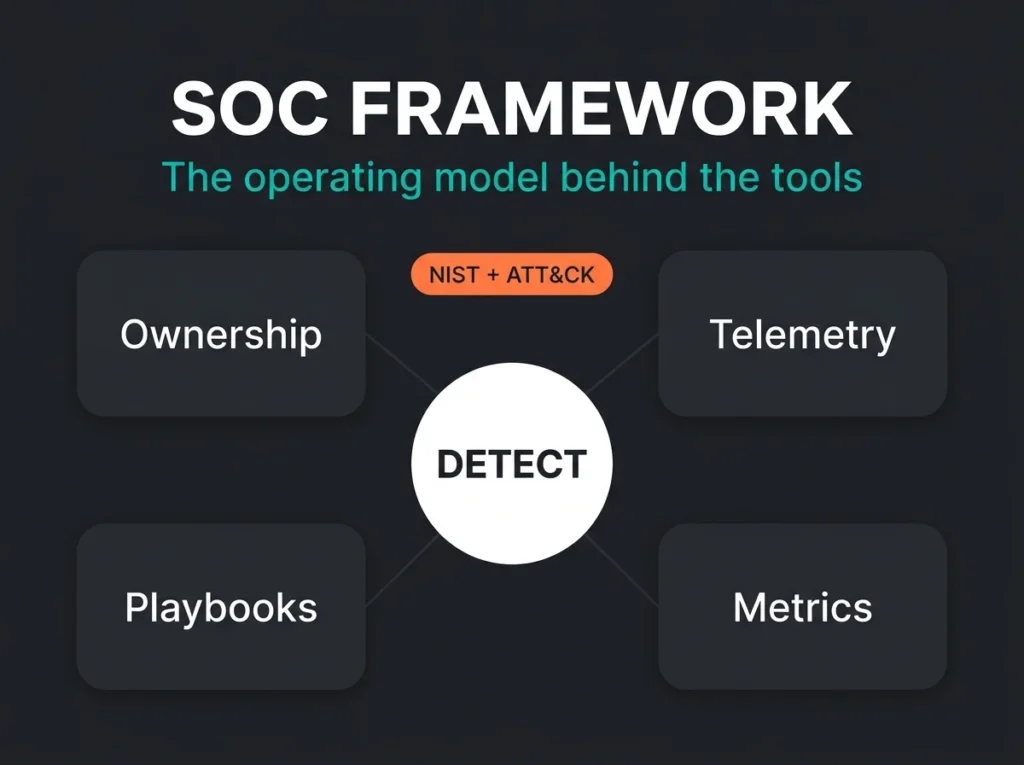
Most companies do not fail at security because they bought the wrong tool. They fail because nobody agreed on how detection, escalation, investigation, and response should actually work once the alerts start coming in.
That is the real job of a SOC framework. It is the operating model behind the tools.
For Falconer Security’s audience, a SOC framework is the documented structure that tells your team what to monitor, which data sources matter, how incidents move from detection to containment, and which controls you map to standards like NIST CSF 2.0 and MITRE ATT&CK. If you run Microsoft 365, Azure, Defender, or Microsoft Sentinel, the framework matters more than the dashboard.
A weak framework gives you noise. A usable one gives you triage discipline, better coverage, and fewer ugly surprises on a Friday afternoon. I see the gap most clearly in midsize environments where the tooling is decent but nobody can answer a simple question: who owns the alert after it fires?
| Question | Weak SOC framework | Usable SOC framework |
|---|---|---|
| Coverage model | “We monitor when people have time” | Named hours, escalation routes, and on-call rules |
| Detection logic | Default rules left mostly untouched | Rules mapped to threat scenarios and business risk |
| Data onboarding | Logs added ad hoc | Priority sources onboarded by attack path and use case |
| Response | Manual, inconsistent, role confusion | Playbooks, approvals, containment paths, evidence handling |
| Reporting | Alert counts with little context | Metrics tied to risk, dwell time, and control gaps |
According to the IBM Cost of a Data Breach Report 2025, the global average breach cost was $4.44 million. That figure matters less as a scare tactic than as a budgeting reminder: messy security operations are expensive. Speed and coordination change outcomes.
CrowdStrike’s 2026 Global Threat Report also notes a fastest breakout time of 27 seconds. You do not build a perfect framework for a 27-second attack. You build one that reduces hesitation, gets the right telemetry in front of the right people, and automates the obvious moves.
- Frameworks are not tools. A SOC framework is the operating model defining ownership, escalation, telemetry, and response; you can own a SIEM and still lack one.
- Borrow from four sources. NIST CSF 2.0 for the management spine, MITRE ATT&CK for detection coverage, NCSC guidance for the operating model, and SOC-CMM for maturity checks.
- Speed is the design target. CrowdStrike reports a fastest breakout of 27 seconds and IBM puts average breach cost at $4.44 million, so the framework must cut hesitation, not add paperwork.
- Start with use cases. Each detection use case should name its ATT&CK techniques, required log sources, severity model, and response path; “enable all rules” is not a strategy.
- Identity comes first on Microsoft. Microsoft-heavy estates need Entra sign-in, audit, and Defender telemetry onboarded before anything else, with identity containment built into playbooks.
What a SOC framework is
A SOC framework is the structure a security operations team uses to detect, investigate, respond to, and learn from threats. That structure covers people, process, telemetry, use cases, escalation, reporting, and continuous tuning.
The formal definitions vary a bit. Google Cloud frames it as the blueprint for how the team operates. The UK’s NCSC SOC guidance puts the emphasis on designing a monitoring capability that is proportionate to the threats faced and the resources available. That second part matters. Plenty of companies copy enterprise SOC diagrams they will never staff properly.
So no, a SOC framework is not a SIEM. It is not an MDR contract. It is not a PDF full of boxes and arrows. It is the agreement between your security goals and your day-to-day operations.
Which frameworks actually matter
The word “framework” gets abused because vendors like turning every product category into a framework. In practice, most SMB and mid-market SOC programs end up borrowing from four sources.
NIST CSF 2.0 gives you the management spine
NIST CSF 2.0 remains the cleanest top-level structure for most organizations. It organizes security work into Govern, Identify, Protect, Detect, Respond, and Recover. For SOC design, that is useful because it stops teams from obsessing over detection while ignoring ownership, communications, and recovery.
If your board asks how the SOC supports business risk reduction, NIST is the language they can usually follow. It is also a sensible anchor for policy, maturity reviews, and service reporting.
MITRE ATT&CK gives you the adversary view
MITRE ATT&CK is the practical layer for detection engineering. MITRE describes ATT&CK as a globally accessible knowledge base of adversary tactics and techniques based on real-world observations. That is why SOC teams use it to map use cases, identify detection gaps, and test whether coverage exists beyond generic malware alerts.
When a SOC says it covers credential access, lateral movement, and exfiltration, ATT&CK helps force a more honest conversation. Show the techniques. Show the log sources. Show the queries. Show the response path.
NCSC guidance is good at operating-model reality
The NCSC material is less flashy than vendor thought leadership, which is exactly why it is useful. It breaks SOC design into operating model, onboarding, detection, threat intelligence, and incident management. That mirrors the real friction points. Log sources are not onboarded because somebody had a nice architecture slide. They are onboarded because they support a threat hypothesis or a business requirement.
SOC maturity models help you avoid fantasy planning
Capability models such as SOC-CMM are useful when you need a maturity lens. They are not a replacement for NIST or ATT&CK. They are a check on whether your current SOC can repeat good work without depending on two tired people who know where everything lives.
What a practical SOC framework includes
This is where competitor articles usually go vague. They list threat intelligence, monitoring, and response, then move on. That is fine for a glossary page. It is not enough for a buyer trying to decide whether their current setup is real or decorative.
An operating model with named ownership
Start with responsibility, not tooling. Who reviews alerts during business hours? What happens after hours? Which incidents can be contained automatically? When does IT take over? When does legal or management get pulled in?
If you cannot answer those questions in plain English, you do not have a framework yet.
- Define coverage hours and on-call arrangements
- Assign incident commander and technical owner roles
- Set escalation thresholds by severity, not by gut feeling
- Document external dependencies such as MSP, IR retainer, or cloud admin
A telemetry plan based on attack paths
The NCSC is right to separate onboarding from detection. Data onboarding is strategy. For Microsoft-heavy environments, that usually means starting with Entra sign-in logs, audit logs, Defender telemetry, Microsoft 365 activity, endpoint data, and cloud control-plane logs before you start hoovering up everything else.
A common mistake: collecting lots of logs that nobody uses while missing identity and privilege telemetry that attackers actually touch. In Microsoft estates, identity almost always deserves first-class treatment.
For companies considering managed SIEM services, this is usually where costs and quality split apart. Better onboarding produces both better detection and cleaner spend.
Detection use cases mapped to ATT&CK and business risk
Good SOC frameworks do not start with “enable all analytics rules.” They start with use cases.
Examples:
- Compromised Microsoft 365 account used for internal phishing
- Privilege escalation in Azure or Entra
- Suspicious OAuth consent or risky app registration
- Ransomware behavior on endpoints tied to identity anomalies
- Data staging or exfiltration from SharePoint and OneDrive
Each use case should name the ATT&CK techniques, required data sources, detection logic, severity model, and expected response actions. That sounds obvious. It rarely exists in smaller environments.
Response playbooks that do not depend on memory
Response quality collapses under stress. Playbooks help because they remove debate from the first few minutes.
A solid playbook defines:
- Trigger conditions
- Validation steps
- Containment actions
- Approvals required
- Evidence preservation steps
- Communication path
- Exit criteria
This is one reason many teams pair a framework with a service model such as managed SOC or SOC as a Service vs MSSP depending on their internal coverage gaps. The framework is the logic. The service is the execution layer.
Reporting that measures operations, not just noise
If the monthly report says “1,842 alerts processed” and nothing else, it is not telling management much. Better SOC framework metrics include time to triage, containment time, false-positive rate, top recurring detection gaps, automation coverage, and incidents by attack path.
For buyer-side evaluation, this is also where vendors expose themselves. If all the reporting is activity theater, keep looking. A stronger benchmark is whether the provider can explain how its service differs from a generic MSSP model and how the operating framework reduces risk in your environment.
How Microsoft environments change the framework
A Microsoft-heavy SOC framework should lean harder into identity, cloud control plane, and cross-product correlation than a generic SOC design.
That means your detection model should connect Entra, Defender, Microsoft 365, and Azure activity instead of treating each console like its own island. It also means your response actions should include identity containment, session revocation, device isolation, mailbox investigation, and cloud configuration review.
For some organizations, managed security services are the only realistic way to maintain that cross-stack view. For others, an internal team backed by MDR support is enough. Either can work. What does not work is assuming the default product integrations equal a finished SOC design.
How to tell if your current SOC framework is thin
Usually the warning signs are boring before they become painful.
- Default detections generate lots of alerts but little confidence
- Log onboarding decisions are driven by convenience instead of threat model
- Escalations rely on Slack messages and memory
- Metrics focus on volume instead of effectiveness
- After-action reviews happen rarely, if at all
- Identity detections are weaker than endpoint detections in a Microsoft estate
If two or three of those sound familiar, the framework probably needs work. If all of them sound familiar, the issue is not staffing alone. The operating model itself is undercooked.
What SMBs should do first
Do not start by searching for the most advanced SOC framework on the internet. Start by shrinking the problem.
Pick the attack paths that would hurt your business most. Build use cases around those. Confirm the logs exist. Confirm the owner exists. Confirm the first response step is documented. Then expand.
That slower approach tends to age better than ambitious one-shot transformations. A tidy framework built around real threats beats a giant framework nobody follows.
NIS2 also pushes in this direction. The directive does not tell you to buy a SOC product. It pushes organizations toward risk management measures, incident handling, and accountability. A documented SOC framework helps translate those broad obligations into repeatable operational work.
FAQ
What is a SOC framework in simple terms?
A SOC framework is the operating model for security monitoring and response. It defines how your team collects telemetry, detects threats, escalates incidents, responds, and improves over time.
Is a SOC framework the same as a SIEM?
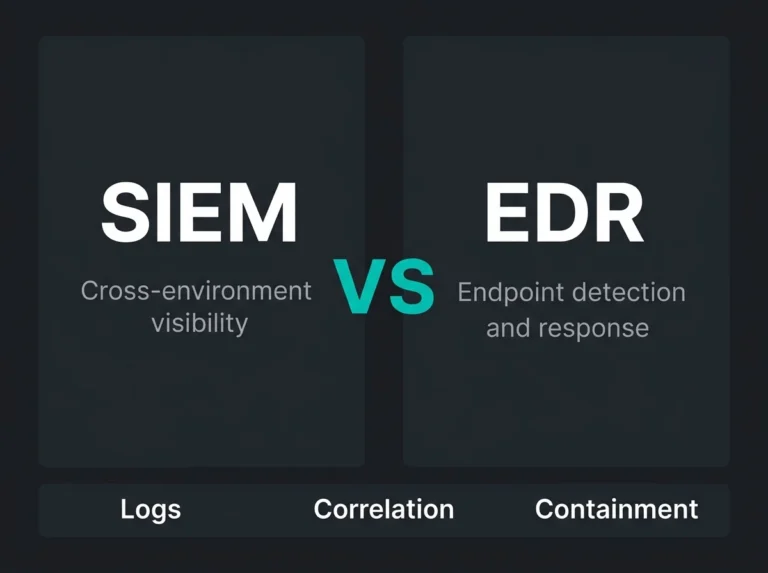
No. A SIEM is a technology platform. A SOC framework is the process and governance structure around detection and response. You can own a SIEM and still have a weak SOC framework.
Which SOC framework should an SMB start with?
Most SMBs should use NIST CSF 2.0 as the top-level structure, ATT&CK for detection coverage, and practical operating-model guidance such as NCSC material for workflow design. That combination is easier to apply than inventing a framework from scratch.
How does NIS2 relate to a SOC framework?
NIS2 is not a SOC blueprint, but it raises the bar for risk management, incident handling, and accountability. A documented SOC framework helps turn those obligations into concrete monitoring and response processes.
When should you outsource part of the SOC?
If your team cannot provide reliable coverage, detection tuning, or incident response depth, outsource the parts you cannot sustain internally. The right mix might be managed SIEM, MDR, or a broader managed security service, but the framework still needs to be defined first.