





vCISO Companies: How to Choose the Right One

If you’re comparing vCISO companies, you’re not shopping for another security tool. You’re looking for judgment. The company you pick will shape your risk register, talk to leadership, pressure-test your controls, and tell you when your current setup is not good enough. For a Swedish or Nordic SMB, that choice gets even more consequential when Microsoft 365, supplier risk, cyber insurance, and NIS2 obligations all collide in the same board meeting.
A strong vCISO company gives you senior security leadership without the lag and fixed cost of a full-time hire. A weak one gives you slide decks, generic maturity scores, and a lot of polite nodding. I’ve seen the difference up close: one approach changes how decisions get made, the other just creates more paperwork.
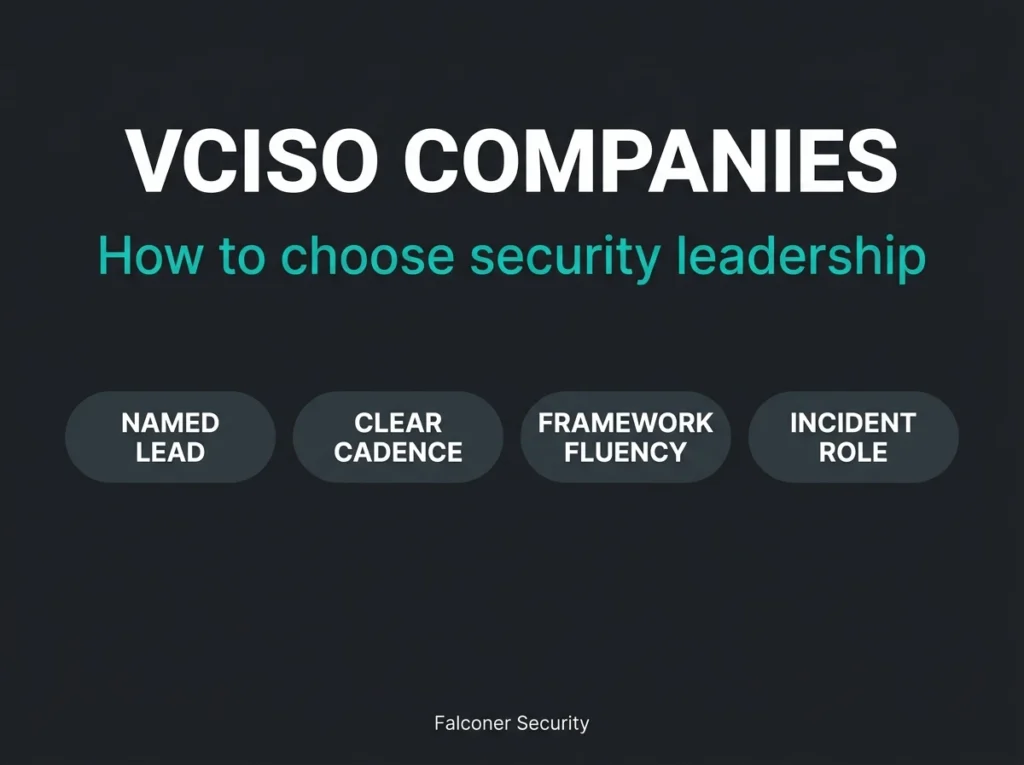
The short version: the best vCISO companies do four things well. They translate security risk into business language, they own a clear operating cadence, they know the frameworks your customers and insurers care about, and they can work inside the Microsoft environments most SMBs already run. If a provider cannot show you how they handle board reporting, incident governance, compliance ownership, and roadmap follow-through, keep moving.
- Buy judgment, not tooling. A vCISO company owns governance, prioritisation, and board communication; an MSSP runs monitoring, and the two roles need clean boundaries.
- Demand a named lead. One accountable senior operator with a clear escalation path beats a rotating bench, especially when an insurer questionnaire lands on a Friday afternoon.
- Insist on a concrete cadence. Strong providers describe the first 30, 60, and 90 days, the meeting rhythm, and the reporting format; “ongoing strategic support” is a red flag.
- Match fluency to your stack. Microsoft-heavy SMBs need providers who know Entra ID, M365, Defender, and NIS2 and ISO 27001 mapping, not generic cloud talk.
- The pressure is real. IBM puts the average breach at $4.44 million and NIS2 makes management bodies explicitly accountable, so waiting for a full-time CISO hire is a bad strategy.
What vCISO companies actually do
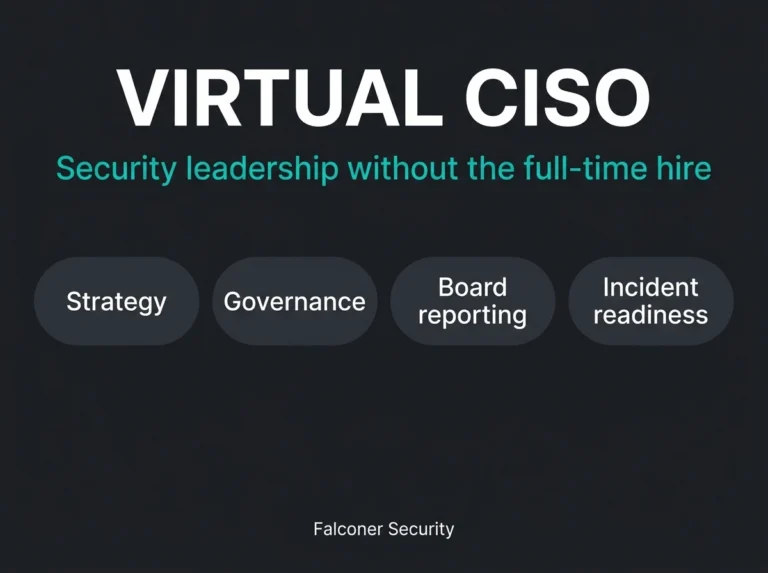
A vCISO company provides fractional or virtual Chief Information Security Officer services. In practice, that means you rent experienced security leadership instead of hiring a full-time executive. The remit usually covers governance, risk assessment, policy direction, security roadmap planning, incident oversight, compliance support, vendor risk reviews, and executive reporting.
That is different from hiring an MSSP or MDR provider. A managed service team watches alerts, runs response workflows, or maintains parts of your stack. A vCISO company is supposed to decide what matters, what gets funded next, what the board needs to hear, and which risks the business is accepting on purpose.
NIST’s Cybersecurity Framework 2.0 centers cybersecurity risk management as a business function, not just a technical one, which is exactly where a good vCISO should operate. If your prospective provider only talks about tools, tickets, and scanners, they’re selling operational support, not security leadership. NIST says the framework is meant to help organizations improve how they manage cybersecurity risk. That is the job.
Why demand for vCISO companies keeps rising
Three pressures keep pushing SMBs toward this model.
First, cyber risk is still expensive. IBM’s current Cost of a Data Breach research puts the global average breach cost at $4.44 million in the 2025 report. That number is not a budgeting formula for a 150-person manufacturer in Sweden, but it does underline the obvious point: waiting until you can justify a full in-house security executive is a bad strategy.
Second, the talent market is still tight. ISC2’s 2025 Cybersecurity Workforce Study describes ongoing staffing and budget pressure across the profession, even if the worst instability has leveled off. In plain English: there still are not enough experienced security leaders available when smaller firms need one. ISC2’s latest workforce study is worth reading if you want a reality check on why security leadership hiring drags.
Third, governance expectations have hardened. Under the NIS2 Directive, management bodies have explicit oversight responsibilities for cybersecurity risk management measures. That matters even for firms still sorting out exact national transposition scope, because customers and partners have already started asking questions as if the answer should be obvious. The NIS2 Directive text makes management accountability impossible to ignore.
How to compare vCISO companies without getting lost in marketing
Most vCISO company comparison pages blur into each other after five minutes. Everyone claims strategic leadership. Everyone says they help with compliance. Everyone promises executive communication. You need a tighter filter than that.
Check whether you get a named senior operator
Do you get one accountable security lead, or a rotating bench? A bench can be useful for specialist depth, but somebody still needs to own the relationship. If nobody is clearly responsible for your roadmap, your incident escalation path, and your board updates, things drift fast.
A named lead also makes accountability easier during rough weeks. That’s not theoretical. When an insurer, auditor, or customer sends a hard questionnaire on a Friday afternoon, you want to know exactly who is answering it.
Ask for the operating cadence, not just the service list
Good providers can describe the first 30, 60, and 90 days in concrete terms. They can explain how risks are logged, how priorities are set, how decisions are escalated, and how leadership sees progress month to month.
Bad providers stay abstract. They say things like “ongoing strategic support” and hope that sounds reassuring. It isn’t. You need a calendar, meeting rhythm, reporting format, and ownership model.
Look for framework fluency that matches your actual world
If your company lives in Microsoft 365, Azure, supplier portals, cyber insurance renewal forms, and customer due-diligence questionnaires, your vCISO provider should be fluent there. Not vaguely familiar. Fluent.
For Nordic SMBs, that often means working knowledge of NIS2 implications, ISO 27001 alignment, Microsoft security controls, and the difference between a policy that exists on paper and a control that actually works. I’ve seen plenty of firms claim compliance support when what they really mean is “we can help you write a policy document.” That’s table stakes.
Test whether they can challenge leadership
This one matters more than most buyers realize. A vCISO company should be able to tell you no. No, that exception should not be permanent. No, that admin model is too loose. No, your MFA rollout is not finished just because the license is assigned.
If every sample deliverable feels frictionless and upbeat, be suspicious. Security leadership is supposed to create some productive discomfort.
Separate governance from monitoring
A lot of businesses need both. They need a vCISO to own governance and a managed security provider to run monitoring and response. Those can come from the same company or from separate partners, but the roles need clean boundaries.
If you already have an MDR or managed SOC partner, a vCISO company should improve that relationship by setting direction and measuring outcomes. If you don’t, they should still be able to define requirements before tools and providers start selling you their favorite architecture. That’s one reason companies often pair vCISO leadership with a broader managed security services model or a focused MDR service.
A practical scorecard for choosing a vCISO company
| Evaluation area | What good looks like | Red flag |
|---|---|---|
| Leadership ownership | Named senior lead with clear escalation path | Shared mailbox model and vague staffing answers |
| Security roadmap | Prioritized plan tied to business risk and budget | Long task list with no sequencing logic |
| Executive reporting | Board-ready summaries, risk language, decision points | Purely technical reports |
| Compliance support | Can map controls to NIS2, ISO 27001, customer requirements | Only offers templates and awareness training |
| Microsoft depth | Understands Entra ID, M365, Defender, Azure governance | Generic cloud talk with no platform specifics |
| Incident oversight | Defined role in escalation, communications, and lessons learned | Waves incident response away to another vendor |
| Measurement | Tracks risk reduction, control progress, open decisions | Reports activity without outcomes |
What the better competitor pages get right, and what they miss
In the current SERP, the ranking pages from Fractional CISO, Cynomi, and SideChannel all do a decent job explaining the model. They emphasize flexibility, lower cost than a full-time hire, and support for compliance. That’s fair. SideChannel is especially clear about service cadence and pricing ranges. Cynomi is strong on category explanation. Fractional CISO leans heavily into team depth.
What these pages usually do not do well is help an SMB buyer separate strategic ownership from nice-sounding support language. They also rarely spend enough time on platform fit. For a Microsoft-heavy business, it matters whether your vCISO company can tie identity, endpoint, email, cloud, and logging decisions into one operating model. If they cannot connect those dots, you’ll end up with guidance that looks polished and behaves like patchwork.
That is also where a Microsoft-specialized provider has an edge. Falconer Security’s CISO as a Service offering is designed for companies that need security governance tied to the controls they already run, not dropped on top as a separate governance theater. The same logic shows up in our posts on what a vCISO actually does and how outsourced CISO support compares to in-house hiring.
Questions to ask before you sign with a vCISO company
Use these in a first call. If the answers are slippery, that’s useful information.
- Who will be my named lead, and what other accounts do they already own?
- What does your first 90 days look like for a 100 to 300 person company?
- How do you report risk to executives and boards?
- How do you handle NIS2, ISO 27001, customer questionnaires, and cyber insurance renewals?
- What is your role during an actual incident?
- How do you work with an existing MDR, SOC, or IT provider?
- What does success look like after six months?
One more question I like: “What kind of client are you a bad fit for?” Serious operators answer that cleanly. Sales-led firms usually can’t.
When a vCISO company is the right fit
This model tends to fit companies in a few common situations. You’ve grown fast and governance has not kept up. A big customer wants clearer security leadership. Your insurer or board is pushing for more mature reporting. You have good technical people but nobody owns the program. Or your current security work is spread across IT, compliance, and an external provider, which means nobody is really steering.
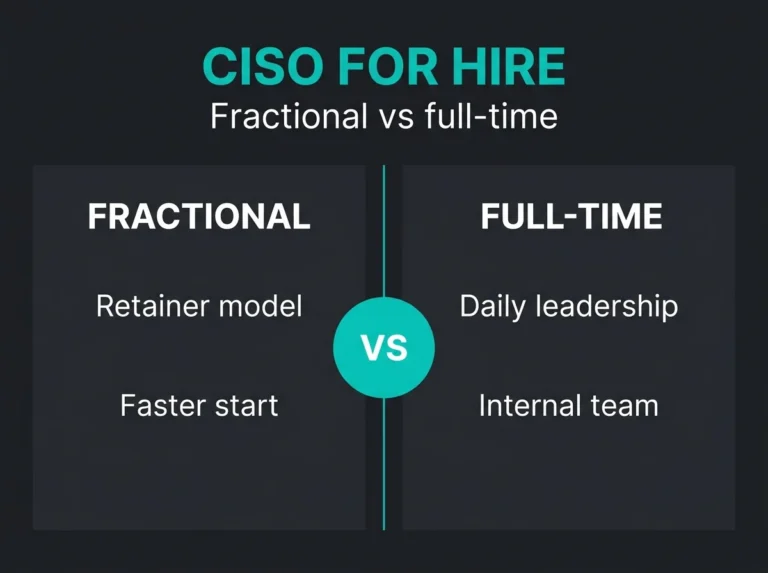
It can also be the right bridge model. Some firms eventually hire a full-time CISO. Others keep a vCISO for years because the economics and access to broad experience still make sense. There is nothing second-rate about that if the provider is truly operating at executive level. Plenty of businesses need sharp judgment for a few days each month, not another payroll commitment.
Choose the company, not the slogan
The best vCISO companies are not the ones with the flashiest comparison page. They are the ones that can show you exactly how they will run your security program, challenge bad assumptions, and help leadership make better decisions under pressure.
If you’re comparing options now, start with the operating model. Ask who owns the relationship, what gets delivered each month, how risk is reported, and how they work inside Microsoft-first environments. Everything else is wallpaper.
If you want a second opinion on that evaluation, Falconer Security can help you review the shortlist through the lens of actual governance, not marketing. Our vCISO service is built for SMBs that need practical leadership, not a ceremonial security title.
FAQ: vCISO companies
What is a vCISO company?
A vCISO company provides fractional security leadership to organizations that need CISO-level oversight without hiring a full-time executive. The service usually covers governance, risk management, executive reporting, compliance coordination, and incident oversight.
How is a vCISO company different from an MSSP?
An MSSP usually runs monitoring or operational security tasks. A vCISO company owns strategy, governance, prioritization, and leadership communication. Many SMBs need both, but they should not confuse one for the other.
When should an SMB hire a vCISO company?
An SMB should look at vCISO companies when customer due diligence, cyber insurance, compliance demands, or board expectations outgrow the internal team’s capacity to lead security formally. It is often the right move before a full-time CISO becomes financially sensible.
What should I ask vCISO companies in a sales call?
Ask who your named lead will be, how they run the first 90 days, what executive reporting looks like, how they support NIS2 or ISO 27001 work, and what role they play during real incidents. If the answers stay generic, the service probably will too.
Are vCISO companies relevant for NIS2 preparation?
Yes, especially for companies that need management-level ownership of cybersecurity risk and more disciplined governance. A good vCISO company can help leadership understand obligations, prioritize gaps, and connect technical controls to regulatory expectations.