





SOC as a Service: Complete Guide for SMBs

If you run a small or midsize business, you already know the shape of the problem: the threat volume looks enterprise-grade, but your security team and budget do not. That gap is the whole reason SOC as a Service exists.
Microsoft defines security operations center as a service (SOCaaS) as a third-party service that delivers around-the-clock security monitoring, detection, and response through the cloud, and notes it can extend to vulnerability management, log management, incident investigation and response, threat intelligence, compliance support, and reporting. Source: Microsoft Security
In plain English, instead of building a 24/7 security operations center yourself, you buy the outcome from a specialist.
For Swedish SMBs that matters, because the hard part is rarely buying one more security tool. It is running detection and response consistently, outside office hours, with enough skill to tell noise apart from the incidents that actually need action.
- You buy the outcome, not a tool. SOCaaS bundles analysts, process, tooling, and an SLA into one outsourced 24/7 detection and response function instead of another dashboard.
- The pressure is measurable. IBM puts the average breach at USD 4.44 million, and ISC2 found 59% of respondents reporting critical or significant skills gaps.
- Know the category lines. Managed SIEM runs the log platform, MDR focuses on detection and response, and SOCaaS wraps both plus reporting, threat intelligence, and compliance support.
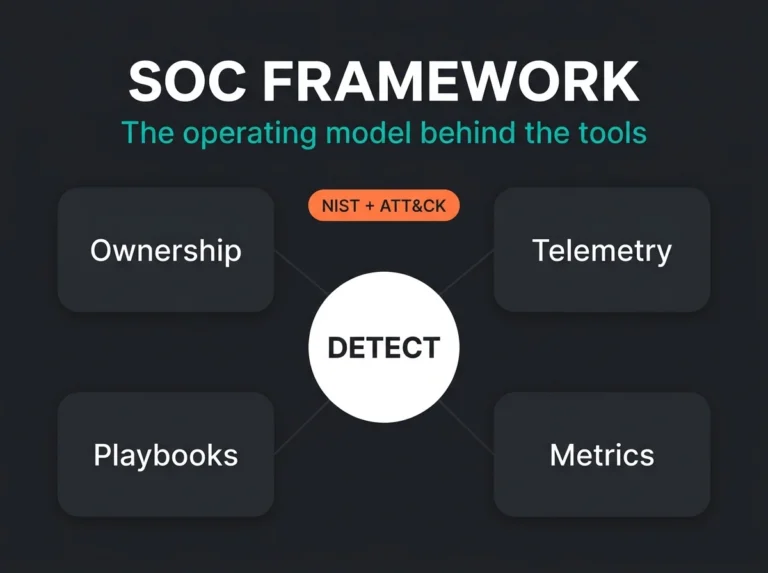
- It fails without your side of the deal. Incomplete telemetry, undefined response authority, and no internal owner turn any SOCaaS contract into expensive alert forwarding.
- NIS2 is a driver, not a mandate. Article 21 requires incident handling and risk-management measures, and outsourced monitoring is often the fastest realistic way for an SMB to operationalize them.
What SOC as a Service actually includes
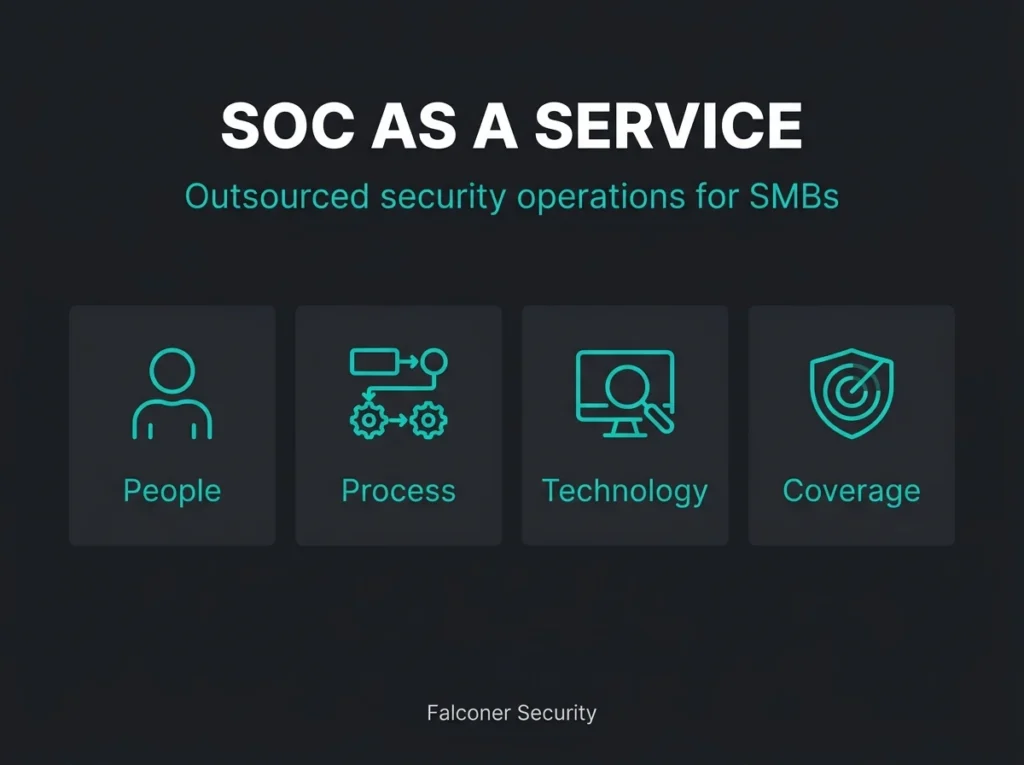
A credible SOCaaS provider normally brings together four things:
- People: analysts, engineers, incident responders, and escalation paths.
- Process: alert triage, investigation, response playbooks, reporting, and service levels.
- Technology: SIEM, endpoint telemetry, identity signals, cloud logs, threat intelligence, and automation.
- Coverage: monitoring that does not stop at 17:00 on a Friday.
Microsoft frames the core components much the same way: a dedicated SOC team, a suite of security tools, a defined set of processes, and a service level agreement. CrowdStrike and Rapid7 describe it in similar terms, a subscription-based outsourced SOC that runs continuous monitoring, detection, investigation, and response rather than leaving the customer to assemble those capabilities alone. CrowdStrike and Rapid7 both land on that definition.
Why SMBs are looking at SOCaaS now
Three practical pressures keep pushing this conversation up the priority list.
The economics of a breach are still ugly
IBM’s Cost of a Data Breach Report 2025 puts the global average breach at USD 4.44 million. That is not an SMB-specific benchmark, but it is a fair reminder that delayed detection and slow containment get expensive, and IBM points to faster identification and containment as a big reason costs fell year over year. IBM Cost of a Data Breach Report 2025
Skills shortages are real, even when headcount looks stable
The 2025 ISC2 Cybersecurity Workforce Study found 59% of respondents reporting critical or significant skills gaps, and 95% reporting at least one current skills need. The problem is not simply “we need more people.” It is needing the right people, with the right operational skills, right now. ISC2 Workforce Study 2025
Compliance pressure is forcing better operational discipline
NIS2 never says “buy SOCaaS,” but it does require appropriate and proportionate risk-management measures. Article 21 covers incident handling, business continuity, supply chain security, vulnerability handling, and policies to assess how well those measures actually work. For a lot of SMBs, outsourced monitoring and response is the fastest realistic way to operationalize parts of that. Directive (EU) 2022/2555, Article 21
SOCaaS vs managed SIEM vs MDR
This is where buyers get tripped up, because vendors love to blur the lines.
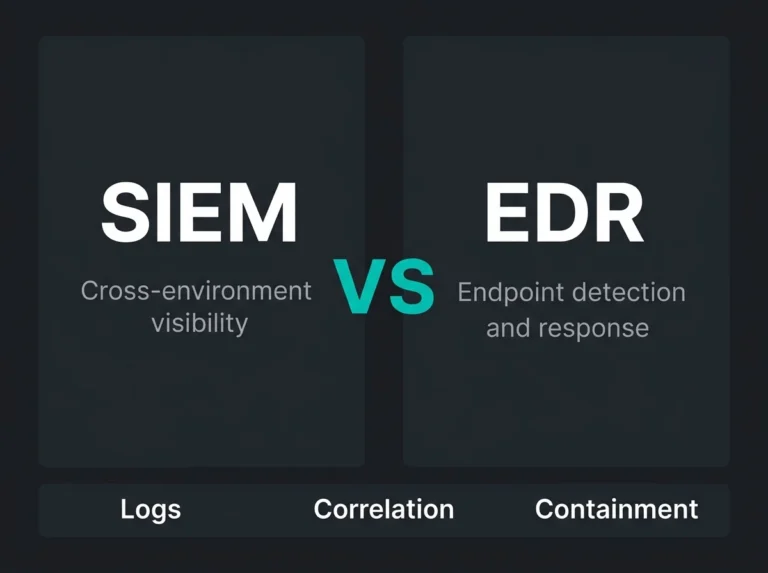
- Managed SIEM means someone operates and tunes the log platform, builds detections, and helps you make sense of the telemetry.
- MDR focuses on threat detection and response, usually with a strong endpoint emphasis.
- SOCaaS is broader, wrapping people, process, tooling, reporting, and service management into one outsourced security operations function.
Microsoft draws the same boundary, describing MDR as detection-and-response focused while SOCaaS reaches wider into threat intelligence, vulnerability management, compliance, and reporting. If you want the longer version, we break down the overlap in Managed SIEM vs MDR vs MXDR.
What a good SOCaaS service should do for an SMB
A decent provider gives you more than a portal and a monthly PDF.
Better detection quality, not just more alerts
The strong services tune detections to your environment, suppress recurring false positives, and escalate only the alerts that matter. Microsoft is candid that without that fine-tuning, SOCaaS can generate excessive alerts and drive analysts straight into fatigue.
Shorter time to containment
Rapid7 centers its definition on continuous monitoring, investigation, and response, and that is exactly where the value sits: shrinking the gap between suspicious activity, analyst validation, and containment. When that window shrinks, everything downstream gets cheaper.
It should strengthen your team, not create a black box
Outsourced operations still need an owner on your side. Someone in-house has to hold priorities, asset context, business decisions, and remediation follow-through. That is doubly true when security has to connect to leadership decisions, governance, or risk acceptance, which is where SOCaaS often works best paired with a vCISO function.
Correlation across Microsoft 365, identity, endpoint, and cloud
Most SMB incidents refuse to stay inside one control plane. Identity compromise, mailbox abuse, endpoint activity, and cloud telemetry have to be correlated, not handled as separate mini-programs. In a Microsoft-heavy environment that means tying Sentinel, Defender, Entra ID, Microsoft 365, and cloud logs into a single workflow rather than running each product as its own little project.
When SOCaaS is a strong fit
- You do not have staff for 24/7 monitoring.
- Your internal IT team is overloaded and security alert triage is inconsistent.
- You already own security tools but are not extracting much operational value from them.
- You need better evidence for board reporting, audits, or customer due diligence.
- You are preparing for NIS2, cyber insurance requirements, or stricter supplier security reviews.
Microsoft positions the model squarely at organizations without the time, funding, space, staff, or expertise to run a dedicated SOC of their own, which describes a large share of the SMB market.
When SOCaaS is the wrong fit
It is not magic, and it is not automatically the right answer.
- If your telemetry is incomplete, the provider works half blind.
- If you expect full response but will not define access, authority, and escalation rules, incidents stall.
- If you want a bespoke enterprise SOC on a tool-administration budget, you will end up disappointed.
- If your bigger need is strategic governance rather than operational monitoring, you may need security leadership first and SOC services second.
Microsoft flags the usual failure modes too: provider dependency, integration complexity, visibility limits, communication gaps, and data privacy concerns. Worth reading its SOCaaS overview with those in mind before you sign anything.
What to ask before you buy
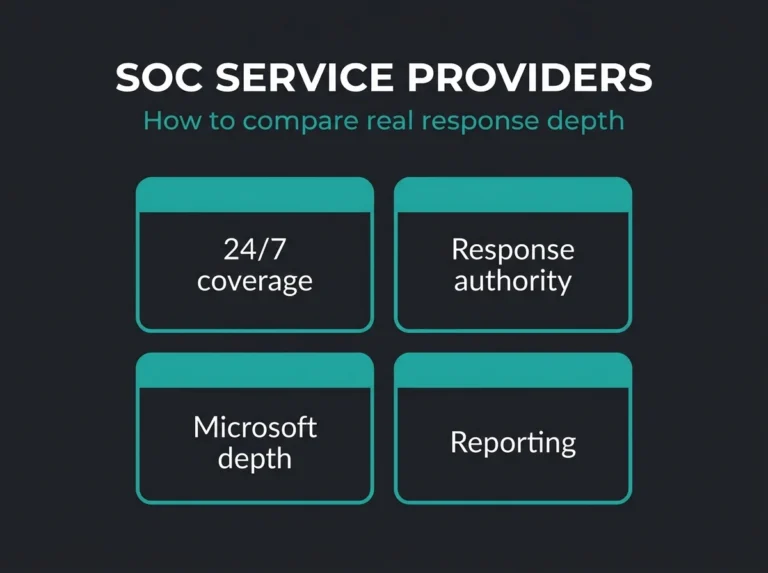
- What telemetry do you actually monitor? Endpoints, identity, email, cloud, network, SaaS?
- What happens after a high-confidence alert? Triage only, guided response, or active containment?
- How is tuning handled? Monthly, continuous, included, or billable?
- What are the SLAs? A real service defines response times, not just “24/7 monitoring.”
- How do you report value? Look for trend data, false-positive reduction, use-case maturity, and incident outcomes.
- How do you support Microsoft environments? For many SMBs, that is the core stack.
- Who owns remediation? Provider, customer, or a shared model?
- How do you support governance and compliance evidence? Especially relevant for NIS2-driven programs.
What this looks like in practice for a Microsoft-focused SMB
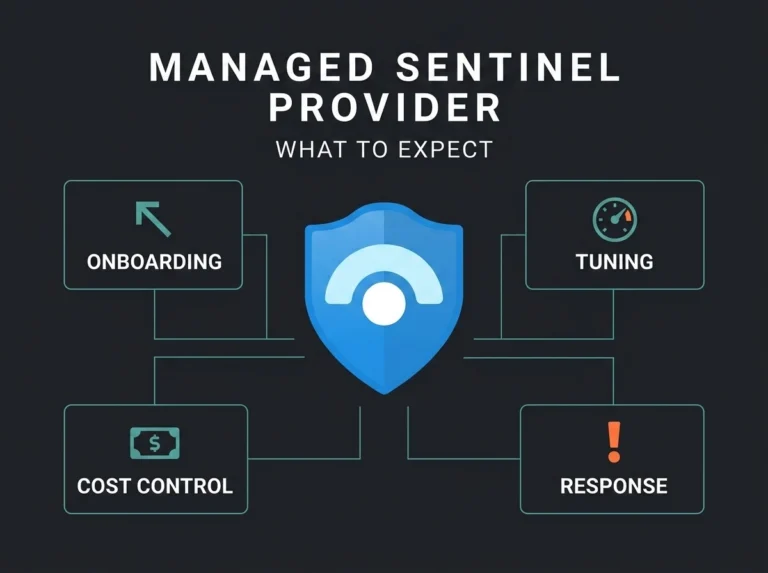
For many Nordic SMBs, a workable outsourced SOC starts with a managed Microsoft security stack: Sentinel for centralized monitoring, Defender for endpoint and identity-aligned detections, and incident workflows that are actually defined rather than improvised. That is a realistic path to operational security without pretending a 50-person company should stand up an in-house SOC from scratch.
If that is the direction you are weighing, the most relevant next reads are:
- Managed Sentinel service
- Managed detection and response
- Managed SIEM services guide
- Managed SOC buyer’s guide
Where SOCaaS actually earns its place
SOC as a Service is not outsourced alert-watching. Done well, it is how an SMB buys a functioning security operations capability instead of trying to assemble one from disconnected tools, overstretched staff, and wishful thinking.
The right provider makes your environment quieter, your escalations sharper, and your response faster. If all you get is another dashboard, you are not buying SOCaaS. You are renting noise.
For a Microsoft-first view of what that should look like in your environment, start with our managed security services or talk to us about a right-sized operating model for your team.