





MSSP vs SOC: Which Security Model Fits Your Business?

If you’re comparing an MSSP to a SOC, you’re usually trying to solve a staffing problem disguised as a technology decision. The board wants better monitoring. The IT lead wants fewer blind spots. The finance team wants to know whether this means buying another tool, hiring a night shift, or outsourcing the whole thing. Those are not the same decision, and vendors often blur them on purpose.
For most Swedish SMBs, an MSSP is an outsourced security provider that runs and manages parts of your security stack. A SOC is the security operations function itself: the analysts, workflows, triage, investigation, and response capability that watches for threats and acts on them. One is a provider model. The other is an operating model. You can buy SOC capability from an MSSP, build it in-house, or end up with neither if you only buy tooling.
That distinction matters because the wrong choice leaves you with expensive dashboards and nobody awake when something real happens. Falconer Security sees this in mid-market Microsoft environments all the time: strong licenses, lots of logs, weak response muscle. The gap is rarely the tool. It’s ownership.
- Different categories, not rivals. An MSSP is a provider you hire, while a SOC is the operating capability that has to run somewhere; you can buy SOC capability from an MSSP or build it in-house.
- Staffing is the real constraint. ISC2 reports 33% of respondents lack the resources to staff their teams properly, which is why in-house SOC plans stall at SMBs.
- The stakes are rising. Third-party involvement showed up in 30% of breaches in Verizon’s 2025 DBIR, and IBM puts the global average breach cost at $4.4 million.
- Ask the 02:00 question. The deciding factor is who owns detection and response after hours and what they are authorized to do, not the label on the service.
- Nordic SMB verdict. For most, an MSSP or managed SOC with clear response authority beats a pure in-house SOC on a mid-market budget.
MSSP vs SOC: the short answer
An MSSP is usually the better fit when you need broad security coverage without building a full internal team. A SOC is the better fit when you want direct control over detection, investigation, and response, and you can afford the people, process, and tooling that come with it.
A practical way to think about it: an MSSP is a service provider you hire, while a SOC is the security operations engine that has to run somewhere. Some MSSPs run a good SOC for clients. Some do not. That is where buyers get burned.
| Area | MSSP | In-house SOC |
|---|---|---|
| Ownership | External provider | Internal team |
| Main purpose | Manage and monitor security services across multiple domains | Detect, investigate, and respond to threats in your own environment |
| Control | Shared, contract-driven | Direct operational control |
| Staffing burden | Provider handles staffing | You recruit, train, schedule, and retain analysts |
| Coverage | Broad service catalog, depth varies by provider | Usually deeper and more tailored if properly funded |
| Best fit | SMBs and MSPs that need capability quickly | Larger organizations with mature security leadership |
What a SOC actually is
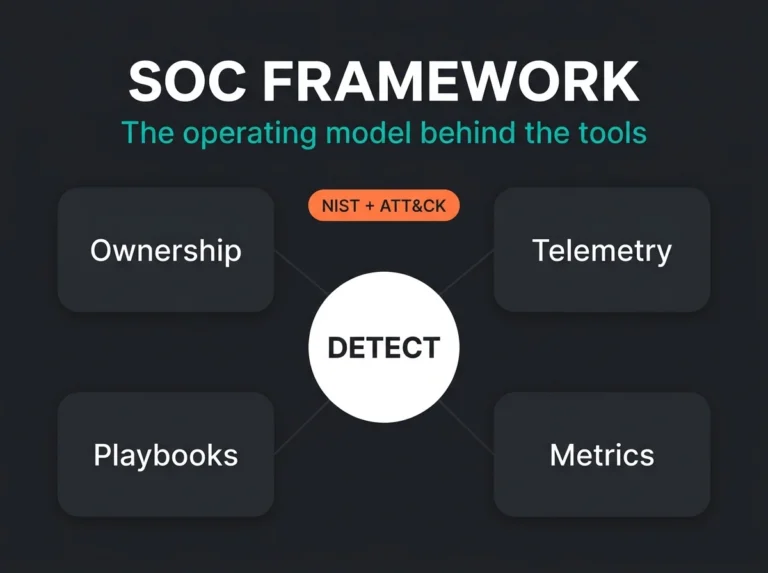
NIST defines a Security Operations Center as a security operations capability, not just a room with screens on the wall. In practice that means analysts, incident handling, playbooks, escalation paths, case management, log analysis, and a repeatable way to separate false positives from live incidents. If that machinery is missing, you do not have a SOC. You have tooling and good intentions.
A real SOC keeps watch over identity, endpoint, cloud, network, and email telemetry. It triages alerts, validates suspicious activity, investigates scope, contains threats, and documents what happened. Good teams also tune detections and hunt for issues that automated rules miss. That last piece gets ignored in a lot of vendor copy. It should not. Default detections age fast.
There’s also a business reality here. Running a 24/7 SOC is hard work. Someone has to own shift coverage, analyst fatigue, investigations at awkward hours, and the constant cleanup that follows noisy detections. Most companies picture the glamorous bit first. The real job is queue management, decision making, and discipline, day after day.
What an MSSP actually does
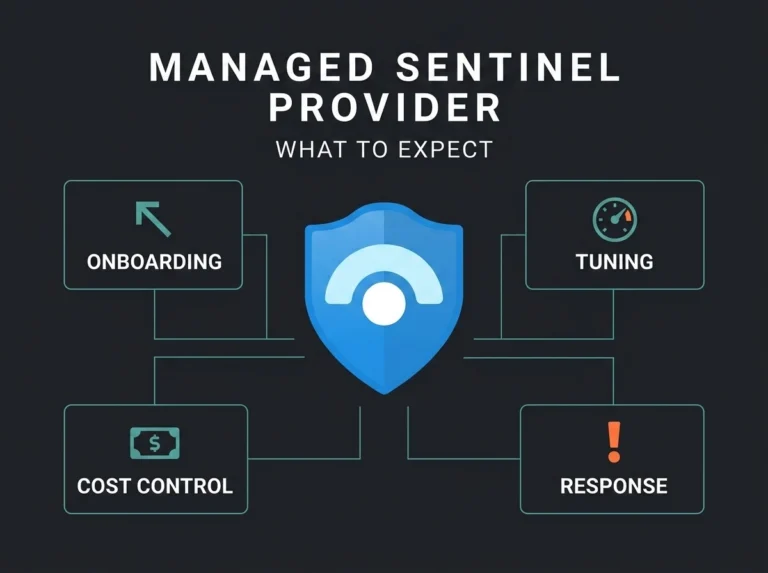
An MSSP, or Managed Security Service Provider, normally offers a wider menu. That can include firewall management, Microsoft 365 monitoring, SIEM administration, vulnerability management, endpoint security operations, reporting, and compliance support. Some providers are genuinely strong. Some are an alert forwarding business with better slides.
The broad service model is the appeal. If your company needs help across managed security services, email protection, endpoint monitoring, and governance reporting, an MSSP can cover much more than an isolated SOC team would. That is why the model works well for organizations that do not want to build separate internal specialties.
The trade-off is depth. One provider might manage your Microsoft 365 email security stack, tune a few SIEM rules, and send a monthly report, but still stop short of hands-on containment. Another might provide a mature analyst-led response function close to what you would expect from a dedicated managed SOC. Same label, very different outcome.
Why this decision matters more in 2026
This is not just a taxonomy debate. The economics of building internal security operations got worse at the same time attackers got faster. According to Verizon’s 2025 Data Breach Investigations Report, third-party involvement showed up in 30% of breaches, double the prior year’s share, and the report analyzed 12,195 confirmed breaches. That tells you two things: supplier exposure is real, and detection has to extend beyond a neat office-hours perimeter.
Then there is staffing. ISC2’s 2025 Cybersecurity Workforce Study says 33% of respondents lack the resources to staff their teams properly, and 72% say reducing security personnel significantly increases breach risk. I see that pressure show up in smaller firms as a very ordinary sentence: “we have one security person, but they also own infrastructure.” That’s not a criticism. It’s just why in-house SOC plans often stall.
Cost matters too. IBM’s 2025 Cost of a Data Breach report puts the global average breach cost at $4.4 million. You do not need a Fortune 500 budget to feel the damage from a breach. A mid-sized Swedish business will not absorb that kind of disruption gracefully, especially if the incident also drags in customer notification, legal review, and contractual fallout.
The honest version: Most organizations do not choose between an MSSP and a SOC because they love operating model design. They choose because hiring enough people for round-the-clock security operations is slow, expensive, and fragile.
When an MSSP is the smarter choice
An MSSP makes sense when you need capability fast, your internal team is small, and your security problems span several domains at once. That is common in businesses that have grown into a serious threat profile but still run with a lean IT and security team.
Choose the MSSP route when most of these are true:
- You need coverage across identity, endpoint, cloud, and email, not just alert triage.
- You want access to specialist skills without building a shift roster.
- You need predictable monthly spending more than full operational control.
- You want external help with reporting, compliance evidence, or service delivery discipline.
- You already know your team will not sustain 24/7 monitoring on its own.
This is also the easier route if you need to pair operational monitoring with related services like MDR, security assessments, or executive guidance from a vCISO service. A good provider can bundle those into one operating rhythm instead of forcing you to coordinate three vendors and an exhausted internal lead.
When building a SOC makes sense
An in-house SOC starts to make sense when security operations are strategic enough that you want direct ownership of the team, the workflows, the escalation decisions, and the tuning priorities. That usually shows up in larger enterprises, regulated environments with unusual response requirements, or organizations with enough internal volume to justify dedicated analysts.
A proper SOC is more than a hiring plan. You need senior leadership support, a tooling budget, threat intelligence inputs, incident handling processes, performance metrics, and enough telemetry to justify the operation. If you cannot staff weekends and holidays without burning out the team, you do not yet have a stable SOC model.
There is one major advantage to doing it yourself: context. Internal analysts understand the business, the weird legacy systems, the political sensitivities, and the difference between a dangerous anomaly and a noisy but expected workflow. That context reduces false positives and speeds up response. It is real value. It is just expensive value.
The question buyers should ask instead
The wrong question is, “Do we need an MSSP or a SOC?” The better question is, “Who is going to own detection and response at 02:00, and what exactly are they authorized to do?” Once you answer that, the marketing fog starts to clear.
If the provider only promises monitoring, ticket creation, and escalation, then you are not really buying a SOC outcome. You are buying partial coverage. That can still be useful. It just should not be priced or sold like full response capability. This is the same problem that shows up in weak comparisons of MDR vs MSSP and in a lot of confusion around outsourced security services in general.
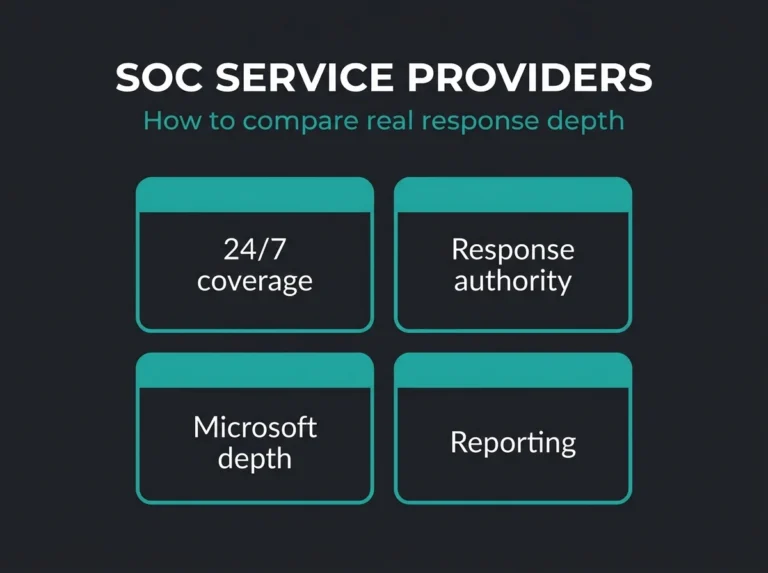
Ask every provider these questions before signing:
- Who investigates alerts after hours: people or automation?
- What actions can you take without waiting for us?
- Do you write custom detections for our environment?
- How do you report on incident trends and control gaps?
- What services are included, and what becomes billable during an active incident?
If the answers are vague, the service probably is too.
Our view for Nordic SMBs
For most Nordic SMBs, the best answer is not a pure in-house SOC. It is an MSSP or managed SOC model with clear response authority, strong Microsoft telemetry coverage, and reporting that helps management understand where the real gaps are. That gives you depth where it counts without pretending you can recruit an enterprise-grade analyst bench on a mid-market budget.
There is also a compliance angle. NIS2 does not tell you to build a SOC. It expects risk management, incident handling, and appropriate technical and organizational measures. Outsourcing those capabilities can be perfectly sensible if the service is real, documented, and accountable. Buying a logo and a portal is not enough.
That is why Falconer usually steers buyers toward operating clarity before tool selection. Start with ownership, escalation, and response authority. Then map the toolset around it. If you do it the other way around, you end up measuring log volume while attackers move faster than your process.
FAQ
What is the main difference between an MSSP and a SOC?
An MSSP is an outside provider that delivers security services. A SOC is the security operations capability that detects, investigates, and responds to threats. An MSSP may run a SOC for clients, but not every MSSP provides full SOC depth.
Is an MSSP cheaper than building an in-house SOC?
Usually, yes. An MSSP spreads staffing and platform costs across multiple clients, while an in-house SOC requires you to fund analysts, tooling, training, shift coverage, and management yourself. The savings only matter if the provider actually delivers response, not just notifications.
Can a small business build its own SOC?
A small business can build parts of a SOC function, but very few can support a mature 24/7 operation without outside help. Staffing is the hard part. Tools are easier to buy than analysts willing to cover nights, weekends, and incident surge periods.
Should a regulated company choose a SOC over an MSSP?
Not automatically. Regulated companies need demonstrable monitoring, incident handling, evidence, and accountability. A capable MSSP can meet those needs if the contract, reporting, and response model are strong enough. The label matters less than the delivered capability.
How does NIS2 affect the MSSP vs SOC decision?
NIS2 raises the pressure to prove that incident detection and response are real operating capabilities. It does not force companies to build an internal SOC. It does force them to make sure outsourced services are more than alert forwarding and can stand up to scrutiny.