





Virtual CISO Services: Complete Guide for SMBs

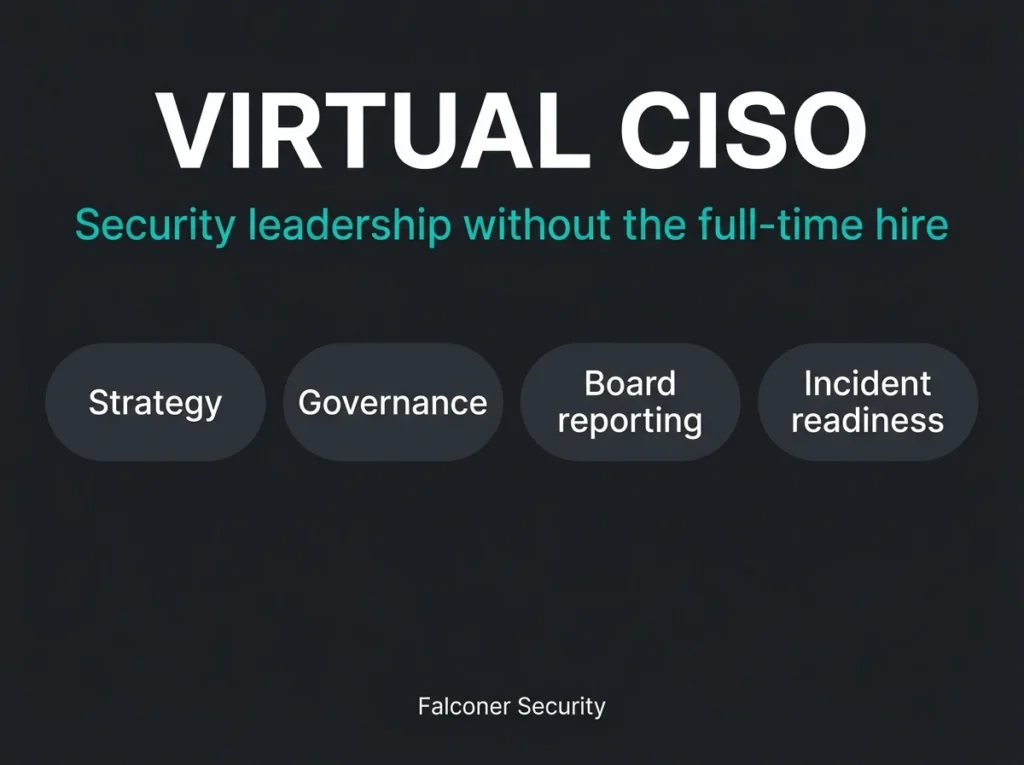
If your business needs security leadership but not a full-time chief information security officer, virtual CISO services can close the gap.
That matters more now than it did a few years ago. Under the NIS2 Directive, management bodies of covered entities must approve cybersecurity risk-management measures, oversee their implementation, and can be held liable for failures. The directive also requires measures covering risk analysis, incident handling, business continuity, supply chain security, training, access control, and multi-factor authentication where appropriate. Meanwhile the people to do all that are scarce: the 2025 ISC2 Cybersecurity Workforce Study found 59% of respondents reporting critical or significant skills needs, and 33% saying their organizations lack the budget to staff teams adequately. IBM’s Cost of a Data Breach Report 2025 keeps the global average breach at $4.44 million.
For many SMBs, that combination creates a simple problem: the board is expected to own cyber risk, but the business does not have enough in-house senior security capacity to do that well.
A virtual CISO, sometimes written vCISO, is often the most practical answer.
- Boards now own cyber risk. Under NIS2, management bodies must approve and oversee risk-management measures and can be held liable for failures.
- The talent math is against you. 59% of ISC2 respondents report critical or significant skills needs, 33% lack the budget to staff adequately, and IBM puts the average breach at $4.44 million.
- A vCISO is fractional leadership. You get senior security direction, governance, and board reporting on a part-time basis instead of funding a full executive seat.
- Judge the first 90 days. A credible engagement delivers a current-state assessment, risk prioritization, a roadmap with 30-, 90-, and 180-day actions, and usable leadership reporting.
- Decisions over documents. The outcome that matters is better security decision-making before an incident or audit forces it, not a stack of unused policies.
What do virtual CISO services include?
A virtual CISO is an outsourced security leader who provides strategic cybersecurity direction on a part-time or fractional basis. Instead of hiring a full-time executive, you get senior leadership time focused on the decisions, priorities, and governance work that usually stall when security is handled only at the IT manager level.
The exact scope varies, but a good virtual CISO typically helps with:
- security strategy and roadmap development
- risk assessments and risk register ownership
- policy and control design
- board and leadership reporting
- incident readiness and response planning
- vendor and supply chain risk reviews
- compliance planning for frameworks such as NIS2, ISO 27001, or customer security requirements
- security program prioritization so the team works on the right things first
If you want the service version of that model rather than an individual consultant, see CISO as a Service.
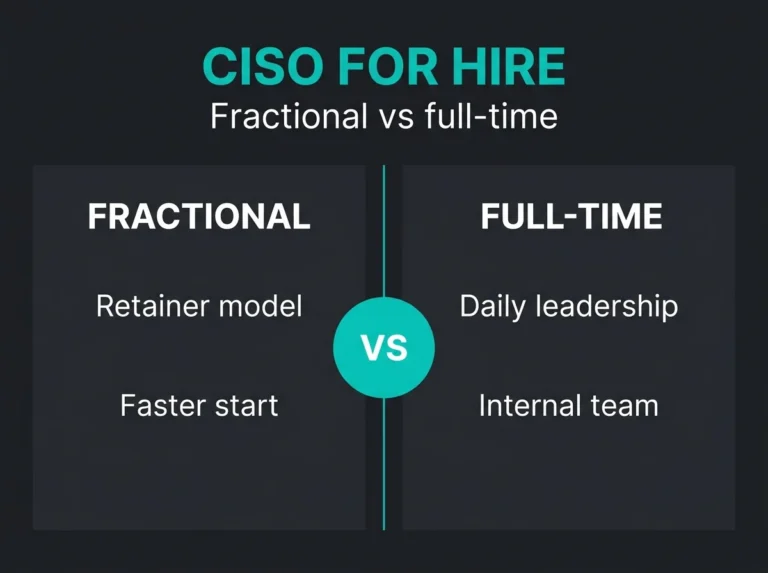
Virtual CISO vs full-time CISO
A full-time CISO makes sense when security complexity, regulatory pressure, internal headcount, and stakeholder demands justify a dedicated executive. Many mid-market and enterprise organizations are in that category.
Most SMBs are not.
They still need executive-level security decisions, but they do not need a full-time leader in that seat every day. They need enough senior guidance to make good calls, avoid obvious mistakes, and build a defensible program. A full-time hire fits organizations with large teams, complex compliance obligations, or heavy customer scrutiny. A virtual CISO fits the SMB that needs strategy, governance, and oversight without the cost of a full executive seat.
When a virtual CISO makes sense
A virtual CISO is usually the right move when one or more of these are true:
- security is owned by IT, but nobody owns the broader risk picture
- leadership gets security questions from customers, insurers, or auditors and does not have clear answers
- security tooling has grown faster than the team’s ability to manage it well
- there is no clear roadmap tying technical controls to business risk
- incident response plans exist on paper but have not been tested
- the company needs to prepare for NIS2, ISO 27001, or similar requirements
- board reporting is ad hoc, vague, or purely technical
In practice, many companies do not need more tools first. They need better sequencing, better governance, and clearer ownership.
What a strong virtual CISO should deliver
The value of a vCISO is not that they attend a few meetings and write policies nobody uses. The value is that they turn scattered security activity into a working program.
At minimum, a strong engagement should produce a current-state assessment of risks, controls, gaps, and priorities, then a realistic roadmap with 30-, 90-, and 180-day actions. From there the ongoing work covers executive reporting that leadership can actually use for decisions, policy and governance structure aligned to the business and its obligations, incident readiness improvements including roles, escalation paths, and test scenarios, and vendor risk review where third parties create material exposure.
The program should also anchor to a recognized framework such as NIST CSF 2.0, which exists to help organizations understand and improve how they manage cybersecurity risk. Frameworks are useful only when someone translates them into an operating model the business can follow. A virtual CISO should do that translation work.
What competitors get wrong about virtual CISO services
Competitor content on this topic usually leans in one of two directions.
One version makes the service sound like a cheap substitute for executive leadership. The other makes it sound so broad that it becomes impossible to measure.
Neither is helpful.
A virtual CISO is not a magic replacement for an internal security function, and it is not just advisory theatre. It works when the scope is clear:
- the business keeps operational ownership where it belongs
- the virtual CISO brings senior judgment, structure, and accountability
- leadership gets reporting tied to risk, budget, and business priorities
- technical work is translated into decisions the company can act on
That is the difference between rented slide decks and real security leadership.
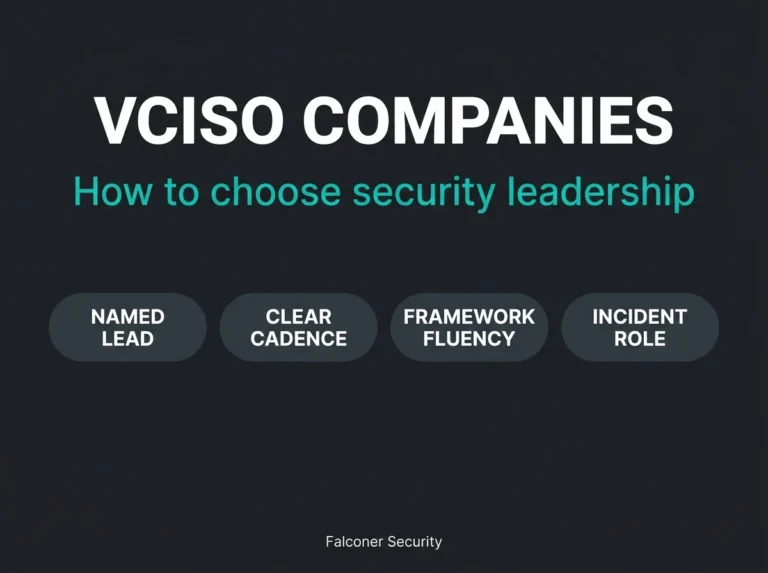
Questions to ask before you hire a virtual CISO
- Who will actually do the work: a senior operator or a junior consultant behind the scenes?
- How do they assess risk and prioritize remediation?
- Can they support board reporting and executive decision-making, not just technical reviews?
- How do they handle incident planning, crisis communications, and escalation paths?
- Can they align the program to NIS2, customer requirements, or cyber insurance demands?
- What does the first 90 days look like in practice?
- What outputs will you receive every month?
If those answers are vague, the engagement probably will be too.
What SMBs should expect in the first 90 days
A credible vCISO engagement should start with evidence, not assumptions.
In the first 90 days, most SMBs should expect:
- Discovery and assessment across the business, environment, threat exposure, third parties, and current controls.
- Risk prioritization that identifies the handful of issues that actually move risk, not a 200-line wish list.
- A roadmap and governance structure with ownership, timelines, reporting cadence, and decision points.
- Immediate fixes for urgent gaps around identity, endpoint coverage, incident readiness, backup assurance, or supplier exposure.
- Leadership reporting that gives management a clear view of current posture, target state, and investment priorities.
That is usually enough to move a company from reactive security to managed security.
The real outcome: better decisions, not just better documents
The best reason to bring in a virtual CISO is not to collect policies or tick a procurement box. It is to improve security decision-making before an incident, an audit, or a customer review forces the issue.
For SMBs, that usually means:
- fewer blind spots in leadership discussions
- better prioritization of limited budget and staff time
- clearer ownership of risk and controls
- stronger readiness for customer and regulatory scrutiny
- a security program that can mature without overbuilding too early
If your business has reached the point where cyber risk is clearly a leadership problem, but not yet a full-time CISO problem, a virtual CISO is often the right next step.
Need senior security leadership without a full-time hire?
Falconer Security helps SMBs build practical security programs, leadership reporting, and governance that stand up to real-world pressure. If you need part-time strategic security leadership, explore CISO as a Service.